IN Brief:
- Government has targeted at least 40% growth in rail freight by 2040, towards 75% by 2050.
- Sizewell C and Tesco show how rail can support both bulk materials and time sensitive consumer goods.
- Network capacity, terminal access, infrastructure capability, and commercial certainty remain significant constraints on wider adoption.
A 270 metre freight train arrived at the Sizewell C construction site in Suffolk in September carrying more than 1,000 tonnes of material from Derbyshire. Its journey through the project’s new Green Rail Route replaced the equivalent of around 50 HGV movements, while approximately 100,000 tonnes are expected to reach the site by rail before Christmas.
The arrival coincided with a significant shift in government policy. Ministers have set an interim target for rail freight to grow by at least 40% by 2040, towards an existing 75% growth ambition for 2050, with particularly strong expansion expected in high value goods and construction materials. The government estimates that meeting the 2040 target could increase the annual value of goods moved by rail from £33.7 billion to £49.5 billion.
The policy gives rail freight a more prominent role in national transport planning, but its relevance to supply chain operators lies in the practical capacity it can add to existing logistics networks. Road remains dominant, accounting for 82% of UK domestic freight activity in 2024, measured in tonne kilometres, compared with 8% for rail and 10% for water. That balance reflects the flexibility of road transport as much as any weakness in rail.
For short journeys, fragmented loads, changing destinations, and first and final mile movements, HGVs remain difficult to substitute. Rail becomes more attractive where volumes are regular, routes are predictable, distances are sufficient, and suitable terminals are available at each end.
A second logistics channel
Sizewell C demonstrates what can be achieved when transport is considered at the design stage rather than added once construction is under way. The project intends to move at least 60% of its construction materials by rail or sea, supported by dedicated infrastructure, upgrades to existing lines, and sourcing decisions that take onward transport into account.
Road still has a substantial role. Around two fifths of the project’s material is expected to move by road, reinforcing the point that rail is more likely to complement HGV transport than displace it altogether.
The same principle is visible in very different supply chains. Tesco’s rail service between Daventry and Trafford Park carries around 600,000 cases of supermarket goods each week and replaces more than 90 road trips. Around half of the produce carried on the route must reach shelves within five hours of arrival, showing that rail is not limited to aggregates, steel, and other slower moving bulk commodities.
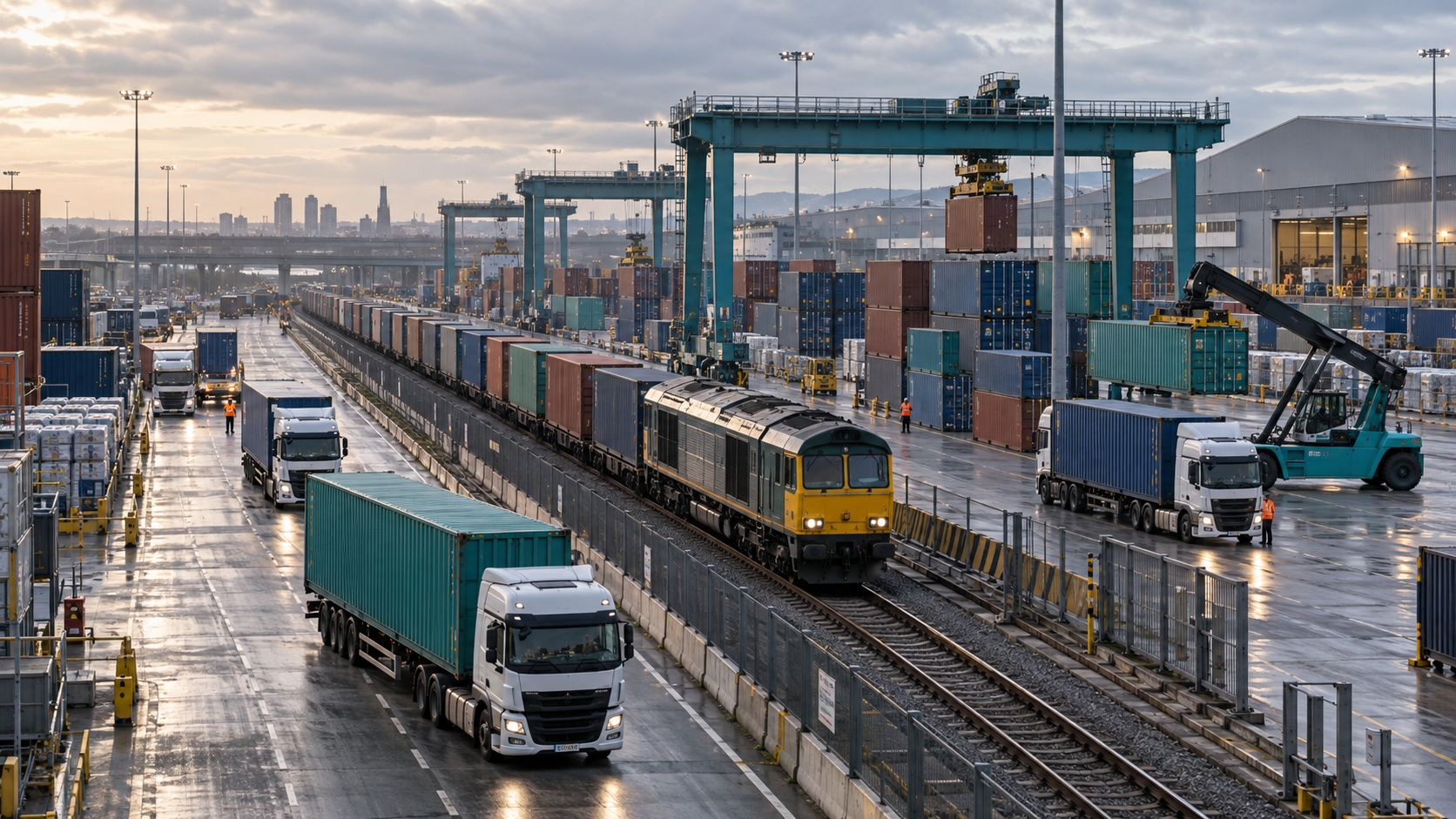
Container traffic provides another example. DP World says its Modal Shift Programme at Southampton has generated an additional 100,000 container movements by rail rather than road, with rail’s share of onward container traffic increasing from 21% to more than 30%. The scheme uses a financial incentive to alter the relative economics of the two modes, underlining how quickly modal choice can change when price, capacity, and service align.
For manufacturers, retailers, and logistics providers, the value of that choice is broader than carbon reduction. Moving the long trunk section of a journey by rail can reduce exposure to road congestion, driver availability, fuel volatility, and disruption while preserving the flexibility of HGVs at either end.
The gains are only available when rail capacity can be secured with sufficient reliability to support commercial planning.
Capacity has to follow ambition
Recent regulatory evidence shows the gap between growth targets and what the network currently delivers. Rail freight growth in England and Wales reached 2.2% in 2025–26 against a target of 3%, while freight moved in Scotland fell 1.6% against a target for 4.3% growth. Weaker construction, steel, petroleum, and other commodity markets contributed to the shortfall, so the figures cannot be attributed solely to railway performance.
Operational reliability has improved, with freight cancellations finishing the year below Network Rail’s target. More significant for future growth is the Office of Rail and Road’s continuing concern over the allocation of network capacity and the speed of long term access decisions.
For freight operators and their customers, access uncertainty has direct commercial consequences. Distribution networks, rolling stock, terminals, and multi year logistics contracts require confidence that usable train paths will remain available for long enough to justify investment.
GB Railfreight chief executive John Smith OBE captured the industry position shortly after the government announced its target: “The challenge now is delivery.”
The delivery requirements are largely practical. Network Rail’s current investment plans include measures to protect structures capable of carrying heavier freight trains, optimise freight paths, support terminal development, and prepare locomotives for digital signalling. The organisation has warned that deterioration of some structures could otherwise force trains to carry significantly lower loads, weakening the economics of individual services.
Logistics UK identifies a similar set of priorities, including competitive operating costs, seven day network access, removal of infrastructure pinch points, loading gauge improvements for container traffic, additional terminal capacity, and affordable Channel Tunnel access.
None of those measures is particularly visible to the end customer, but together they determine whether rail can become a dependable part of a modern supply chain. A national target may encourage investment and give freight greater prominence in network planning, but shippers will ultimately respond to service availability, cost, reliability, and ease of access.
There are signs that the conditions for growth are improving. Network Rail already supports hundreds of freight connected sites and is investing in longer and heavier trains, signalling, terminals, and corridor capacity, while the emerging Great British Railways structure is intended to give freight a clearer place in long term network decisions.
Sizewell C has been able to engineer rail into its logistics model because its volumes, duration, and project economics justify dedicated infrastructure. Most manufacturers, retailers, and logistics operators will never work at that scale. The wider test of the 2040 target will be whether the network can give ordinary shippers the same underlying advantage: a realistic choice of transport modes without requiring them to build the infrastructure themselves.