IN Brief:
- Comau has acquired 100% of Invent Smart Intralogistics Solutions, a Brazilian warehouse automation specialist.
- The acquisition adds software orchestration, box handling, order fulfilment, and AI-enabled logistics capability.
- Invent will continue operating under its current management structure and business model.
Comau has completed its acquisition of Invent Smart Intralogistics Solutions, adding warehouse automation, software orchestration, box handling, and order fulfilment capability to its intralogistics platform.
The deal gives Comau full ownership of the Brazilian specialist and strengthens its position in warehouse automation after the company’s earlier acquisition of Automha. Invent will continue operating under its current management structure and business model.
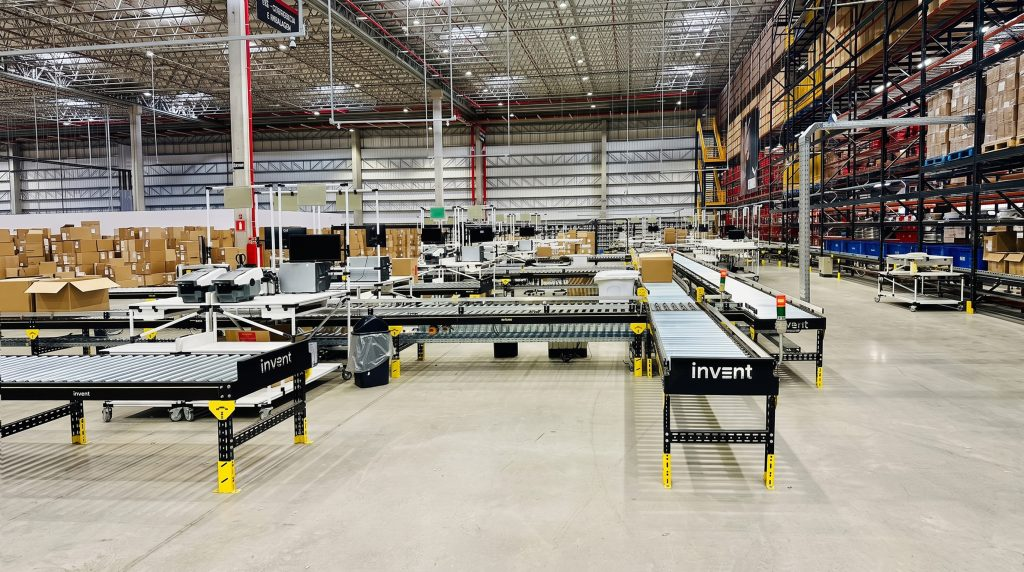
Invent specialises in intralogistics and warehouse automation, with a focus on e-commerce and high-throughput distribution environments. Its capabilities add box handling, order fulfilment, AI-enabled technologies, and software-led logistics orchestration to Comau’s existing automation base.
The acquisition expands the combined Comau–Automha offer, which already covers automated storage, pallet handling, inbound movement, retrieval, order preparation, and outbound shipping. With Invent added, Comau gains a stronger position across the smaller-unit fulfilment processes that define e-commerce and high-velocity distribution.
Warehouse automation is becoming less about isolated equipment purchases and more about the control layer that coordinates storage, movement, picking, replenishment, and dispatch. Operators still buy shuttles, conveyors, robots, lifts, and storage systems, but performance increasingly depends on whether the whole flow behaves as one operation.
Box handling and order fulfilment sit close to the most variable parts of that flow. Pallet movements can often be planned around known inbound and outbound volumes, while each-level and case-level fulfilment introduce more SKU diversity, order volatility, replenishment pressure, and exception handling. Software has to decide not only where goods are stored, but how they should move as demand changes.
The acquisition also strengthens Comau’s position where factory automation and warehouse automation are converging. Production lines require reliable parts feeding, work-in-progress movement, finished-goods transfer, and outbound logistics. Distribution centres require speed, density, accuracy, and labour efficiency. Manufacturers increasingly want fewer gaps between those environments.
Comau’s industrial automation background gives it a base in production systems and robotics. Invent adds depth in the logistics processes that come before and after manufacturing, while Automha’s systems strengthen automated storage and handling. The combination gives Comau a wider route into end-to-end material flow.
Capital discipline across automation projects is also increasing. Labour pressure and throughput requirements remain strong, but customers are asking harder questions about integration, uptime, return on investment, lifecycle support, and scalability. Broad portfolios are only useful when they reduce complexity rather than adding new interfaces.
Integration is likely to become the deciding factor. Automated warehouses can be weakened by poor handovers between storage systems, robots, conveyors, WMS platforms, transport systems, and human workstations. A supplier able to take responsibility for more of that chain can reduce implementation risk, provided the platform remains open enough to fit customer operations.
Invent also adds geographic value. Brazil’s logistics and e-commerce markets are large, demanding, and still developing modern automated capacity. Bringing that expertise into a global automation platform gives Comau more exposure to emerging distribution models outside the traditional European industrial base.
The warehouse automation market is consolidating around companies that can combine equipment, software, controls, integration, and service. Customers want systems that can be engineered around their operational profile rather than standardised technology packages forced into complex sites.
Comau’s Invent acquisition moves directly into that space. The deal gives the company a broader automation platform, but the commercial test will be how effectively it combines Invent’s orchestration capability, Automha’s storage systems, and Comau’s industrial robotics heritage into projects that are easier to deploy, easier to support, and measurably better on the warehouse floor.