IN Brief:
- The fire burned for more than 52 hours across the upper floors of Coupang’s Incheon fulfilment centre.
- All 121 workers escaped, although one firefighter was injured and neighbouring premises were evacuated.
- High-density storage, mixed inventory, structural damage, and network continuity will face closer examination.
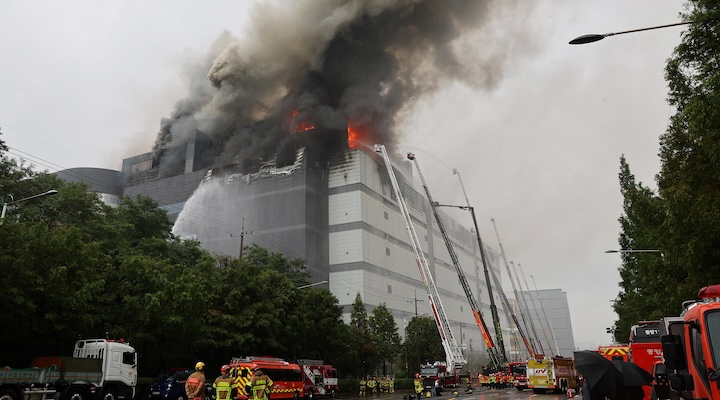
A fire at Coupang’s No. 32 logistics centre in Incheon burned for more than 52 hours, forcing the evacuation of neighbouring businesses and removing one of the ecommerce group’s largest metropolitan fulfilment assets from service.
The blaze began at approximately 6:54am local time on 18 July on the sixth floor of the eight-storey building, before spreading into the floor above. All 121 employees inside escaped safely, although one firefighter was injured during an operation involving more than 700 emergency personnel and 200 vehicles and pieces of equipment.
Fire crews encountered intense heat, thick smoke, and large quantities of combustible stock, including household goods, cardboard cartons, and plastic packaging. Although rainfall continued during parts of the response, smoke remained visible into the third day and access to the upper levels was constrained by both fire conditions and concern over structural stability.
An exclusion zone was established around the building after authorities identified a risk of partial collapse, prompting shops and factories within approximately 116 metres of the warehouse ramp to close. Initial control was eventually achieved on 20 July, allowing cooling, structural assessment, and investigation work to begin.
The cause had not been confirmed when the main fire was brought under control, and investigators will need to examine electrical infrastructure, equipment, stored products, fire suppression systems, and the route through which flames moved between levels. Until that work is completed, attributing the incident to automation, batteries, or any particular class of inventory would be premature.
Covering approximately 299,000m², the Incheon centre stores products bought directly by Coupang for its rapid-delivery operation across the Seoul metropolitan region. Its scale, combined with the volume and variety of goods passing through the building, gives the loss of capacity consequences extending well beyond the damaged floors.
Orders allocated to the facility must be redirected, inbound deliveries rescheduled, and stock records reconciled against material that may be inaccessible or unsaleable. Even products untouched by flames may require quarantine or disposal after exposure to smoke, heat, firefighting water, or uncertain storage conditions.
Coupang operates more than 100 logistics centres across over 30 South Korean regions, giving it alternatives for some volume, but network redundancy is rarely equivalent to spare floor area alone. Receiving warehouses need available labour, dock capacity, inventory, packaging materials, carrier collections, and sufficient system capacity before diverted orders can be absorbed without creating fresh congestion.
Density changes the fire equation
High-density fulfilment has become central to ecommerce economics because it allows broader ranges to be held near demand while reducing travel between storage, picking, and packing. Those same characteristics can make a developing fire more difficult to locate and isolate, particularly where tall racking, mezzanines, conveyors, and mixed product categories divide the interior into tightly connected operating zones.
A modern fulfilment centre may contain aerosols, cleaning products, cosmetics, batteries, paper goods, plastics, consumer electronics, and general merchandise within the same building. Fire strategy must therefore reflect changes in commodity mix and packaging, rather than relying indefinitely on assumptions made when the warehouse first opened.
Automation introduces further dependencies because conveyors, lifts, shuttle systems, charging areas, and control cabinets can obstruct access or create routes through which smoke and heat travel. Emergency isolation must stop machinery safely without trapping employees, blocking evacuation paths, or preventing firefighters from reaching affected areas.
Sprinkler design, rack flue spaces, smoke extraction, water supply, fire doors, and structural protection all depend on the building remaining close to its approved configuration. Retrofitted mezzanines, denser pick faces, altered storage heights, and new charging equipment can change fire behaviour unless the protection strategy is reviewed alongside each operational modification.
The increased power, floor-loading, automation, and fire-protection requirements shaping warehouse selection were already evident in GLP’s assessment of the changing Chinese logistics-property market. Large warehouses are no longer passive shells around an operation; the building, energy supply, automation, and stored inventory now function as one interdependent system.
Insurers and landlords are likely to examine whether risk assessments have kept pace with rising throughput and stock density, while occupiers will need to test the assumptions beneath their continuity plans. A neighbouring site may appear capable of accepting diverted orders on paper, yet lack enough compatible automation, trained labour, or transport capacity to reproduce the lost operation.
Recovery also depends on the integrity of data. Inventory-management systems may continue showing stock as available even when the corresponding location is inaccessible, damaged, or under investigation, creating the risk that customers order products which cannot be released.
Physical counts, write-offs, supplier claims, and customer refunds will have to proceed while the network continues fulfilling new demand. The longer a building remains unavailable, the more its original stock profile diverges from the live records used by purchasing and allocation systems.
Emergency exercises commonly focus on evacuation, which succeeded at Incheon, but a prolonged warehouse fire creates a second operational emergency after employees have left the building. Carriers, suppliers, neighbouring sites, customer-service teams, insurers, landlords, and regulators all require accurate information while the physical condition of the facility remains uncertain.
Coupang has not quantified the financial loss or the expected disruption to its delivery network. Those figures will depend on structural damage, inventory write-offs, recovery time, insurance arrangements, and the amount of volume that other sites can absorb without materially raising operating costs.
The investigation will establish how the fire began and whether the building’s protection systems performed as designed. Its longer legacy may be a broader reassessment of how ecommerce operators combine dense inventory, automation, building modifications, and network contingency within facilities whose operational intensity has moved well beyond conventional warehousing.