IN Brief:
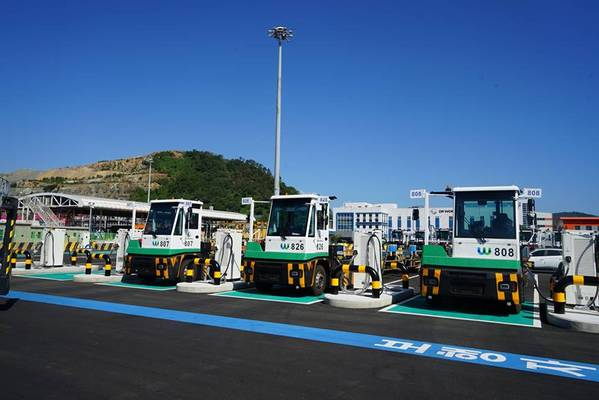
- Fifty-five electric yard tractors now account for approximately 36% of the Busan terminal fleet.
- DP World estimates a 70% reduction in CO₂ emissions per replacement vehicle, rather than reporting measured savings.
- The equipment substitutes LNG-powered tractors used to move containers between working areas of the terminal.
DP World has introduced 55 electric yard tractors at its Busan container terminal in South Korea, replacing liquefied natural gas-powered equipment across a substantial part of its internal transport fleet. The deployment covers approximately 36% of the site’s 154 yard tractors. The operator expects each electric vehicle to produce around 70% less carbon dioxide than the LNG vehicle it replaces, although it has not published measured fleet-wide savings from the new units.
The deployment leaves 99 yard tractors outside the announced replacement programme. DP World has not described the propulsion mix of those vehicles or published a timetable for converting them. The current fleet therefore includes the electric equipment alongside tractors of unspecified propulsion type. Other mobile equipment and fixed terminal systems are outside the stated replacement count, limiting what can be inferred about total site emissions.
Yard tractors undertake the relatively short, repeated movements needed to transfer containers between quay-side operations, storage areas and other parts of a terminal. Their working pattern differs from a long-haul road vehicle: frequent starts, stops, acceleration and low-speed manoeuvring can make drivetrain responsiveness and equipment availability particularly relevant. DP World says the electric tractors provide smoother acceleration, quieter operation and more consistent performance during these repeated movements.
Replacing an LNG powertrain also changes the maintenance regime. Electric drive systems have fewer mechanical components associated with combustion, and the new machines reduce the need to use and dispose of engine fluids. DP World expects lower maintenance requirements, fewer opportunities for fluid leaks and improved vehicle availability. Those are operational expectations, rather than independently quantified results from a completed reliability study at Busan.
DP World’s approximately 70% CO₂ reduction estimate applies to each replacement tractor against the LNG-powered machine it displaces. It cannot be extended to the terminal’s total emissions: the electric vehicles make up only part of the transport fleet, while cranes and other equipment continue to consume energy. The company has not published charging electricity consumption, the scope of its emissions calculation or the carbon intensity assumed for the electricity supply. Those inputs, along with the work performed by the tractors, would determine the measured carbon result.
Keeping the electric fleet available for vessel work requires suitable charging infrastructure and a duty cycle that leaves enough tractors available when container moves peak. Charging periods have to be arranged alongside dispatch, maintenance and the movement of containers between quay cranes and stacks. DP World has not disclosed battery sizes, charging power, the number of chargers or whether the units recharge between duties or during longer scheduled stops. Consequently, the Busan announcement does not establish a transferable operating range or charging model for another port.
DP World Busan participates in South Korea’s emissions trading scheme, placing the project within a wider framework for managing operational greenhouse-gas emissions. Electrification can reduce combustion emissions at the point of use, but the scheme participation alone does not establish how the company accounts for purchased electricity or what carbon allowances, if any, the deployment will change. The confirmed operational step is replacement of LNG-powered mobile equipment at the terminal.
Anders Dømmestrup, chief operating officer for ports and terminals in DP World’s Asia Pacific business, linked the deployment to the company’s emissions objectives and its responsibility to maintain terminal service. Container handling places a practical limit on the pace of equipment change: quay cranes, yard stacks and the transport fleet must work as a coordinated system during loading and discharge. Any difference in tractor availability or charging time can affect that coordination, although DP World has not reported interruptions attributable to the electric vehicles.
Related fleet electrification is under way at DP World facilities at Fisherman Island in Brisbane, Manila South Harbour and Laem Chabang. The company is also pursuing a separate €53.8 million electrification programme at Constanța, announced earlier in October, covering planned electric terminal tractors, electrical preparation for crane operations and shore power. The four locations have different facilities, fleet compositions and project timetables; none of the announced investment value for Constanța is attributable to Busan.
Busan’s 55 deployed vehicles provide a basis for testing energy consumption, maintenance needs, charging downtime and tractor utilisation during routine terminal activity. DP World has not published these performance measurements or a further Busan purchase order. The company intends to expand electric equipment use, but additional quantities and delivery dates remain unspecified. Its measured operating data will determine whether the forecast emissions and maintenance benefits are sustained as the vehicles carry normal container traffic.