IN Brief:
- The Düsseldorf Innovation Lab is Geekplus's first European facility dedicated to demonstrating and testing its robotics portfolio.
- Systems include pallet-, tote-, and shelf-to-person automation, robotic picking, software, humanoid technology, and the Gravity AI framework.
- Geekplus expects more than 1,000 visitors annually for technology evaluation, training, and future-system testing.
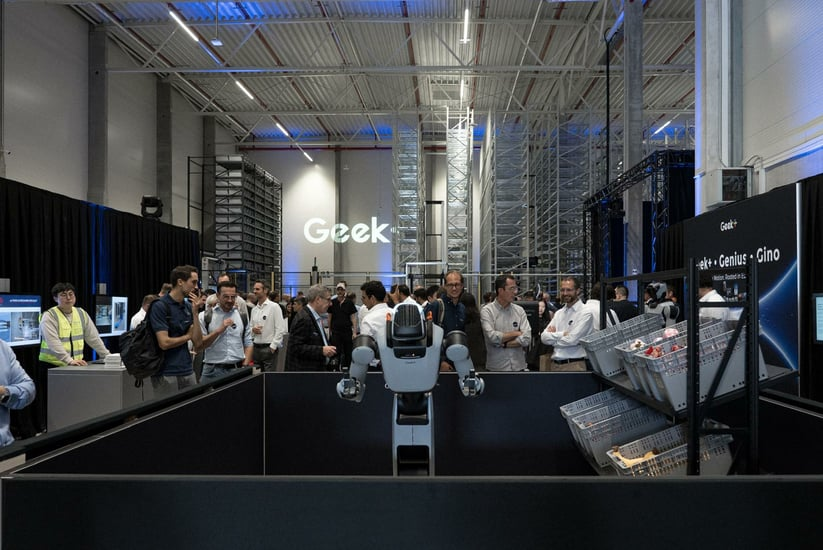
Geekplus has opened its first European Innovation Lab in Düsseldorf, creating a permanent environment where logistics operators can evaluate warehouse robotics, automation software, robotic picking, and AI-supported systems before committing them to live facilities.
The centre opened on 16 September and will operate as a testing and demonstration hub for European customers and partners. More than 150 industry representatives attended the inauguration, including people from GXO, DSV, and LPP Logistics, while Geekplus expects the facility to receive more than 1,000 visitors each year through customer sessions, technology demonstrations, training, and industry events.
The lab brings several automation approaches into one working environment. Visitors can examine pallet-to-person, tote-to-person, and shelf-to-person workflows alongside the RoboShuttle Hyper system, an integrated robotic-arm picking station, logistics software, and Geekplus’s Gino 1 humanoid robot. The company is also demonstrating Gravity, its embodied-AI framework intended to support longer and more complex physical tasks across robotic systems.
Warehouse automation projects increasingly have to be assessed at system level. A robot can perform well as an individual machine while producing a poor overall result if software integration, order release, workstation design, exception handling, replenishment, or interaction with surrounding equipment creates bottlenecks elsewhere. Bringing several technologies into one lab allows users to examine how those workflows fit together before transferring them into a production warehouse.
The facility will also be used to develop and test future systems. Geekplus says customers can assess person-to-automation processes, logistics software, robotic handling, and newer AI capabilities within the same environment, allowing operations teams to work from a defined warehouse process rather than evaluating each machine in isolation.
Geekplus already has substantial live deployments beyond the laboratory. Toyota has deployed 436 Geekplus moving-type autonomous mobile robots across several factories in Japan, where the machines automate internal material movement linked directly to production. Once a system reaches that scale, fleet control, maintenance, battery management, routing, safety, and integration with production schedules become continuous operating requirements.
The Düsseldorf lab gives European users a place to investigate those requirements without beginning with a full-site rollout. Warehouse robotics procurement may start with a throughput or labour objective, but the final design also has to account for order profile, SKU range, building geometry, peak demand, human workstations, fire and safety requirements, existing WMS architecture, and the ability to expand later.
Testing several systems together can also expose handover delays that are invisible in isolated equipment demonstrations. A tote may arrive faster at a workstation while replenishment, packing, or downstream sortation remains constrained, leaving the overall order cycle unchanged. Measuring those interfaces gives operators a better basis for deciding where automation investment will actually remove a bottleneck.
Geekplus is also using the centre to bring its software and AI development closer to the physical hardware. Its warehouse portfolio spans robot management, execution, system monitoring, and integration with ERP, WMS, and manufacturing applications. Gravity extends that approach with an AI layer intended to coordinate more complex physical tasks, while robotic arms and humanoid platforms broaden the types of handling operation under development.
Different warehouses will require different combinations of those systems. Pallet movement, tote storage, piece picking, production logistics, and ecommerce fulfilment have different labour, throughput, and inventory profiles, and their automation economics vary accordingly. A test facility gives operators an opportunity to compare technical approaches against a defined process before selecting the equipment architecture.
The Düsseldorf location also gives Geekplus a permanent customer-facing base closer to Western European deployment activity. The company plans regular customer visits and dedicated industry days rather than treating the facility as a one-off exhibition, giving operational teams and integrators access to systems that can be tested under repeatable conditions.
The challenge for warehouse robotics has shifted towards integration as installations grow larger and more varied. Moving a shelf, tote, or pallet autonomously is only one part of the process; the surrounding software, workstations, people, and material flows have to maintain the same pace. Geekplus’s Düsseldorf lab provides a European site where those interactions can be tested before they become part of a live distribution operation.