IN Brief:
- Washington United Terminals is planned to increase annual capacity from approximately 590,000 to 880,000 TEU.
- Two ageing ship-to-shore cranes will be replaced and two rubber-tyred gantry cranes added.
- The equipment is expected to be delivered and commissioned by 2028 as HMM prepares the gateway for larger vessels.
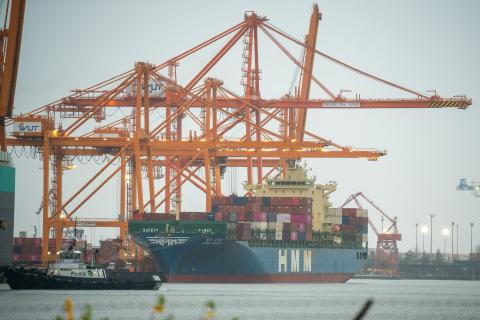
HMM is investing in Washington United Terminals at Tacoma to increase annual container-handling capacity from approximately 590,000 TEU to 880,000 TEU. The programme will replace two ageing ship-to-shore cranes and add two rubber-tyred gantry cranes, with the new equipment expected to be delivered and commissioned by 2028.
The underlying modernisation programme was announced on 30 July, rather than 20 August, and forms part of HMM’s longer-term commitment to the Seattle-Tacoma gateway. The investment is intended to improve cargo flow and allow Washington United Terminals to handle larger container vessels as transpacific networks continue to evolve.
The planned increase represents nearly 50% more annual handling capacity. That figure cannot be delivered by crane additions alone, but the equipment addresses two of the terminal’s most important interfaces: moving containers between vessel and quay, and then organising those boxes inside the yard.
Replacing ageing ship-to-shore cranes gives the terminal greater ability to work larger vessels and reduces dependence on older equipment whose maintenance requirements can rise as components and control systems age. Crane outreach, lift height, cycle time, and reliability all influence how effectively a terminal can exchange containers during a vessel call.
The two additional RTGs address the next stage. Faster discharge creates little benefit if boxes then accumulate in the yard because stacking and retrieval capacity cannot keep pace. Yard cranes determine how efficiently containers are placed, reshuffled, and presented for onward road or rail movement.
Balancing berth and yard capability is therefore more important than headline crane productivity. A terminal that raises ship-to-shore moves per hour without improving the rest of the operation can simply transfer congestion from the vessel interface into storage blocks and truck lanes.
Washington United Terminals is an established HMM gateway for transpacific traffic in Tacoma Harbor. Its role inside the carrier’s North American network gives HMM a direct interest in terminal reliability as well as vessel scheduling, particularly where cargo connects onwards to inland markets.
The wider Seattle-Tacoma gateway competes with other North American west coast ports for vessel calls and discretionary inland cargo. Carriers consider berth availability and crane performance, but importers and exporters experience the full logistics chain through terminal dwell, truck gates, rail connections, and onward transit.
Capacity investment therefore has to be assessed against fluidity rather than nameplate throughput. An additional 290,000 TEU of theoretical annual capacity is useful only if the terminal can move those containers through the yard and inland network without materially increasing dwell times.
The 2028 commissioning date illustrates the long procurement cycle for major port equipment. Ship-to-shore cranes are engineered to order, manufactured in specialist facilities, transported by sea, erected or delivered in large sections, tested, and integrated with local operating systems before entering commercial service.
That creates a different planning horizon from transport markets themselves. Freight rates and container volumes can change within weeks, while terminal equipment decisions have to anticipate vessel and trade requirements several years ahead. Operators therefore invest against expected network needs rather than the current month’s cargo figures.
The decision to accommodate larger ships also reflects continuing changes in fleet deployment. Larger vessels concentrate more container exchanges into individual calls, increasing the pressure on terminals to move boxes quickly enough to prevent yard congestion and maintain berthing windows for following services.
HMM’s programme is one element of wider investment across the Seattle-Tacoma system, where ports and terminal operators are modernising equipment and infrastructure to protect the gateway’s competitive position. That competition is increasingly based on reliability rather than maximum vessel size alone.
For cargo owners, dependable terminal performance can reduce inventory buffers and inland transport disruption. A late vessel is difficult enough to absorb; a vessel that arrives on time but then encounters prolonged terminal dwell creates a second source of uncertainty after the ocean leg has finished.
The two new quay cranes and two RTGs will therefore be judged on more than their individual specifications. Their role is to increase the amount of cargo Washington United Terminals can process while preserving the flow between ship, stack, gate, and inland connection.
By 2028, HMM expects annual capacity to reach 880,000 TEU. The important number after commissioning will be how much of that additional capacity can be used consistently without longer container dwell or more congestion around the terminal. For a transpacific gateway, reliable throughput remains more valuable than capacity that exists only on paper.