IN Brief:
- Maersk has ordered 1,000 additional India-manufactured shipping containers from DCM Shriram Group.
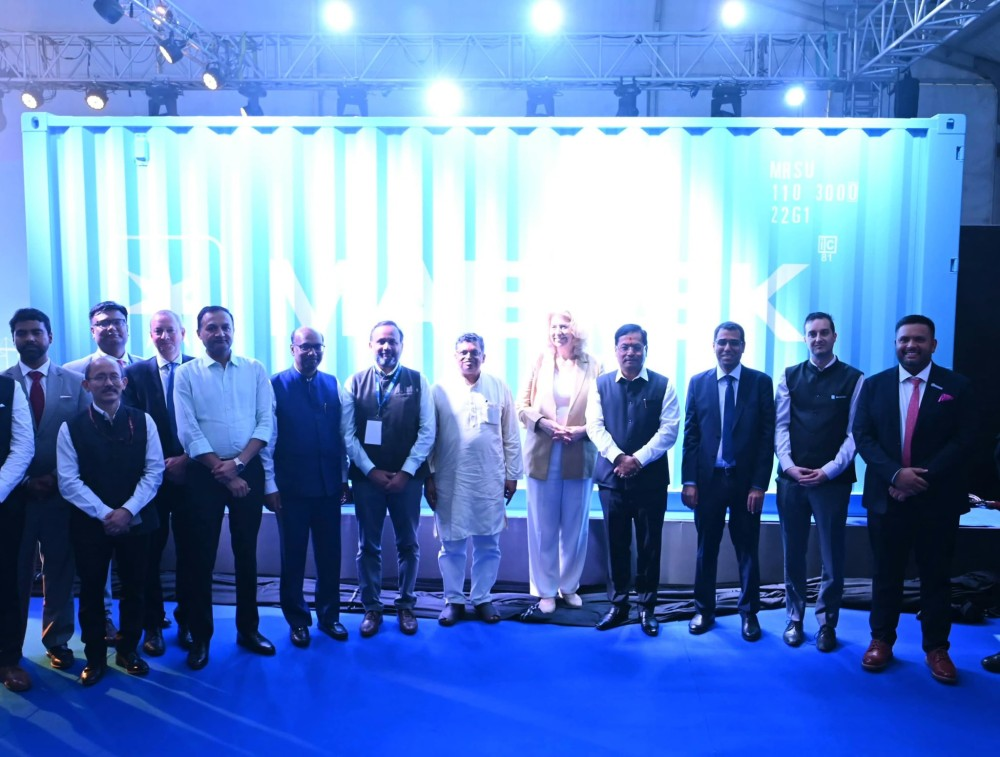
- The first India-made EXIM container for Maersk has been unveiled at the Maersk-CONCOR ICD Dadri facility.
- The order supports India’s push to build domestic maritime equipment capacity and reduce dependence on imported container supply.
A.P. Moller – Maersk has placed an order for 1,000 additional India-manufactured shipping containers with DCM Shriram Group, giving India’s domestic container manufacturing programme a significant international customer at a time when equipment availability remains a strategic concern for exporters.
The order follows the unveiling of the first export-import grade shipping container manufactured in India for Maersk at the Maersk-CONCOR Inland Container Depot in Dadri, Uttar Pradesh. Produced by DCM Shriram Group, the container was presented during an event attended by Union Minister for Ports, Shipping and Waterways Sarbananda Sonowal.
By moving from a first box to a further 1,000-unit order, the project shifts from symbolism into a more substantial supply arrangement. Maersk becomes the first international shipping line to procure an India-made EXIM container, while DCM Shriram gains a reference customer with global operating requirements and exposure to demanding international equipment standards.
Container availability became a structural weakness during the pandemic, when equipment shortages, port congestion, and imbalanced trade flows left exporters exposed to high costs and missed sailings. Standard dry boxes may be basic assets, but when they are not in the right place at the right time, the effects move quickly through freight rates, customer commitments, and production schedules.
India has been building a broader maritime self-reliance agenda around ports, inland logistics, shipbuilding, and equipment manufacturing. Domestic container production forms part of that strategy because it gives exporters and carriers another source of supply closer to manufacturing clusters, rather than relying entirely on imported boxes from established overseas producers.
Dadri’s role adds an operational dimension to the announcement. Inland container depots link production centres to seaports through rail and road corridors, allowing cargo to be cleared, consolidated, and moved without every exporter handling logistics at the port gate. Placing the first Maersk container at an inland gateway connects manufacturing capability with the export networks that need more predictable equipment supply.
Maersk’s Indian logistics activity is already extending beyond ocean carriage. The company’s refrigerated rail corridor between Hyderabad and Nhava Sheva has added scheduled cold-chain capacity for pharmaceutical flows, linking a major life sciences manufacturing cluster with one of India’s most important container ports. The container order works at a more fundamental layer of the same system, addressing the physical asset base on which export reliability depends.
The commercial test now shifts to scale, repeatability, and cost. EXIM containers must meet international standards, withstand repeated handling, and operate across ports, vessels, rail terminals, depots, truck movements, and customer sites. A single successful build is useful; consistent production at the right quality and price is what turns the programme into logistics infrastructure.
Domestic container manufacturing could also support more specialised equipment categories over time. Reefers, tank containers, open-top units, and other specialised boxes are critical to sectors such as pharmaceuticals, chemicals, engineering, and food. A stronger local manufacturing base for standard containers may create the technical and supplier foundations for more complex equipment production later.
India’s export ambitions rely on more than factory capacity. Goods need dependable inland movement, customs processes, port access, carrier calls, container availability, and onward connectivity in destination markets. Weakness in any one layer can erode the advantage of lower production costs or expanded manufacturing investment.
Maersk’s order does not remove the need for global container repositioning, nor does it end India’s exposure to shipping cycles. It does, however, create a domestic manufacturing route for an asset that underpins international trade. The first India-made EXIM box carries significance because it is ordinary by design: a standardised tool entering a global system that depends on standardisation, scale, and dependable repetition.