IN Brief:
- Rail Cargo Group has added a direct intermodal service between Wels and Hamburg/Bremerhaven.
- The route supports 20ft to 45ft containers and operates as a weekly round trip.
- The service strengthens Austrian access to North Sea container flows and global shipping routes.
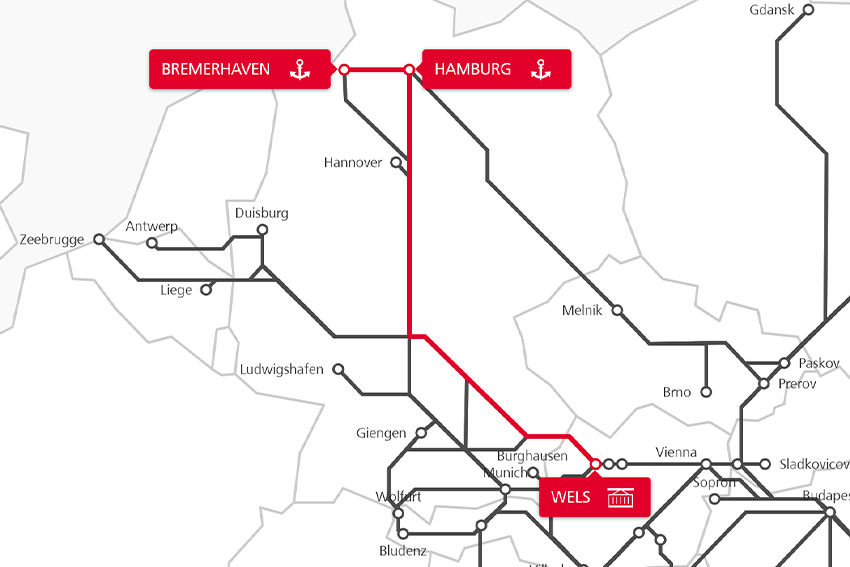
Rail Cargo Group has expanded its TransFER network with a direct intermodal service between Wels in Austria and the northern German ports of Hamburg and Bremerhaven.
The new Wels–Hamburg/Bremerhaven service provides a scheduled rail connection for standard containers moving between Austria and two major North Sea seaports. The route supports 20ft to 45ft containers and operates once a week as a round trip, with the option to increase frequency as demand grows.
The service adds to Rail Cargo Group’s existing Vienna–Hamburg/Bremerhaven and Linz–Hamburg/Bremerhaven connections. It gives central Upper Austria direct access to northern German port infrastructure and strengthens links between the Alpine region and international container flows.
Customers can use first- and last-mile trucking on request, alongside freight forwarding services including customs clearance, trucking, and related logistics support. The structure allows shippers to use rail as part of a door-to-door chain rather than only a terminal-to-terminal movement.
The launch improves rail access for one of Austria’s key industrial regions. Upper Austria has strong manufacturing, engineering, automotive, metals, and consumer goods activity, all of which generate containerised inbound and outbound flows. A direct link to Hamburg and Bremerhaven gives exporters and importers another route into global shipping networks without depending entirely on long-distance road haulage.
Intermodal rail is receiving renewed attention across Europe as shippers reassess inland transport around cost, reliability, emissions, and capacity. Road freight continues to face driver shortages, congestion, toll pressure, and decarbonisation requirements. Rail does not remove every constraint, but scheduled port-linked services can provide greater predictability for steady container flows.
The choice of Hamburg and Bremerhaven gives the route strong maritime relevance. Both ports are major gateways for European container traffic, and their rail connections are central to their inland reach. By adding Wels to the network, Rail Cargo Group increases the number of Austrian industrial centres connected directly to North Sea cargo flows.
The service also gives logistics planners more flexibility at a time when European supply chains remain exposed to port congestion, infrastructure works, labour constraints, and weather disruption. Additional rail routes can help spread volumes across inland networks and reduce dependence on a single port or transport mode.
The inclusion of trucking and customs support gives the service a practical route into shipper networks that may not have direct rail access. Modal shift depends on operational usability as much as environmental ambition. Fixed rail schedules, port access, and integrated first- and last-mile options make rail easier to use for manufacturers and forwarders managing regular container volumes.