IN Brief:
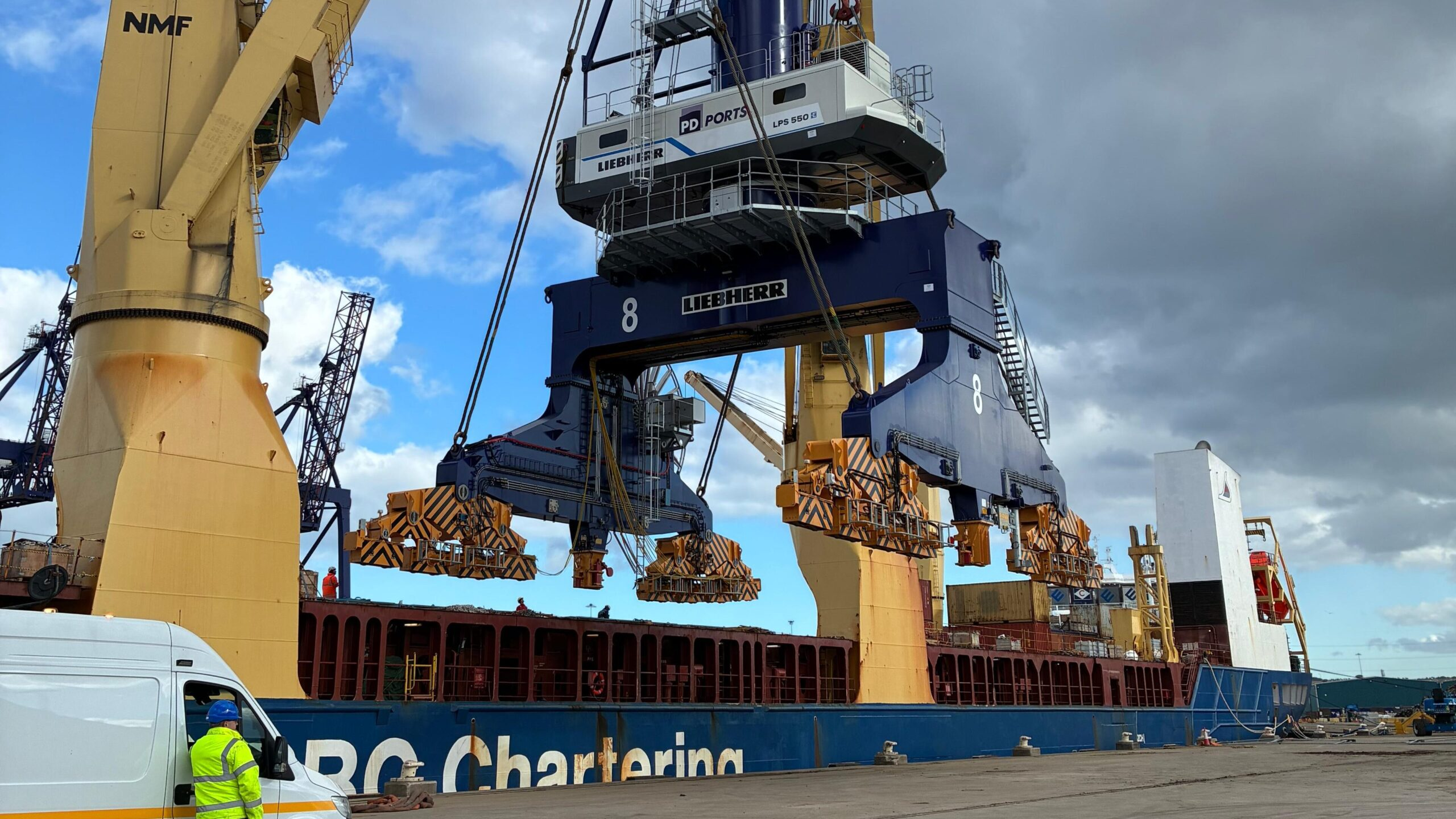
- PD Ports has invested £5.4m in a third electric-hydraulic Liebherr LPS 550 crane at Teesport.
- New grabs include a scrap metal unit increasing capacity from 7.5m³ to 17m³ per grab.
- The investment supports bulk commodities, breakbulk, project cargo, offshore infrastructure, and carbon capture activity.
PD Ports has strengthened Teesport’s bulk handling capability with a £5.4m investment in a third electric-hydraulic Liebherr LPS 550 crane and new task-specific grabs.
The new crane complements two identical models introduced in 2023 under an £8.6m investment programme. The additional unit expands Teesport’s ability to handle bulk and breakbulk commodities, improve discharge rates, reduce emissions, and respond more flexibly to customer demand.
New grabs have been selected for specific cargo types and operating conditions. A scrap metal grab increases capacity from 7.5m³ to 17m³ per grab and includes bespoke lifting points, allowing plant to be transferred from shore to ship without changing lifting gear.
The equipment will support faster discharge, improved safety, and entry into new bulk markets. PD Ports is also targeting project cargo opportunities, including tandem lift operations linked to offshore infrastructure and carbon capture developments across Teesside and beyond.
Tees Dock’s bulks quay now handles more than 3m tonnes of cargo per year. PD Ports has reported a 263% increase in agribulk productivity since 2016, supported by investment in electric cranes, higher-capacity grabs, eco-hoppers, storage, planning systems, automated weighbridges, and workforce training.
Bulk handling is being reshaped by cargo variability, because ports serving industrial clusters must accommodate agribulks, aggregates, steel, recycled metals, biomass, construction materials, offshore components, and heavy project cargo. Equipment that can be matched to the cargo gives operators more control over berth productivity and storage movement.
Teesside’s industrial base adds weight to the investment. The region is being positioned around offshore energy, industrial decarbonisation, carbon capture, and advanced manufacturing, all of which require port infrastructure able to handle high-volume commodities and irregular project cargo. Large structures, specialist plant, steel components, and construction materials sit between conventional bulk work and heavy-lift logistics.
Electrified cranes also support lower-emission port handling. PD Ports has set a target of net zero operations by 2040, and electric-hydraulic equipment can reduce local emissions while improving operational performance. Industrial customers are increasingly asking how cargo movement, not just production, contributes to the carbon profile of infrastructure and manufacturing projects.
The productivity gains at Tees Dock show how materials handling improvements build over time. A crane upgrade does not transform a port by itself; the performance improvement comes from combining lifting capability with storage planning, weighbridge automation, trained operators, suitable grabs, and reliable berth scheduling. Bulk logistics depends heavily on that coordination because every cargo behaves differently.
Faster discharge can reduce vessel time, improve inventory availability, and ease pressure around quayside storage. In markets exposed to demurrage, weather windows, and downstream production schedules, handling reliability can be as valuable as raw capacity.
The investment also strengthens Teesport’s role as a materials flow platform for regional industry. Ports connected to manufacturing, construction, energy, and infrastructure are no longer simply maritime gateways; they are operating nodes where cargo sequencing, equipment choice, storage, inland movement, and project planning converge.
PD Ports’ latest crane investment gives Teesport additional reach into that work. As offshore and carbon capture projects demand heavier lifts and more complex logistics planning, port-side materials handling will become a central part of industrial delivery rather than a supporting service at the edge of the chain.