IN Brief:
- MATE-XT GO is positioned for logistics and material handling workflows.
- Comau claims up to 50% physical strain reduction for repetitive overhead tasks.
- Certification as Category II PPE signals a push into regulated workplaces.
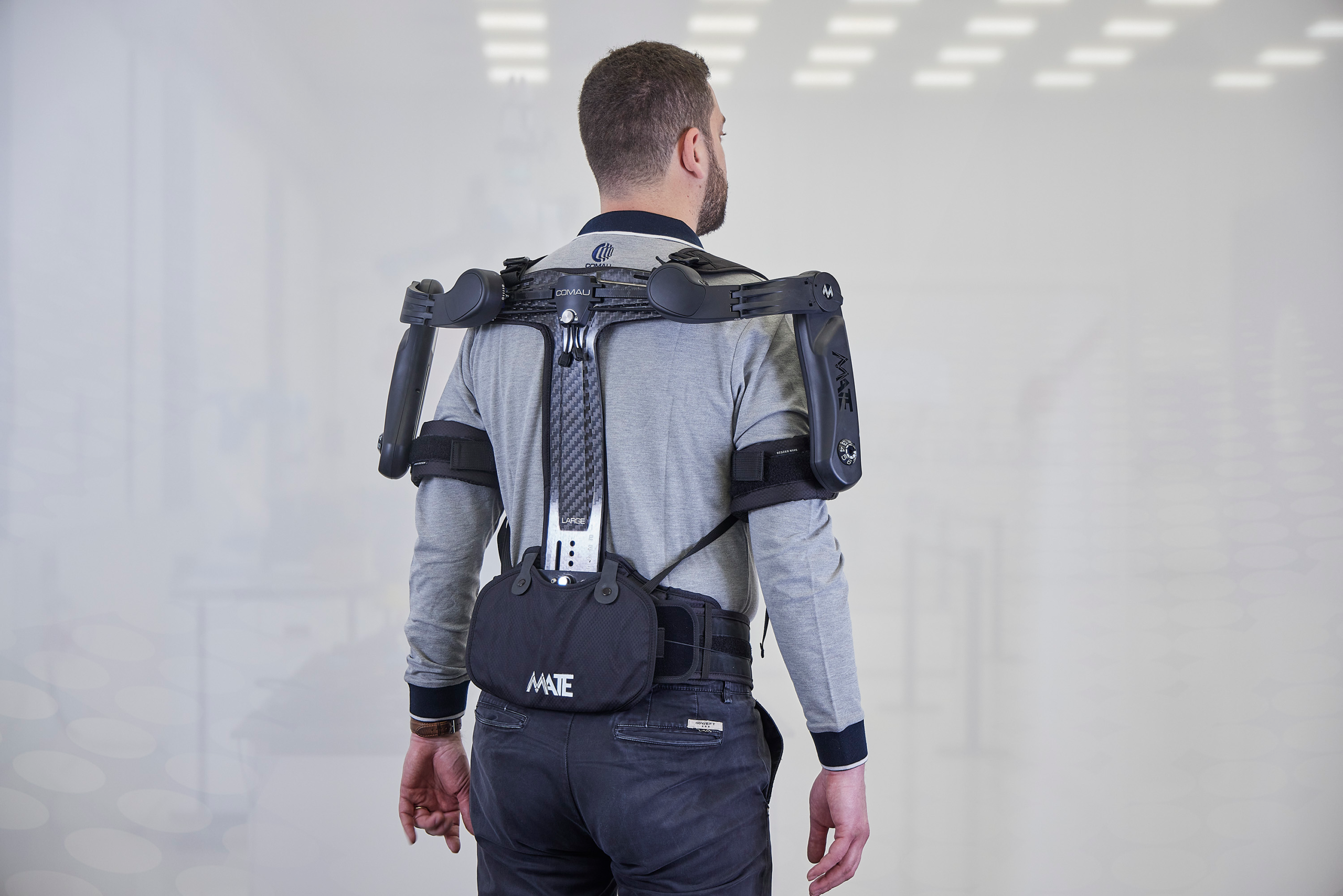
At A&T 2026 in Turin, Comau introduced MATE-XT GO, a wearable exoskeleton designed to support workers’ arms and shoulders during repetitive or overhead tasks in logistics and material handling environments. The launch places wearable robotics in a more explicitly operational frame: not as a novelty for demo days, but as kit intended to sit alongside conventional MHE and warehouse automation.
Comau positions MATE-XT GO around sustained work, where fatigue is cumulative and form breaks down late in shift. The company says the exoskeleton reduces physical strain by up to 50% during repetitive and overhead tasks, aiming to improve comfort and stamina while maintaining productivity across a full shift. In practical terms, that points to workstations and movements that do not disappear even in highly automated sites: depalletising exceptions, mixed-SKU handling, returns triage, and the awkward, non-standard lifts that sit outside the tidy world of uniform cartons.
The device’s compliance posture is also telling. Comau says MATE-XT GO is certified as Category II personal protective equipment under EU Regulation 2016/425. For many operators, that matters as much as the mechanism, because wearables introduced at scale quickly become a safety, training, and workforce acceptance issue, not just an engineering one. Certification does not eliminate those challenges, but it reduces friction when sites are already operating within tightly controlled risk assessments and audit regimes.
From a design perspective, Comau highlights a lightweight carbon fibre structure, breathable fabrics, ergonomically designed cuffs, and an intuitive lock/unlock mechanism for donning and doffing, with sizing offered in small and large. Those details are not trivial. In real warehouses, adoption fails fast if a wearable is uncomfortable, time-consuming to fit, or incompatible with the varied body types and task rotations that distribution work requires.
Comau has been aligning its messaging around “smart warehouses” rather than isolated automation islands, and the A&T programme reflects that, with presentations spanning intralogistics topics from ergonomics through to AMRs and cobots for picking. The broader implication is that wearable robotics is being framed as a complement to automation, not a competitor — a way to stabilise the human part of the workflow while capital projects roll out in phases.
For operators, the business case will be judged on more than wellbeing metrics. Sites will look for measurable impacts on throughput stability, quality, unplanned absences, and the ability to hold performance during peak periods. Expect pilots to focus on the most ergonomically demanding tasks, then expand only if managers can show that “support” translates into fewer slowdowns, fewer injuries, and more consistent shift output.