IN Brief:
- Paxon has transformed a site near Lyon into an automated e-commerce fulfilment hub.
- The operation supports JDE Peet’s coffee brands including L’Or and Tassimo.
- Peak volumes exceed 3,000 orders per day, with headcount rising from around 20 to 50.
Paxon has completed the transformation of a logistics site near Lyon into a fully automated e-commerce fulfilment hub for JDE Peet’s coffee brands, including L’Or and Tassimo.
The project brings together Active Ants’ automated e-commerce fulfilment capability with Staci’s logistics network in France. It marks the first large-scale collaboration between Active Ants and Staci under the Bnode group as the group’s 3PL businesses transition towards the Paxon brand.
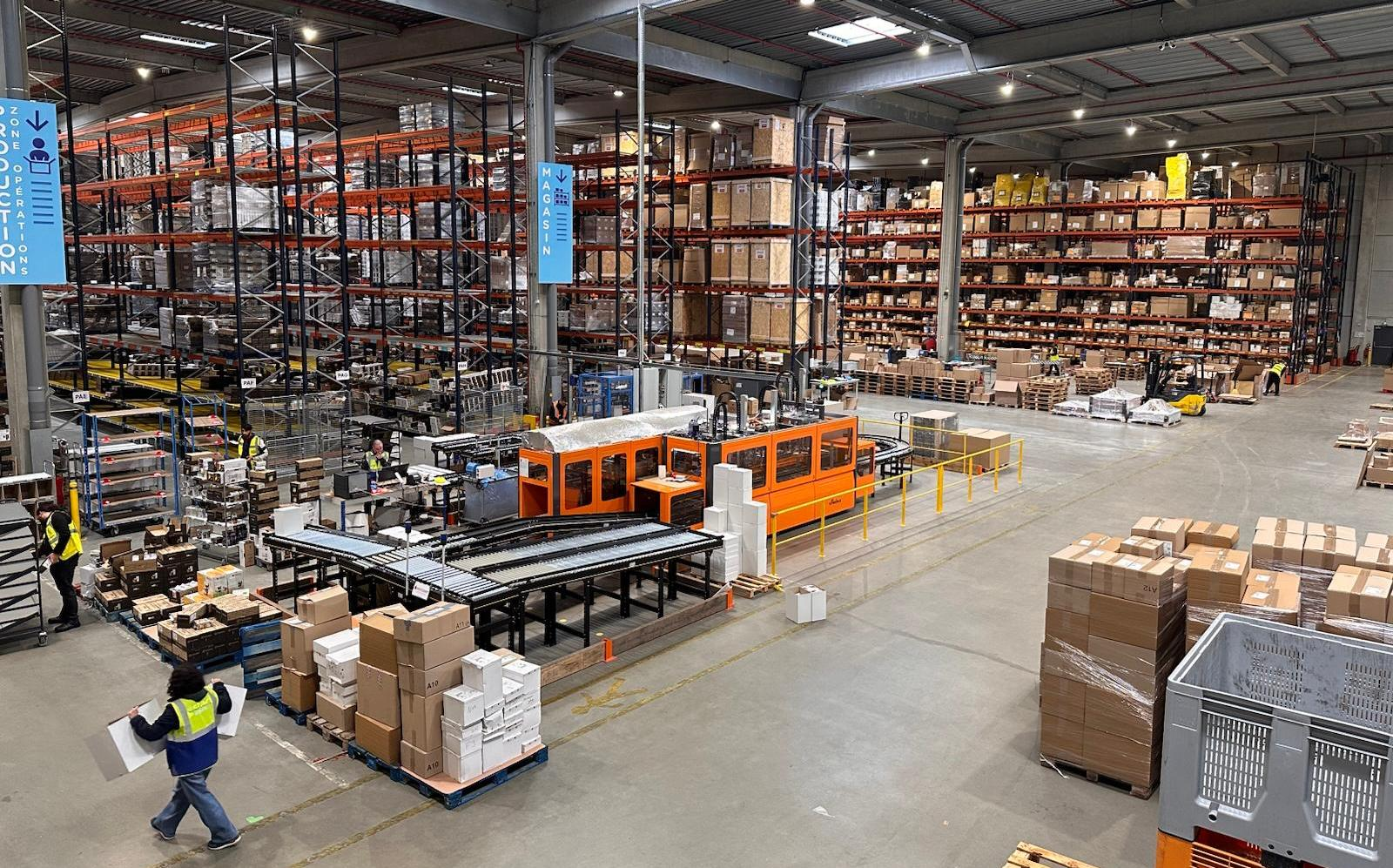
Located in Pusignan, close to JDE Peet’s production site in Saint-Étienne, the facility went live on 1 February 2026 following a major overhaul delivered in less than eight months. The transformation included automated picking and packing equipment, conveyor systems, new racking, upgraded electrical infrastructure, and Active Ants fulfilment technology.
The site also includes automated packaging technology that prints customised boxes and right-sizes packaging to reduce wasted space. The platform now processes several hundred thousand e-commerce orders each year, with peak volumes exceeding 3,000 orders per day. Headcount at the site has doubled from around 20 to 50 employees.
The project extends an existing relationship between Active Ants and JDE Peet’s in Belgium, the Netherlands, and the UK into France. It also gives JDE Peet’s a more automated route for handling direct-to-consumer and e-commerce orders in a strategic local market.
Food and beverage e-commerce creates different fulfilment pressures from store replenishment or palletised retail distribution. Order profiles are smaller, packaging quality affects customer experience, and promotional peaks can create sharp demand bursts. Coffee products also involve brand presentation, pack integrity, SKU variation, and customer-specific delivery expectations that leave limited room for manual inconsistency.
Right-sized packaging is a practical gain in this environment. Smaller, better-fitted boxes can reduce void fill, packaging waste, shipping cube, and damage risk. When the capability is integrated with automated picking and packing, it also reduces the number of manual decisions made on the warehouse floor during high-volume periods.
Dense, automated fulfilment is becoming more common inside established European logistics markets. Bleckmann’s Roosendaal AutoStore distribution centre uses automated storage, conveyors, carton erecting, and packing technology to support fashion and lifestyle fulfilment. Paxon’s Lyon project applies a similar operating principle to branded food and beverage ecommerce: reduce walking time, compress storage, automate repetitive packing steps, and keep service levels stable through peaks.
Food supply chains are moving in the same direction. Grupo Bimbo’s warehouse automation project shows how automation is being used to improve throughput, inventory rotation, and order fulfilment in high-velocity food logistics. The Lyon facility adds a parcel-ready e-commerce layer to that pattern.
The workforce increase at the Pusignan site gives the project a broader operational reading. Automation deployments are often reduced to labour substitution, but many modern fulfilment projects are aimed at scaling volume, stabilising quality, and moving people away from repetitive travel or manual packing decisions. Higher headcount at an automated site can reflect a larger operation, more value-added activity, and greater need for supervisory, technical, maintenance, and exception-handling roles.
The Paxon transition also reflects what customers now expect from 3PL networks. Automation, carrier access, packaging capability, data visibility, and local market knowledge increasingly need to be delivered as one operating model. Active Ants, Staci, Radial, and Base Logistics bring different capabilities into that structure, but the commercial value will depend on how smoothly those capabilities work together across borders and sectors.
For JDE Peet’s, the immediate result is a more scalable French ecommerce fulfilment platform close to production. Across the wider market, the project shows automation moving deeper into branded food and beverage logistics, where customer expectations are shaped by ecommerce speed while product integrity, packaging discipline, and cost control remain firmly industrial problems.