IN Brief:
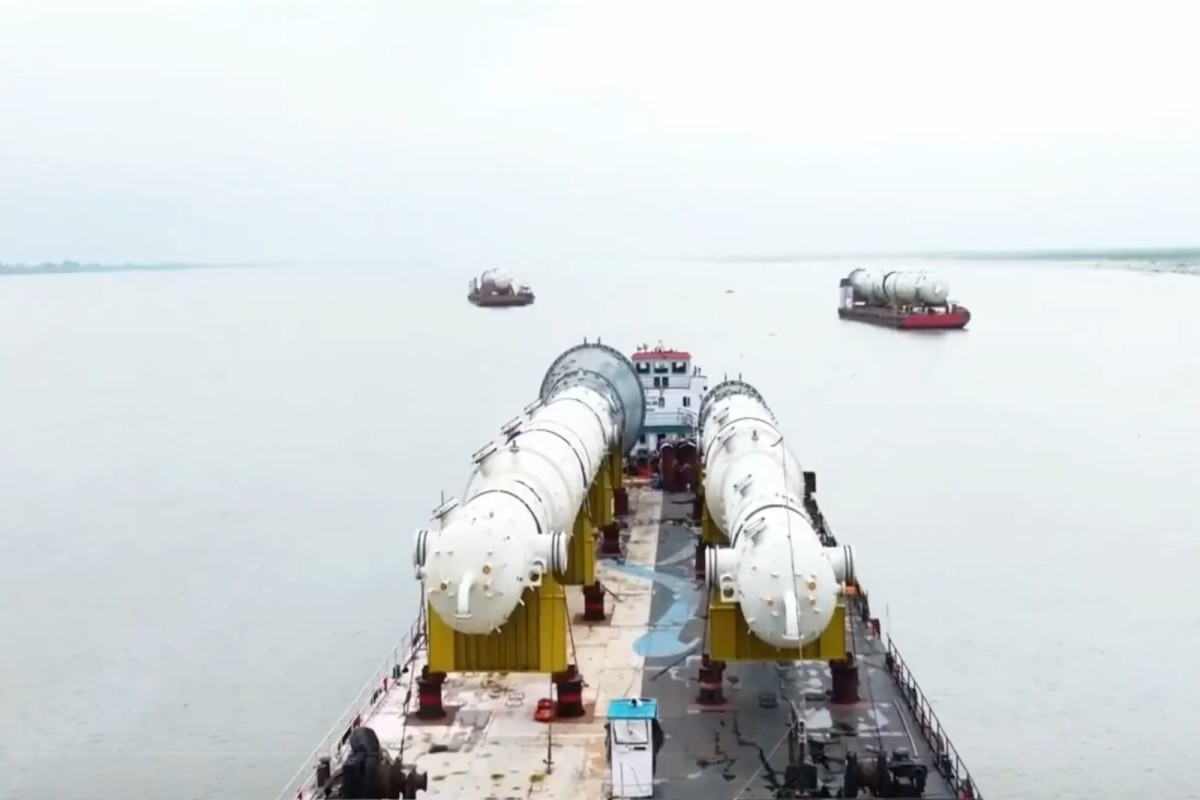
- A 1,668-tonne refinery consignment travelled from Diamond Harbour to Simaria Ghat on National Waterway-1.
- The equipment is destined for IndianOil’s Barauni refinery in Bihar.
- Repeatable water depth, landing infrastructure, lifting capacity, and final-mile access will determine wider adoption.
A 1,668-tonne consignment of oversized refinery equipment has completed a 713km journey along India’s National Waterway-1, moving from Diamond Harbour near Kolkata to Simaria Ghat in Bihar before the final transfer to IndianOil’s Barauni refinery.
The movement used the Ganga-Bhagirathi-Hooghly river system, which connects Haldia with Prayagraj and forms the principal corridor within India’s inland-waterway development programme. The equipment’s weight and dimensions would have created extensive bridge, route, escort, and traffic-management requirements had the entire journey been completed by road.
Project-cargo movements of this scale depend on far more than an available stretch of river. Hydrographic surveys must confirm adequate depth and width, while bends, currents, bridge clearances, overhead infrastructure, landing conditions, and seasonal changes determine whether the selected barge arrangement can pass safely.
The equipment reached Simaria Ghat after travelling through West Bengal, Jharkhand, and Bihar, but its journey will not be complete until the modules are lifted from the barge and carried to the refinery. That interface between river and road frequently presents the most demanding engineering stage because quay strength, crane capacity, road geometry, utilities, and temporary storage must all align within a tightly controlled operation.
Heavy equipment can spend days moving successfully by sea or inland water, only to encounter a final-mile obstruction which was not fully reflected in early planning. A bend too tight for a transporter, an overhead cable, a weak culvert, or inadequate hardstanding can halt a consignment within sight of its destination.
IndianOil is expanding and modernising the Barauni refinery, requiring large process modules whose fabrication and delivery must be sequenced against construction and installation work. Late arrival can leave cranes, specialist contractors, and downstream commissioning activity idle, multiplying the cost far beyond the freight charge.
Water transport offers a way to move larger assembled units, potentially reducing the amount of fabrication, welding, alignment, and testing required after arrival. The trade-off appears earlier in the project, when engineers decide whether equipment should travel as one large module or be divided into smaller sections compatible with conventional routes.
Designing around the transport envelope gives manufacturers greater control than attempting to solve an oversized movement after fabrication is complete. Module dimensions, lifting points, centre of gravity, transport supports, and installation sequence can be adjusted while engineering changes remain possible.
Technical success must become repeatable capacity
The completed river leg proves that National Waterway-1 can carry an exceptional industrial consignment over a substantial distance, although future project planners will require predictable operating conditions rather than an isolated success. Vessel availability, draught, terminal access, lifting equipment, permits, and transit windows must be dependable enough to sit inside a construction programme with contractual milestones.
Seasonality remains the most obvious constraint because water depth affects payload, speed, route selection, and the number of barges required. Dry periods can restrict navigation, while monsoon flows introduce stronger currents, debris, flooding, and reduced access to landing areas.
Dredging and channel maintenance can support navigability, but rivers remain dynamic systems whose conditions cannot be fixed as readily as a road or railway. Accurate forecasts and conservative loading plans are therefore essential when a delayed voyage would disrupt a large industrial project.
Landing sites need more than sufficient water alongside the bank. Heavy-lift cranes or roll-on equipment require stable ground, appropriate bearing capacity, secure storage, lighting, access control, and roads capable of accepting multi-axle transporters.
Temporary infrastructure can be built for a single project, although repeated movements become more economical when established terminals serve several industrial sites. Refineries, power stations, chemical plants, steelworks, and manufacturing developments along the corridor could collectively support permanent project-cargo capability.
Road transport remains faster and more flexible for many consignments, whereas exceptional loads can require closures, bridge assessments, police escorts, utility relocation, and extensive local disruption. A barge can remove hundreds of axle movements from public roads, but the comparison must still include terminal handling, tug operations, empty positioning, and the unavoidable final road leg.
India’s freight policy is increasingly connecting inland production with ports, rail terminals, and waterways rather than treating each mode as an independent network. The proposed relaxation of coastal-shipping restrictions seeks to broaden domestic sea capacity, while a direct Rajasthan–Mundra block train has given inland exporters another route to the western seaboard.
National Waterway-1 extends that multimodal strategy into river transport, where the strongest commercial case lies in heavy modules, bulk commodities, and flows that value carrying capacity above transit speed. Its contribution will depend on how reliably waterborne movements connect with road and rail at either end.
Equipment manufacturers located near eastern ports or navigable rivers could gain a wider inland market if assembled modules can travel without being broken down to meet highway limits. Fabrication sites would still need suitable quays, cranes, and barge access, making location an increasingly important part of project design.
Environmental performance may favour inland shipping when barges carry full loads and replace lengthy road journeys, although lightly loaded vessels, additional handling, and substantial dredging can erode that advantage. Each movement requires a route-specific assessment rather than a simple modal assumption.
Data from this voyage should now inform future engineering, including actual draught, transit speed, stoppages, handling times, and final-mile constraints. Capturing those details allows later projects to move beyond broad feasibility and develop more accurate cost and schedule models.
The equipment’s arrival at Simaria Ghat has completed the longest portion of the journey, while the final specialist haul into Barauni will determine whether the complete transport chain performs as planned. Once installed, the modules will provide a stronger reference for manufacturers and project owners considering waterway transport during the earliest design stages.