IN Brief:
- TGW has commissioned a 16,000m² production hall and automated warehouse at Marchtrenk.
- The installation includes 11,000 pallet positions, 49,000 tote locations, mobile robots, shuttles, and conveyors.
- Manufacturing growth is being matched with greater spare-parts and service capacity for a widening installed base.
TGW Logistics has commissioned a 16,000m² production hall and highly automated storage system at its Marchtrenk headquarters in Austria, bringing component supply, manufacturing, and global spare-parts fulfilment into a single connected operation.
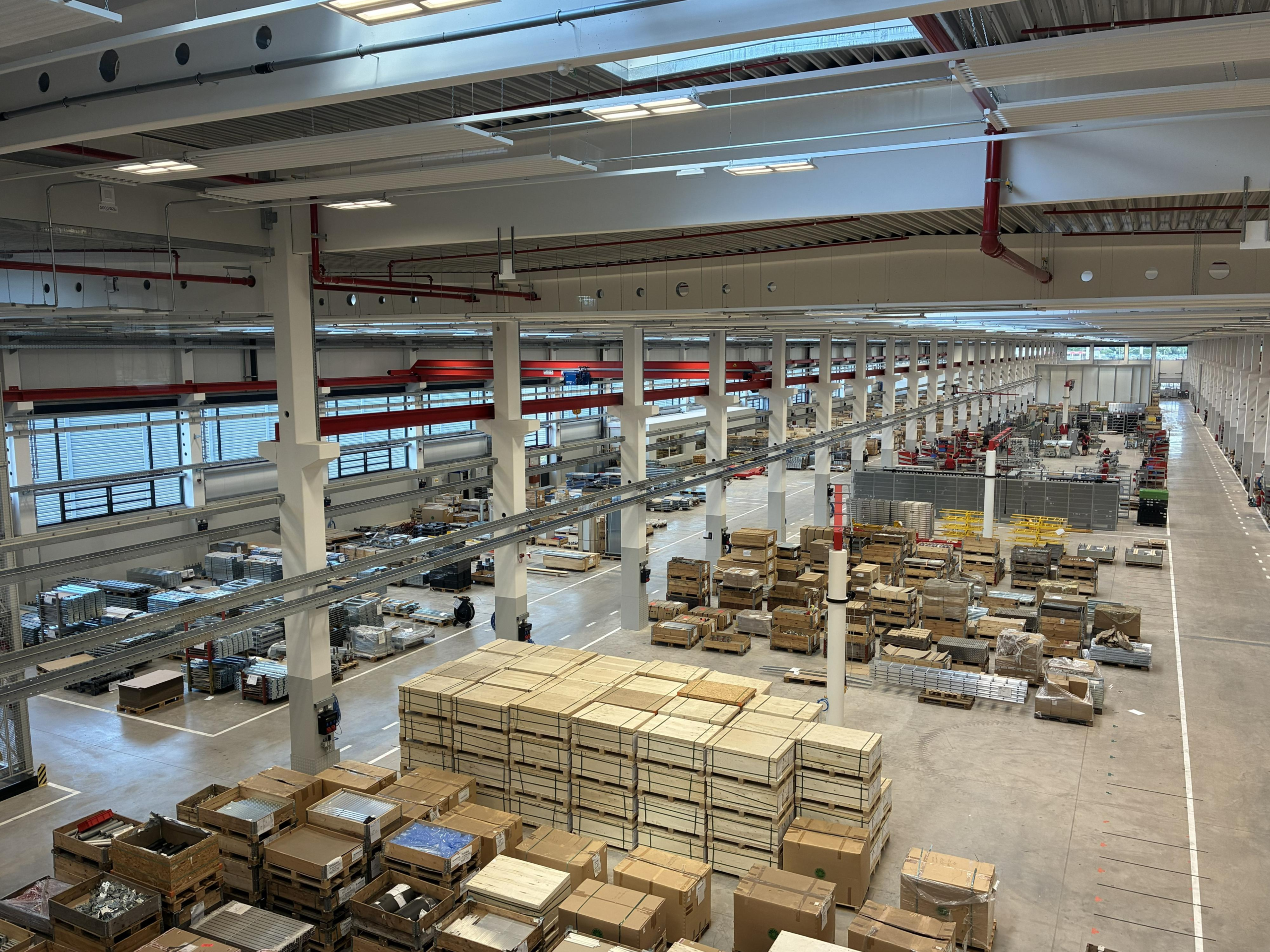
The development contains 11,000 pallet positions and 49,000 tote locations, supported by storage and retrieval machines, shuttle technology, conveyors, mobile robots, and TGW’s WERX software. All operational areas are scheduled to enter service by the end of August as teams and production activity transfer from Wels and several rented properties.
Measuring approximately 240 metres by 63 metres, the hall will manufacture shuttle robots, storage and retrieval machines reaching heights of up to 25 metres, pallet and roll-cage conveyors, and electrical control cabinets. Wels will retain production of KingDrive conveyor technology for totes and cartons.
Around 700 production specialists work across Marchtrenk and Wels, where TGW manufactures approximately 90% of the mechatronic modules used in customer projects worldwide. Consolidating component storage and production should reduce internal transport, repeated handling, and the operational friction created by moving work between separate buildings.
Mobile robots will deliver parts to assembly and picking stations on carts and pallets, while WERX coordinates inventory, replenishment, and material movement. The warehouse supplies both current manufacturing and the spare-parts operation supporting installed systems in international markets.
That dual role places different demands on the same inventory. Production requires components in project sequence and sufficient quantity to keep assembly moving, whereas service operations may need an individual critical part dispatched immediately to a customer whose conveyor, shuttle, or storage machine has stopped.
Centralising those flows can improve stock accuracy and reduce duplication, although prioritisation becomes essential whenever manufacturing and aftersales compete for limited material. A part required to finish a new machine may also be the only available replacement for an operating customer system.
The storage building reaches 32 metres and uses a clad-rack structure, in which the racking supports the roof and external envelope. Construction and automation consequently form one engineered system, with structural tolerances, fire protection, access, and equipment geometry designed together.
TGW has invested €100m in the headquarters expansion and plans a further €50m office development by early 2028. The company intends to double annual revenue to €2bn by 2030, following reported record order intake of €1.5bn.
Growth expands the service obligation
Automation manufacturers are increasingly applying their own equipment within production and service networks, partly because customer growth creates an internal logistics problem of comparable complexity. Conveyors, shuttles, motors, frames, sensors, controls, and cabinets must arrive in the correct order across projects whose configurations differ.
A missing low-value component can delay testing or dispatch of a much larger system, leaving completed material occupying factory space while project teams wait. Automated component supply gives TGW a closer connection between stock availability, assembly demand, and customer schedules.
Manufacturing output represents only part of the capacity needed to support a larger order book. Engineering, software, testing, field installation, project management, commissioning, maintenance, and technical support must expand in step, otherwise gains inside the factory create bottlenecks elsewhere.
Every system delivered also enlarges the installed base requiring parts and service for years after commissioning. Automated warehouses often depend on continuous operation, making a failed motor, sensor, controller, or shuttle component disproportionately expensive when it interrupts an entire aisle or process.
Regional service stocks will remain necessary for the most critical parts because a central Austrian warehouse cannot overcome every customs delay, weekend closure, or intercontinental transit time. Marchtrenk can nevertheless improve central availability, repair flows, and the accuracy of demand data used to position regional inventory.
The company’s technology is already being deployed within increasingly specialised facilities, including Lineage’s automated cold-store project in Texas, where shuttles, palletising, depalletising, and conveyors must function in a low-temperature environment. Such installations carry demanding service requirements because equipment access and manual recovery are more difficult inside cold storage.
Growth in automated fulfilment is also changing the relationship between original equipment sales and lifecycle support. Customers increasingly expect remote diagnostics, software updates, retrofit paths, predictive maintenance, and guaranteed parts availability rather than a system delivered as a completed capital project.
The Marchtrenk investment includes a 7,200m² photovoltaic array expected to generate approximately 1.2GWh annually. Heat pumps, a borehole heat-exchanger field, and automatic night ventilation support the site’s heating and cooling requirements.
Energy performance carries direct operating value because automated production and storage add electrical loads from drives, controls, mobile-robot charging, computing, and building systems. Available power and grid resilience can constrain expansion even when a site has sufficient land and labour.
Bringing the new hall online in stages reduces the risk of a single cutover, but the transfer still requires careful synchronisation of stock, work in progress, equipment, employees, and digital records. Components recorded in one location must remain visible and available while storage and manufacturing processes migrate.
Performance will be measured through shorter internal lead times, higher inventory availability, stable production output, and faster parts dispatch rather than the number of installed machines. The automation must improve the reliability of manufacturing and service while the company continues delivering existing customer projects.
TGW’s record order intake provides the demand case behind the expansion. Marchtrenk is intended to ensure that component flow, production space, and aftersales logistics do not become the limiting factors as the systems leaving the factory grow larger and more interconnected.