IN Brief:
- Früchte Jork has commissioned a fully automated deep-freeze warehouse in Baden-Württemberg.
- Tray-based goods-to-person picking and a sequence buffer are designed to raise throughput, and reduce time spent at -22°C.
- Stacker-crane controls include Leuze’s FBPS 607i safe bar code positioning system, specified for operation down to -30°C.
Früchte Jork GmbH, a family-run fresh food wholesaler in Baden-Württemberg, has brought a fully automated deep-freeze warehouse into operation, shifting frozen picking away from manual forklift work at minus 22 degrees and towards a tray-based goods-to-person flow. The project was implemented with Klinkhammer Intralogistics, as the company sought to add capacity, and stabilise performance as volumes increased.
The wholesaler supplies more than 13,000 items to around 600 restaurants and hotels within a radius of 180 kilometres, and says steady growth pushed its previous manual deep-freeze warehouse to its limits. “In recent years, we have evolved from a traditional fruit and vegetable wholesaler to a fresh produce service provider. The automated logistics center is another milestone in our growth strategy,” said Maximilian Jork, Managing Director of Früchte Jork GmbH.
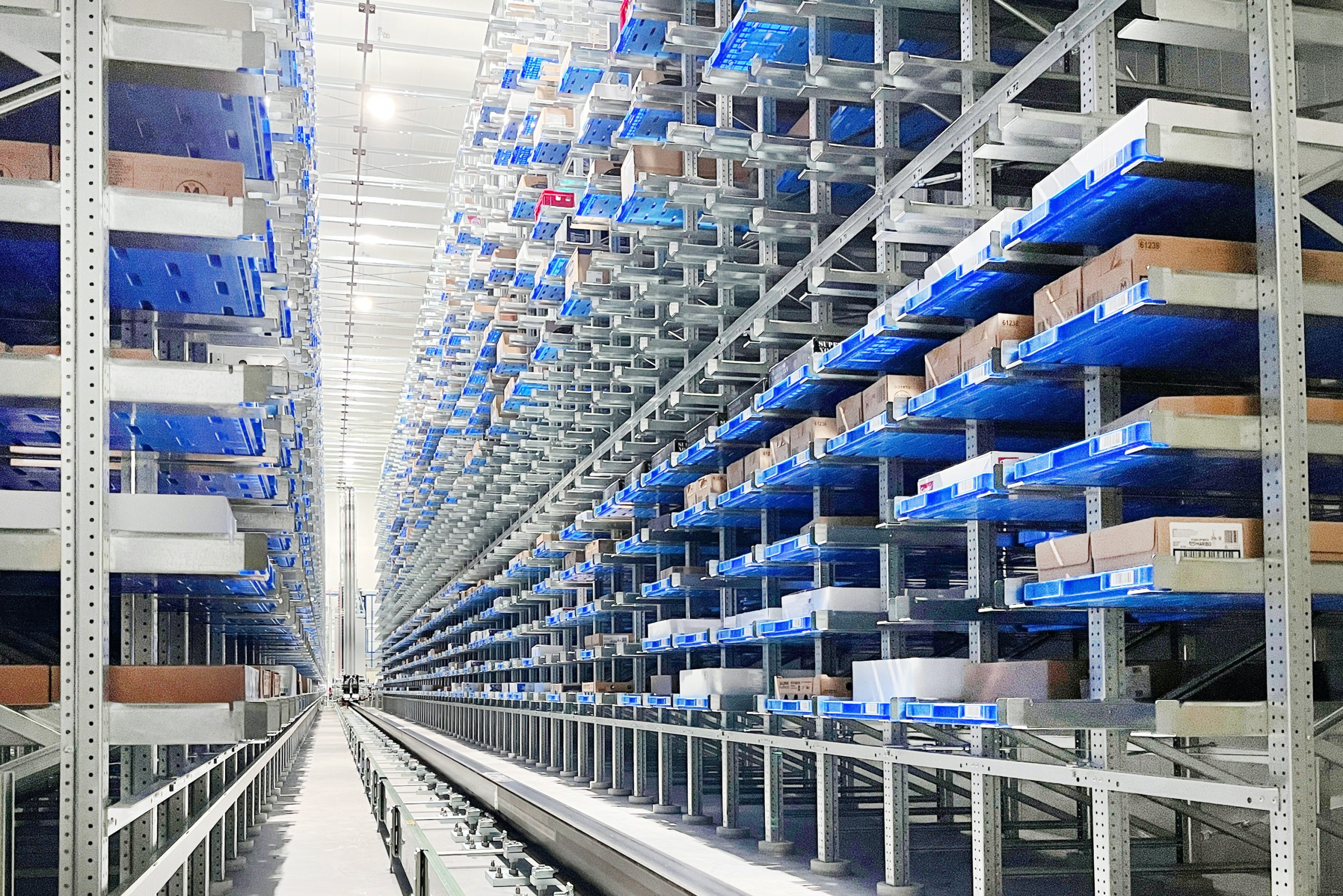
At the centre of the installation is an automated deep-freeze tray warehouse with 26,280 tray storage positions across five aisles. The tray concept is intended to improve space utilisation while supporting a range of carton sizes, and to keep handling consistent through the cold store. Trays are delivered directly to goods-to-person workstations at ergonomic height, reducing bending and lifting, and limiting the time operators spend in the deep-freeze area.
Process control features are designed around order integrity rather than brute-force capacity. An integrated sequence buffer is used to ensure orders are presented in the correct dispatch order, and to smooth internal flow so that picking and consolidation do not become an avoidable source of delay. Flexible tray systems are specified to accommodate different carton formats, helping the facility cope with a broader SKU mix without manual intervention.
The warehouse’s stacker cranes are described as incorporating camera technology for precise control, alongside measures intended to reduce electricity consumption, including energy recovery during braking. Positioning for the cranes is supported by Leuze’s FBPS 607i bar code positioning system, which Klinkhammer has been using for crane positioning since 2022. The system is specified with a redundant SSI interface and integrated heating for operation down to minus 30 degrees, and is connected directly to the drive’s frequency converter, with a stated reaction time of 10 milliseconds.
In addition to low-temperature performance, the positioning architecture is positioned as a simplification for safety-related requirements. The FBPS 607i is described as meeting stricter requirements associated with the new machinery directive approach, with the claim that a single FBPS can replace two separate devices previously needed to achieve the required performance level, reducing installation and integration effort.
The deep-freeze warehouse is also framed as one part of a wider site automation programme. In a second expansion phase, automatic shuttle warehouses for chilled and dry goods have been put into operation, with systems designed to combine orders automatically across temperature zones. For a food wholesaler balancing short delivery windows, SKU breadth, and cold-chain constraints, the operational value will be determined less by the height of the racking and more by how reliably those automated zones feed a single, consolidated dispatch flow.