IN Brief:
- Indonesia has more than 280 million people, and KION says annual demand for material handling equipment has exceeded 10,000 units since 2022.
- The Jakarta launch gives KION a direct platform for forklifts, warehouse automation, safety systems, and fleet management, while broadening dealer coverage.
- The move follows KION’s Vietnam entry and comes as the group pushes harder into automation-led growth across Asia-Pacific.
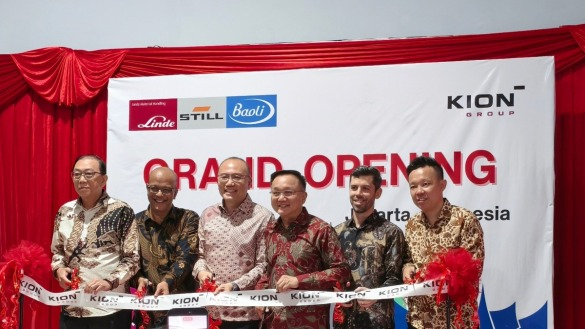
KION Group has expanded its Southeast Asian footprint with the launch of a new entity in Indonesia, giving the materials handling and warehouse automation supplier a direct base in Jakarta as demand rises in one of the region’s largest logistics markets. The move strengthens KION’s in-country presence at a point when warehouse capacity, distribution activity, and automation requirements are all moving up across the Indonesian market.
The attraction is straightforward. KION says Indonesia’s economy has grown by more than 5 percent annually for five consecutive years and that annual demand for material handling equipment has exceeded 10,000 units since 2022. Chingpong Quek, KION Group board member, chief technology officer, and president of KION ITS APAC, described the market plainly: “Indonesia presents significant opportunities for growth.”
This is not a first entry so much as a deeper one. Through Linde Material Handling, KION says it has operated in Indonesia for 30 years and delivered more than 4,000 units into the market. What changes with the Jakarta entity is the degree of direct control over local sales, application support, dealer development, and service execution, which matters in a market where customers are increasingly buying systems rather than standalone trucks.
KION used the opening to widen its dealer network and to showcase a broader offer that goes beyond counterbalance and warehouse trucks. Product workshops and live demonstrations at the launch included safety technologies and fleet management tools, underlining how the company is trying to position its Indonesian operation around connected warehouse performance rather than equipment supply alone.
That fits the group’s wider direction. KION’s 2025 results, published in late February, showed group order intake rising to €11.705 billion, with Industrial Trucks & Services order intake up 4.9 percent and Supply Chain Solutions order intake up 39.5 percent year on year. E-commerce-driven project business and service activity were both important contributors, suggesting that the company’s growth case is increasingly tied to integrated automation and service platforms rather than volume truck sales alone.
Indonesia is a logical place to test that mix. The market offers scale, a growing distribution base, and a logistics sector that is modernising fast enough to support warehouse software, fleet management, and automation investment alongside more traditional lift truck demand. Quek also said the new operation reflects KION’s long-term commitment to the Indonesian market, a line that carries more weight when a supplier is adding direct presence rather than relying solely on channel reach.
For KION, the Indonesian launch is another step in turning Southeast Asia from a regional opportunity into a built-out operating footprint. For local warehouse operators, distributors, and manufacturers, it should mean faster access to equipment, service, and systems support in a market that is getting less forgiving of delivery lag and manual inefficiency.