IN Brief:
- High-throughput intralogistics systems are moving toward zoned, software-defined safety rather than fixed relay architectures.
- Metalprogetti’s Trident uses dual Mosaic M1 controllers, remote I/O, and PROFINET-linked diagnostics to manage selective and global stops.
- As automated storage systems become denser and more modular, programmable safety is becoming part of uptime and commissioning strategy.
IN Brief:
- High-throughput intralogistics systems are moving toward zoned, software-defined safety rather than fixed relay architectures.
- Metalprogetti’s Trident uses dual Mosaic M1 controllers, remote I/O, and PROFINET-linked diagnostics to manage selective and global stops.
- As automated storage systems become denser and more modular, programmable safety is becoming part of uptime and commissioning strategy.
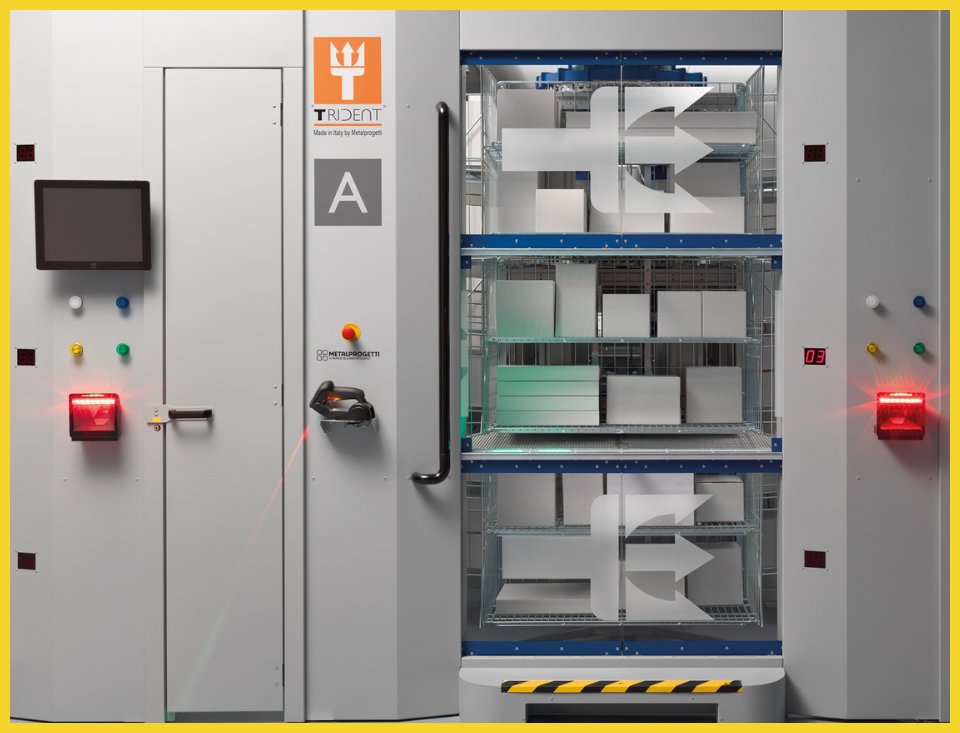
ReeR Safety is at the centre of a safety architecture now being used by Italian OEM Metalprogetti in its Trident multi-level warehouse system, a horizontal carousel platform designed for simultaneous picking and replenishment in compact automated storage environments. The project shows how safety logic is shifting from a compliance layer into an operational control layer, particularly in machines where dense layouts and continuous motion make blunt emergency-stop logic too disruptive.
That problem is especially pronounced in Trident’s stacked configuration, where multiple levels operate independently and personnel may need access to one part of the machine without halting the rest of the installation. Transparent sliding doors are monitored so that only the carousel being accessed is stopped, while metal access doors between modules can trigger a safe stop across a shared corridor. Perimeter safety ropes are used to detect falling products or positioning anomalies, and emergency-stop buttons remain in place for full system isolation when needed.
To manage that mix of local and global responses, Metalprogetti adopted the Mosaic platform rather than building around conventional safety relays. The architecture uses two Mosaic M1 controllers, each responsible for half of the machine, with safety signals collected via the MCT bus from remote interface boxes located above each workstation. MOR4 modules handle Safe Torque Off functions for the drives, while an MBEP module links the safety layer to the primary PLC over PROFINET, giving operators much more precise visibility into the origin of a stop or fault.
The operational gain is not simply tidier electrical design, although reduced cabinet space and less field wiring matter. It is that programmable safety makes the machine easier to commission, easier to diagnose, and easier to adapt when site layouts or customer requirements change. In high-density intralogistics, where operators are under pressure to increase throughput without adding complexity that cannot be maintained, safety architecture is increasingly bound up with uptime, serviceability, and the economics of scalable automation.
For UK manufacturers looking to scale their automation, the Trident case study serves as a blueprint: when safety is programmable, the possibilities for efficiency are endless, and PLUS Automation is keen to discuss your application.