IN Brief:
- Körber is using NVIDIA Omniverse libraries to build physics-accurate digital twins for warehouses and logistics sites.
- The collaboration is aimed at layout testing, peak-demand modelling, breakdown simulation, and pre-deployment training for robotics.
- The move pushes warehouse planning further toward continuous simulation, where design, operations, and automation tuning increasingly sit in one workflow.
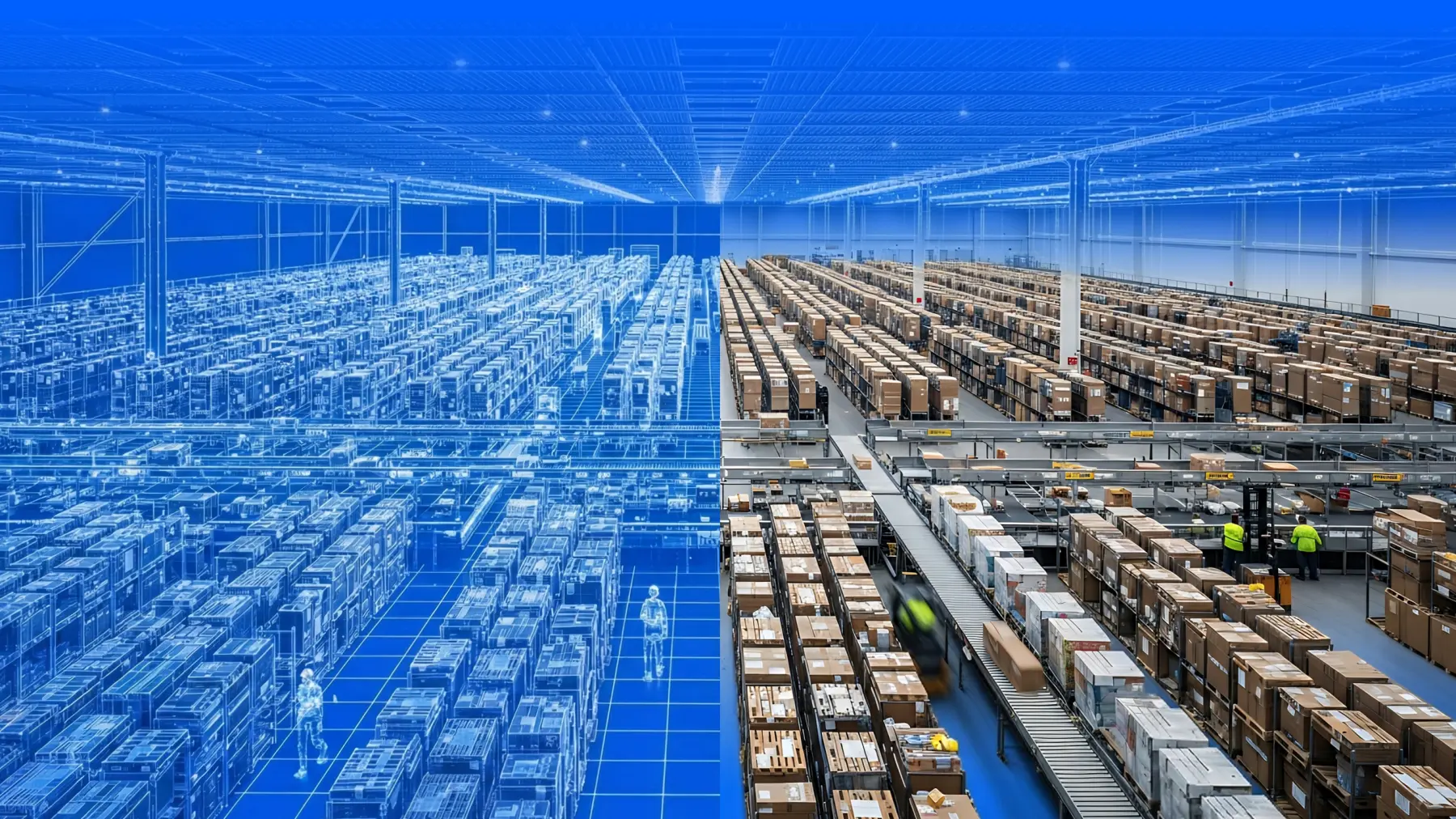
Körber is bringing NVIDIA’s AI and simulation stack into warehouse and logistics engineering, in a collaboration that moves digital twin technology closer to day-to-day operational decision-making. The company plans to use NVIDIA Omniverse libraries to create physics-accurate digital twins of warehouses and logistics facilities, giving operators a way to test changes virtually before committing capital and labour on site.
That takes warehouse modelling beyond the static visualisation that has often passed for a digital twin. In practice, the new workflow is aimed at simulating layout changes, testing peak-demand conditions, modelling breakdown scenarios, and refining the interaction between equipment, people, and robotics. Körber is also positioning the environment as a training ground for advanced robotic systems before they enter live warehouse or parcel hub operations.
The timing is significant. As operators layer warehouse execution software, parcel automation, autonomous vehicles, and machine vision into the same facility, the cost of getting design decisions wrong has risen sharply. A conveyor route, a pick face relocation, or a change to robotic orchestration can now ripple through throughput, labour planning, safety, and maintenance performance. Simulation is becoming less of a sales-room extra and more of an engineering requirement.
Körber’s advantage is that it is not approaching this as a pure software exercise. The company is feeding the models with operational data and experience drawn from warehouse, parcel, and sector-specific logistics environments across pharma, FMCG, food and beverage, courier and parcel, retail, and e-commerce. That should make the simulations more useful than generic 3D replicas, particularly where operators want to compare multiple automation scenarios before committing to a rollout.
The broader direction is clear enough: warehouses are starting to be designed, validated, and tuned in virtual form before equipment arrives on the floor. If Körber can connect simulation closely enough to real operational data, the result will be shorter design cycles, lower commissioning risk, and a more credible route to scaling automation without treating every site as a one-off experiment.