IN Brief:
- Advance Lifts is highlighting three PALLET PRO configurations aimed at warehouses and industrial sites with different power, hygiene, and positioning requirements.
- Shared design elements include a rotating turntable, protected mechanisms, and fork-truck pickup points for easier relocation inside facilities.
- The split between pneumatic, mechanical, and electric-hydraulic formats reflects continued demand for ergonomic pallet handling without committing every application to the same control architecture.
Advance Lifts is putting renewed emphasis on its PALLET PRO range of self-leveling palletizers, offering pneumatic, mechanical, and electric/hydraulic variants for facilities trying to reduce strain in pallet loading and unloading without overcomplicating installation.
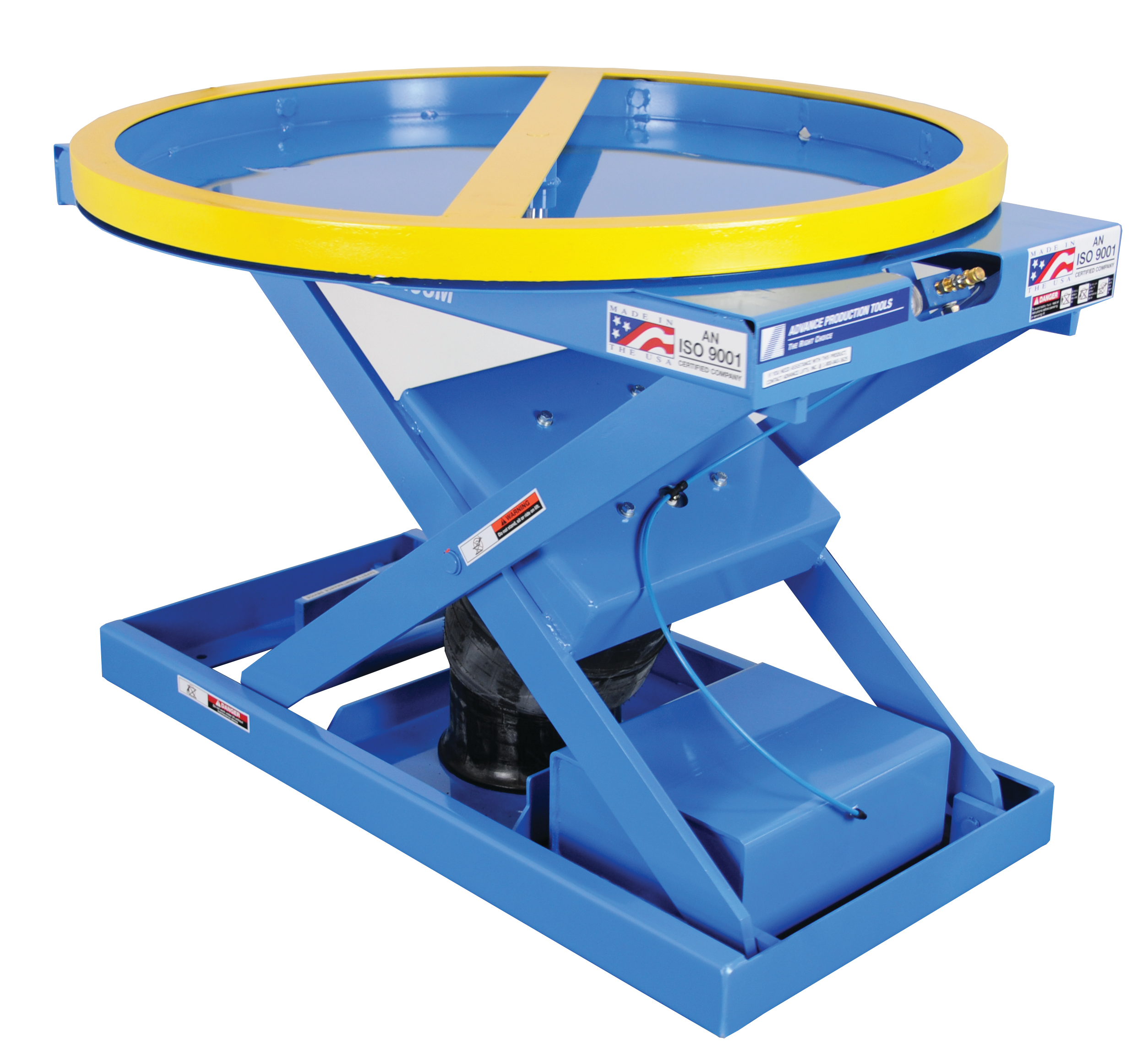
The common design across the range is practical. The units use a finger-protected rotating turntable to give operators 360-degree access to a pallet, while a solid platform below the turntable protects the lifting mechanism. Built-in fork-truck pickup points are another notable detail, allowing the equipment to be moved around a site without full disassembly when work cells, packing lines, or dispatch areas are reconfigured.
The pneumatic version is aimed at sites that want automatic height adjustment without electrical lines or control wiring. Advance Lifts specifies a Firestone air spring, plus a pressure gauge and air bleeder for setting working height, making the model suited to hygiene-sensitive environments and simpler packing stations. The mechanical version takes the power-free route further, using factory-installed powder-coated springs and a no-assembly format backed by a lifetime structural warranty.
Where more precise positioning is needed, the electric/hydraulic models are set up differently. Advance Lifts says those units plug into a standard 110V outlet, use UL-listed controller assemblies, and conform to applicable ANSI codes. The company also points to built-in platform centering devices and a choice of load capacities, giving the range a clearer role in applications where pallet height needs to be controlled more exactly over the course of a shift.
Warehouse ergonomics is often discussed as a labour issue, but in practice it is also an equipment-selection question. Operators want less bending, less twisting, and fewer awkward lifts, but they also want pallet handling kit that fits the reality of each site, whether that means a power-free station, a washdown-sensitive area, or a packing line that needs repeatable vertical control.