IN Brief:
- DeepWay has expanded its pre-IPO round to more than $310 million, one of the larger recent financings in autonomous heavy-duty trucking.
- The company is developing electric heavy trucks, driver-assistance systems, platooning capability, and freight operations technology.
- The raise points to continued investor appetite for commercial vehicle platforms that combine electrification with automation rather than treating them as separate bets.
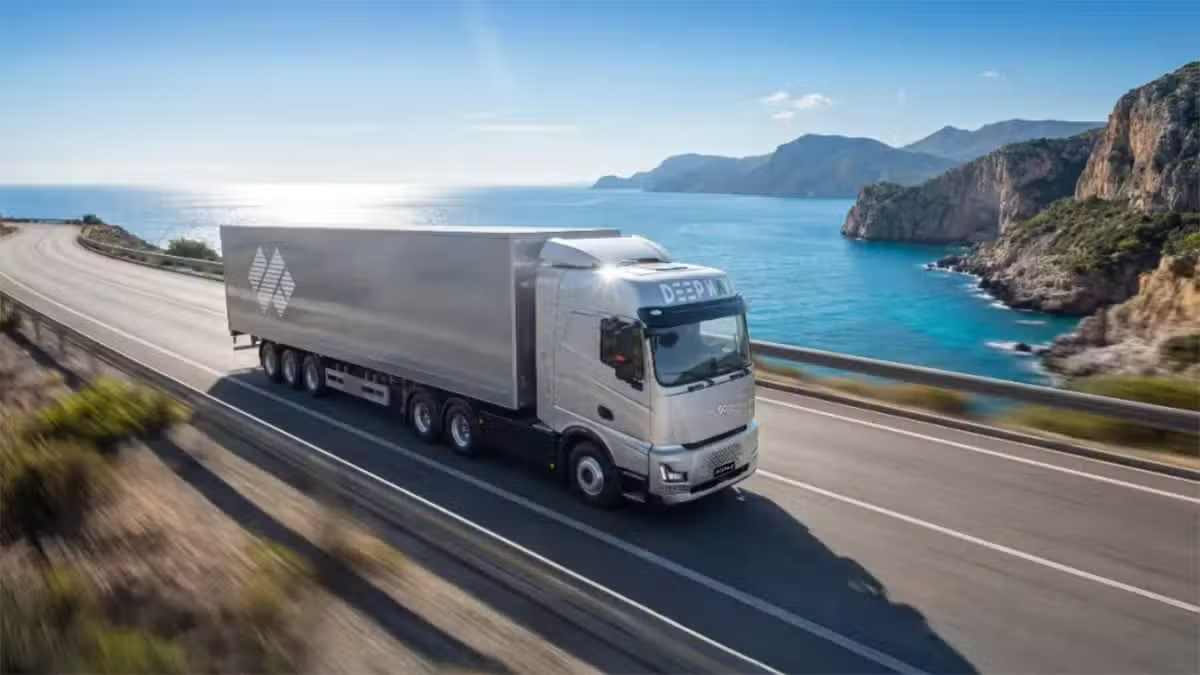
DeepWay has expanded its pre-IPO funding round to more than $310 million, giving the Chinese heavy-duty truck developer additional capital to accelerate autonomous driving development and wider commercial deployment. The company is building its business around a combined model of electric trucks, driver-assistance software, and freight operations technology.
The latest extension to the round adds further overseas backing and follows an earlier pre-IPO financing package completed before the new top-up. DeepWay said the funds will be used to advance autonomous driving research and support the commercialisation of unmanned freight robots in overseas markets. The company has been developing new-energy heavy trucks alongside advanced driver-assistance systems and platooning capability, with commercial deliveries already underway in China.
Heavy-duty road freight remains one of the more difficult transport segments to decarbonise. Payload, utilisation, route profile, and charging infrastructure all weigh more heavily on fleet economics than they do in lighter vehicle categories. Developers that focus on a cleaner powertrain alone still face operational questions around uptime, route suitability, and total cost of ownership. DeepWay’s model ties electrification to data, assisted driving, and remote operations, placing vehicle performance inside a wider freight system.
The financing round also reflects a more selective phase in the commercial vehicle market. Fleet operators are no longer short of pilots, prototypes, or technology demonstrations. Procurement decisions are being shaped by whether platforms can fit into real route structures, realistic charging strategies, and existing maintenance regimes. That has pushed developers toward more integrated offerings that combine hardware, software, telemetry, and service support.
Road freight continues to attract automation investment because routes are more structured, operating patterns are easier to model, and the value of savings in energy use, labour support, and asset utilisation is easier to measure than in less predictable transport environments. At the same time, the bar for deployment is rising. Reliability, safety validation, corridor support, and service coverage all matter more once a vehicle moves from test operation into day-to-day fleet use.
DeepWay’s enlarged round shows that capital is still flowing into freight-specific vehicle platforms, particularly those that treat electrification and automation as part of the same operating proposition. The next stage will be decided less by funding size than by repeatable deployment. Investors may be backing the category, but fleet confidence will rest on how well these trucks perform across real lanes, real duty cycles, and real infrastructure constraints.