IN Brief:
- Siemens and Humanoid have tested the HMND 01 Alpha in live logistics operations at Siemens’ Erlangen electronics factory.
- The robot achieved 60 tote moves an hour, more than eight hours of uptime, and pick-and-place success above 90%.
- The deployment focused on system integration and repeatable logistics tasks inside an operating factory environment.
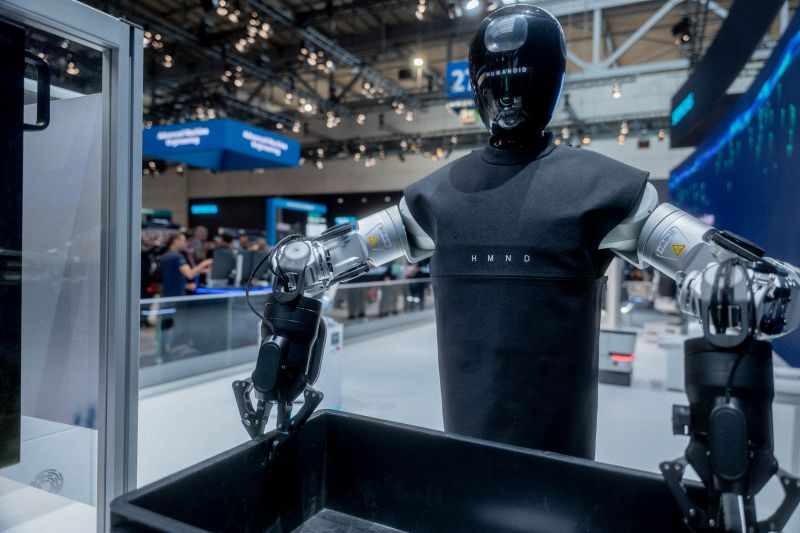
Siemens has tested a humanoid robot in live factory logistics at its electronics plant in Erlangen, Germany, adding a more practical example to the current wave of physical AI activity in industry. Working with robotics company Humanoid and NVIDIA’s physical AI stack, Siemens deployed the HMND 01 Alpha wheeled humanoid into tote-handling tasks involving picking, transporting, and placing containers for human operators within the plant’s logistics workflow.
The trial generated performance data that gives the deployment substance. Siemens says the robot met target metrics including 60 tote moves an hour, more than eight hours of uptime, and autonomous pick-and-place success rates above 90%. The work was linked into Siemens’ Xcelerator environment, intended to provide the industrial integration layer between robotics, factory systems, and operational workflows. Humanoid used NVIDIA tools including Jetson Thor, Isaac Sim, and Isaac Lab to shorten development cycles and train the system before deployment.
The Erlangen trial sits in a crowded automation landscape where warehouses and factories already use AMRs, AGVs, shuttle systems, and fixed robotics. A humanoid only becomes useful when it can slot into existing processes without forcing an operator into major layout changes or excessive engineering overhead. Siemens is clearly positioning the HMND 01 in that space: a mobile manipulator able to operate within a current factory setting and handle repetitive internal logistics work that still relies heavily on manual intervention.
The robot’s wheeled design is an important part of that approach. In structured industrial environments, wheels offer predictable motion, greater stability, and lower energy demand across flat surfaces. That suits logistics tasks where reliability and repeatability matter more than theatrical mobility. Throughput, placement accuracy, uptime, maintenance, and safe interaction with people and equipment remain the real measures of performance in this sort of deployment.
The industrial case for this type of machine rests on flexibility. Fixed automation works well where tasks are highly stable and volume justifies tailored engineering. The gap appears in mixed environments where workflows change, footprints are constrained, and operators want a higher degree of automation without rebuilding the site around it. A general-purpose robot that can move between pick, carry, and place tasks begins to address that middle ground if the economics hold up.
That remains the central test. A strong trial does not settle questions around supervision, service intervals, exception handling, or total deployment cost. Those factors will decide whether physical AI in logistics becomes a niche capability or a broader tool inside industrial sites. Even so, the Erlangen deployment gives the discussion firmer ground. It shows a humanoid system performing routine factory logistics inside a live operation, with metrics attached and systems integration in place.
That is a more useful benchmark than another concept video. As factories and logistics sites look for automation that can adapt more easily to changing workflows, trials like this will shape where general-purpose robotics fits into the stack.