IN Brief:
- Tosca and Cabka have launched the CP 1208, a 1200 x 800mm Euro-standard circular pallet.
- The pallet is made from recycled plastic and designed for reuse, repairability, and recyclability.
- Automation compatibility, hygiene performance, and packaging regulation alignment are central to the product’s logistics case.
Tosca and Cabka have launched the CP 1208 circular pallet, a 1200 x 800mm Euro-standard pallet designed for automated FMCG, retail, and food supply chains.
The pallet has been developed to integrate with standard Euro-size pallet handling equipment and is compatible with Tosca’s reusable plastic crates. It includes rounded skid edges, deck grooves to help secure crates without additional strapping, and optional RFID integration for traceability and asset management.
The CP 1208 is made from 100% recycled plastic and has been designed for reuse, repairability, and recyclability. It is non-porous, splinter-free, and easy to clean, with drainage holes intended to support hygiene-sensitive applications. The companies have positioned the product as an alternative to one-way packaging and conventional wooden pallets, particularly in operations preparing for stricter packaging and waste rules.
The pallet is around 4kg lighter than a comparable wooden pallet, reducing handling weight in high-volume operations. Its modular repairability allows damaged parts to be replaced rather than scrapping the full pallet, extending asset life within pooling and closed-loop logistics models.
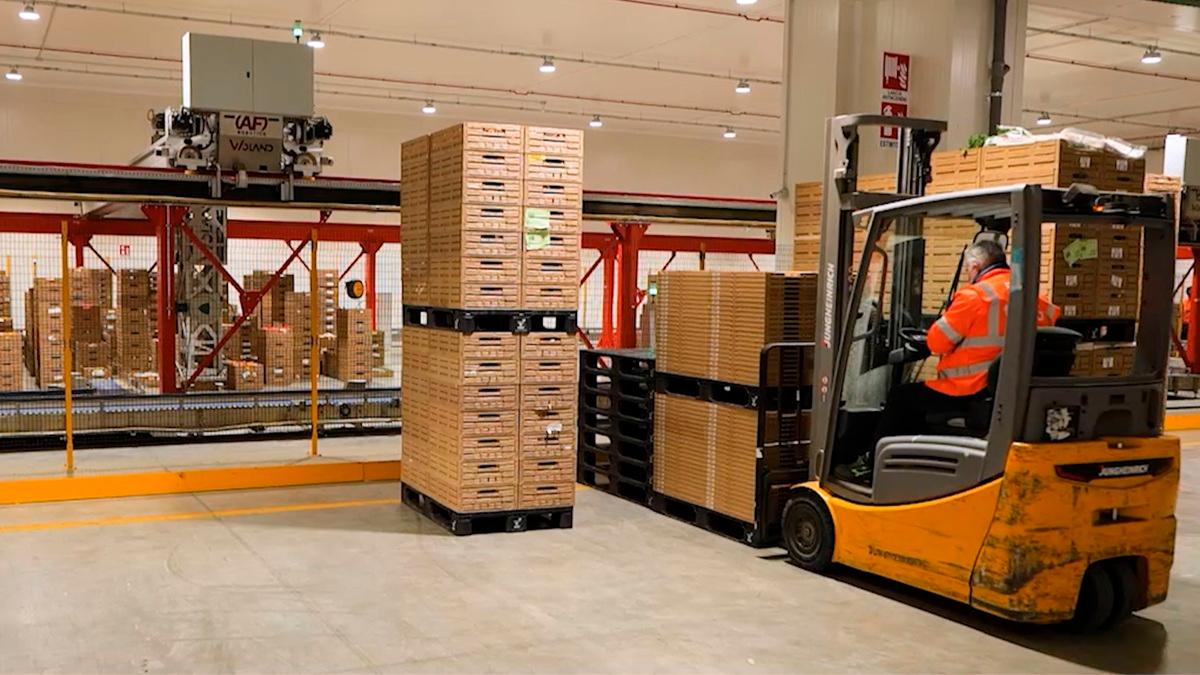
Pallet specification is becoming more closely linked to warehouse performance. In automated environments, pallets interact with conveyors, automated storage and retrieval systems, palletisers, robotic cells, warehouse management systems, and scanning infrastructure. Dimensional inconsistency, broken boards, contamination, or poor deck condition can cause stoppages, misreads, product damage, and safety risks.
Plastic reusable pallets have gained ground where hygiene, strength, and consistency outweigh the higher upfront cost. Food, FMCG, and retail networks often run at volumes where repeat use and asset pooling can support the economics, particularly when products move through standardised crate and pallet systems.
European packaging policy is adding further pressure to reduce waste and increase reuse. Pallets that can be repaired, tracked, cleaned, and recycled fit more naturally with circular transport packaging models than one-way formats. Asset recovery, loss rates, and cleaning cycles still need tight control, but reusable systems give operators a clearer route to lower waste in closed or semi-closed networks.
The CP 1208 also sits in a market where sustainability and automation are converging. A pallet with strong circular credentials still has to perform reliably in high-throughput automated systems. An automation-ready pallet that cannot support reuse and waste reduction will face increasing scrutiny as packaging regulation tightens.
Transport packaging has traditionally been treated as a low-interest operating cost. In automated and regulated supply chains, it has become part of the production system. The CP 1208 reflects that shift, combining equipment compatibility, hygiene, data capture, and circularity in a single handling platform.