IN Brief:
- DHL Supply Chain is planning a 194,000ft² automated healthcare logistics hub at Infinity Park Derby.
- The multi-user, multi-temperature site will support pharmaceuticals, medical devices, consumer health, and animal health.
- Planned features include pallet shuttle systems, future AMR capability, solar generation, EV charging, and BREEAM Excellent design.
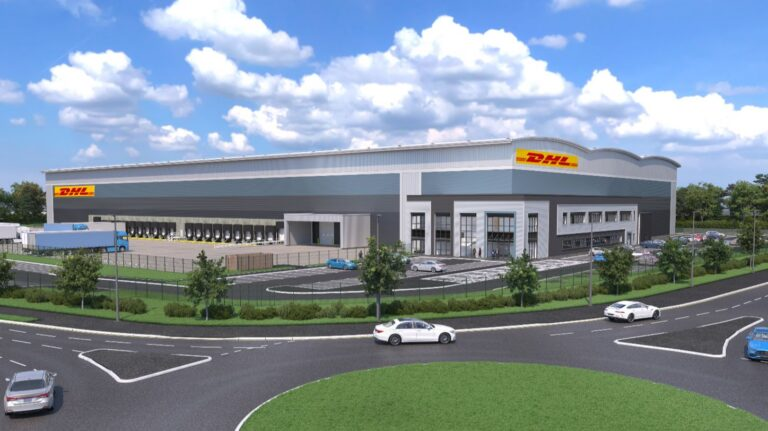
DHL Supply Chain is planning a 194,000ft² healthcare logistics hub at Infinity Park Derby, adding automated, multi-temperature capacity for life sciences and healthcare supply chains in the UK.
The proposed facility will support consumer health, pharmaceuticals, medical devices, and animal health operations. Designed as a multi-user hub, it will combine temperature-controlled storage, high-density automation, and sustainability features intended to reduce operating energy demand.
Planned automation includes pallet shuttle systems, with scope for autonomous mobile robot capability in future. The building is also targeting BREEAM Excellent and EPC A credentials, supported by solar generation, electric vehicle charging, and energy-efficient building systems.
Healthcare logistics requires a different design discipline from general warehousing, because storage density, temperature control, traceability, security, and validated handling processes all have to operate together. Product integrity depends on the building, the systems, the people, and the internal movement of stock being aligned from the start.
Derby strengthens DHL’s access to a major logistics region with motorway, air cargo, manufacturing, and healthcare distribution links. The East Midlands has become one of the UK’s most important warehouse and fulfilment corridors, but the strongest demand is increasingly for specialist facilities rather than basic storage capacity.
DHL’s Derby footprint is already expanding through a recommissioned shared-user ecommerce hub with George at Asda, which includes AutoStore and pocket sorter automation. The healthcare project follows a different compliance model, but it points to the same estate strategy: automated shared-user facilities designed around specific product and service requirements.
Life sciences distribution has become more demanding as product ranges diversify. Pharmaceuticals, diagnostics, medical devices, consumer health products, and animal health items each bring different handling profiles, and customers increasingly want facilities that can support multiple controlled environments without fragmenting inventory across several locations.
Multi-temperature capability is central to that requirement. Ambient, chilled, and specialist healthcare flows often need to move through the same network, but they cannot be managed casually within the same physical space. Segregation, temperature monitoring, cleaning regimes, access control, and validated transfer processes have to be built into the operating model.
Automation has a broader role than labour reduction in that environment. Pallet shuttle systems can improve storage density and consistency, reduce unnecessary touches, and support better inventory control. Future AMR deployment could extend automation into replenishment, internal transport, and goods-to-person workflows, provided it is integrated with quality and compliance controls.
Sustainability measures are also moving closer to procurement decisions in healthcare logistics. Temperature-controlled warehousing can be energy intensive, while customers face growing pressure to reduce emissions across distribution and storage. Solar generation, EV charging, efficient systems, and high building-performance ratings strengthen the commercial case only if they preserve the environmental conditions required by regulated products.
The Derby hub reflects a broader move towards infrastructure-led healthcare logistics. Capacity is still necessary, but the market is rewarding facilities that combine compliance, automation, energy performance, and operational flexibility. In regulated supply chains, the warehouse is no longer a passive holding point. It is part of the product-control system.