IN Brief:
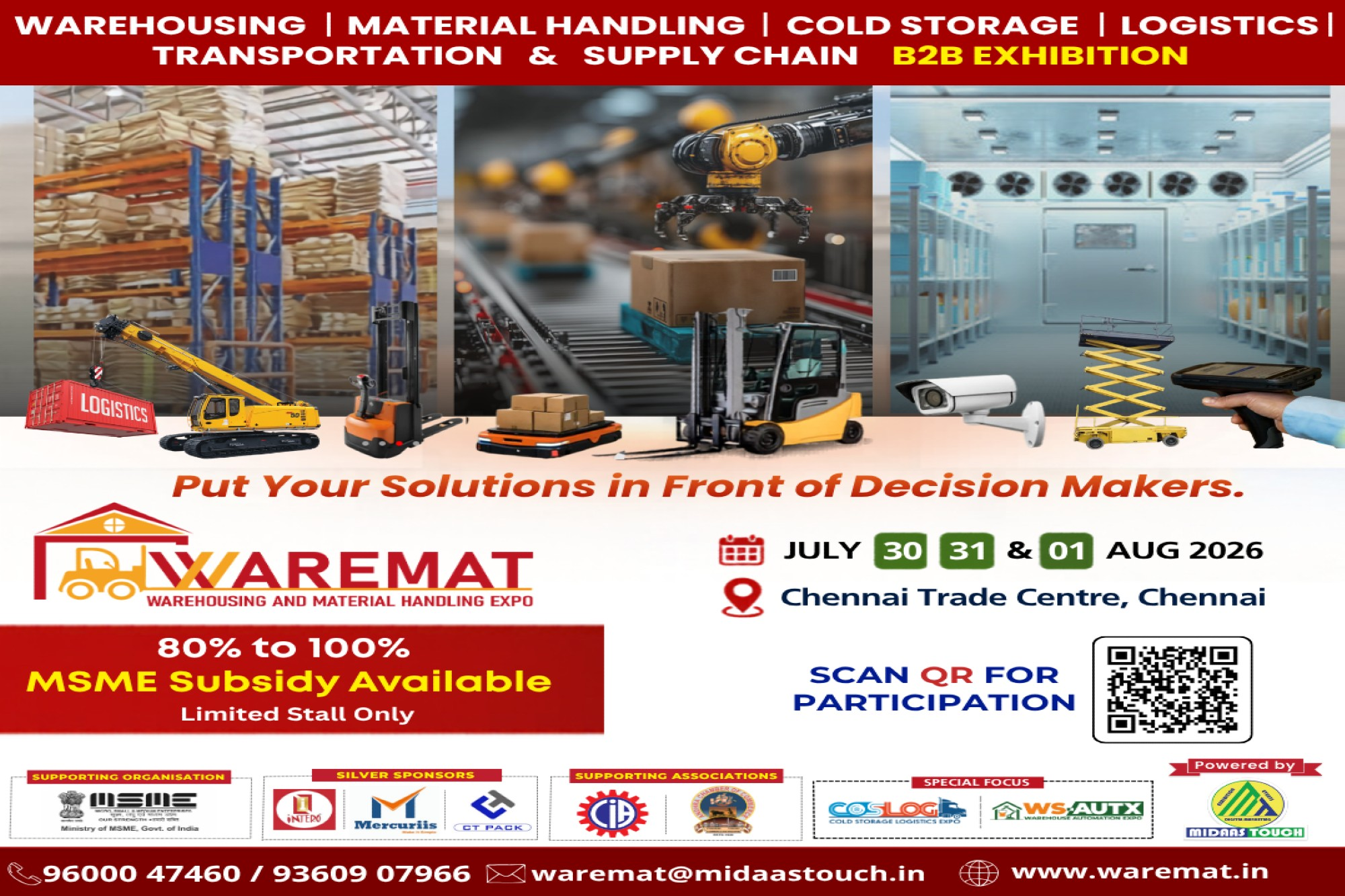
- WAREMAT 2026 will run at Chennai Trade Centre from 30 July to 1 August.
- The show will cover warehousing, material handling, automation, robotics, storage, cold chain, RFID, and transport systems.
- India’s logistics market is moving toward more integrated, higher-throughput, technology-enabled warehouse operations.
WAREMAT will return to Chennai this summer with warehousing, material handling, automation, robotics, cold-chain systems, transport equipment, storage, RFID, AIDC, and supply chain technology forming the centre of its 2026 exhibition.
The seventh edition is scheduled for 30 July to 1 August at Chennai Trade Centre, with a further edition due in Hyderabad later in the year. The event will include product launches, live demonstrations, seminars, and supplier showcases across intralogistics, handling equipment, warehouse design, packaging, cold storage, and digital systems.
The Chennai edition gains extra breadth through co-located events covering cold-chain logistics and warehouse automation. That combination is well matched to the direction of India’s logistics market, where capacity growth is now being joined by demand for higher throughput, better temperature control, stronger visibility, and more efficient movement through the building.
Warehousing in India is no longer a simple real estate story. Organised retail, food processing, pharmaceuticals, automotive, e-commerce, electronics, and export-led manufacturing are increasing the need for facilities that can handle SKU complexity, faster order cycles, product segregation, compliance requirements, and tighter delivery windows. Storage density remains important, but operators are increasingly specifying racking, conveyors, forklifts, dock systems, WMS, labelling, automation, energy systems, and fire protection as connected parts of one operating environment.
The strongest automation demand is likely to remain practical rather than spectacular. Many operators are not ready for fully automated warehouses, but they are prepared to invest in mechanisation where it reduces travel time, improves picking accuracy, cuts manual handling risk, or protects labour availability. Pallet movement, sortation, goods-to-person workflows, cold-room handling, packing, and inventory control are more immediate targets than showcase robotics.
The same pattern is visible in mature European markets, where automation investment is being tied more closely to labour planning, network design, and building specification. Amazon’s European robotics programme, set out through its €10bn fulfilment automation investment, shows the scale of the shift at the top of the market. At the property and fit-out level, the move from sheds to systems has already changed how developers and operators think about power, sprinklers, automation readiness, and future expansion.
India’s next phase will not be identical, but the direction is similar. Warehouse users are asking buildings to support more process complexity, while logistics providers are trying to increase productivity without losing the flexibility needed for multi-customer or regional operations. Retrofittable systems, modular automation, scalable racking, and equipment that can work in existing buildings are likely to draw strong interest.
Cold chain adds another layer to the exhibition’s relevance. Food, dairy, meat, frozen products, vaccines, and pharmaceutical goods require tighter temperature assurance, traceability, and handling discipline. In cold storage, every additional touchpoint, poor dock process, or manual delay can raise product risk and energy cost. Linking refrigeration, racking, door systems, monitoring, and materials handling is becoming central to both quality and operating economics.
The supplier opportunity is therefore broad but not simple. India’s warehouse base includes advanced national 3PL networks, industrial distribution centres, regional warehouses, and operators still moving away from basic storage formats. Technology providers will need to demonstrate not only equipment capability, but maintenance support, training, integration, energy performance, and payback inside Indian operating conditions.
WAREMAT’s value will be measured by how well the show reflects that practical buying environment. Buyers need to compare systems that can improve productivity without imposing unrealistic complexity. Equipment that can reduce damage, manage labour constraints, support cold-chain compliance, and integrate with warehouse software will sit closer to immediate procurement than full-scale automation presented without a clear operating case.
The Chennai event arrives as warehousing shifts from square footage to performance. The competitive edge is moving inside the building, where handling, automation, energy, software, and workforce design determine how quickly and reliably goods move. WAREMAT 2026 gives that transition a concentrated stage in one of India’s most important industrial logistics regions.