IN Brief:
- Padrock has submitted plans for a £120m, 245,000ft² urban MLI and logistics development in Elstree.
- The proposed 17-acre brownfield scheme includes 13 units ranging from 10,500ft² to 130,000ft².
- The development targets BREEAM Outstanding, EPC A+, and practical completion in late 2027.
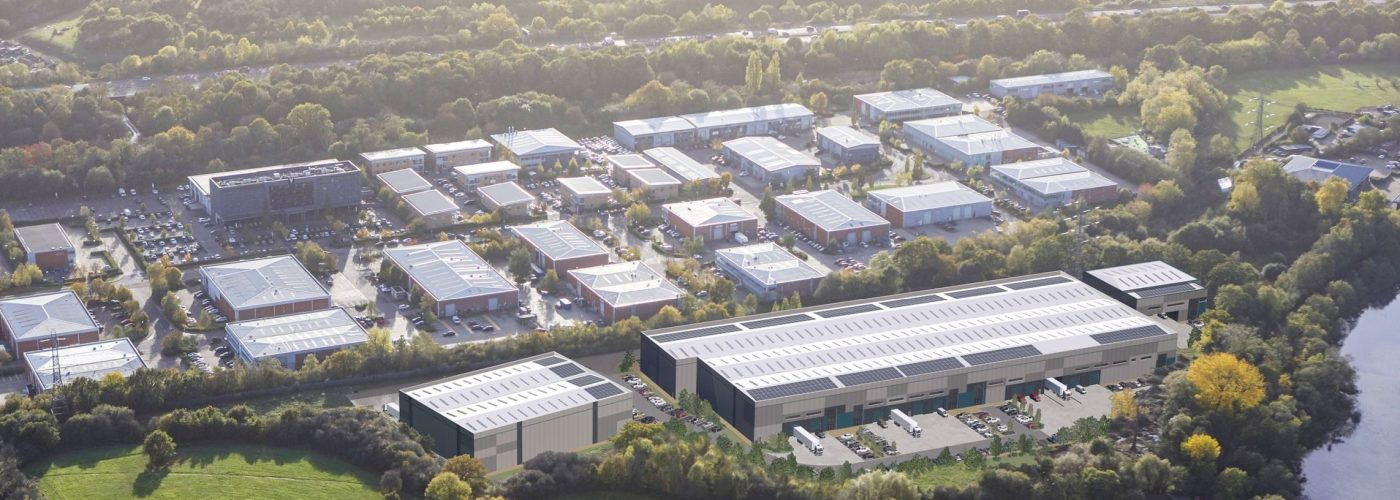
Padrock has submitted plans for a £120m, 245,000ft² Grade A urban multi-let industrial and logistics development in Elstree, Hertfordshire.
The proposed scheme would be built speculatively on a 17-acre brownfield site acquired by Padrock in March. It sits next to the established Centennial Park business estate, adjacent to the A1, around three miles from the M1, and six miles from the M25. The plans include 13 units ranging from 10,500ft² to 130,000ft².
All units have been designed to target BREEAM Outstanding and EPC A+ ratings, with alignment to EU Taxonomy objectives. Subject to planning approval, construction is expected to start in autumn 2026, with practical completion scheduled for late 2027.
The scheme would add modern industrial and logistics space in a South East market where well-located, energy-efficient capacity remains difficult to secure. London and its surrounding counties continue to generate demand from urban distribution operators, trade suppliers, service businesses, light manufacturers, and last-mile networks that need to sit close to dense consumption and labour markets.
The unit mix gives the proposal more flexibility than a single big-box scheme. Larger units can support distribution, production-led logistics, or regional consolidation, while smaller buildings can accommodate trade counters, specialist suppliers, local fulfilment operators, and businesses needing proximity to north London and Hertfordshire. Multi-let industrial estates have become more strategically useful as companies bring service, repair, stockholding, and local distribution closer to customers.
Brownfield development is commercially significant in this part of the market. Land supply near London is constrained, planning scrutiny is high, and existing stock often struggles to meet modern requirements around loading, yard depth, office quality, energy performance, and power. Reusing brownfield land can add capacity without forcing occupiers further away from the customers and workers their operations depend on.
The sustainability targets also affect the operating case. Buildings with stronger energy performance can reduce running costs, support occupier reporting, and improve resilience against future regulation or customer procurement requirements. Logistics property is now judged on power availability, roof specification, EV charging potential, lighting, heat systems, biodiversity, and the ability to support lower-emission fleet strategies.
The proposal follows the same market pressure visible in Eurocentral Gateway’s planning consent in Scotland, where high-specification logistics units were designed around transport access, sustainability, and occupier efficiency. Elstree sits in a different geography, but the development logic is similar: modern logistics buildings are being asked to solve network, energy, and workforce constraints at the same time.
Speculative development carries risk in a more selective property market. Occupiers remain active, but they are scrutinising rent, service charge, fit-out cost, power, transport connections, labour access, and sustainability credentials more closely than during the most overheated phase of warehouse demand. A strong location can still justify speculative delivery where competing stock is limited and older buildings cannot meet operational requirements.
The site’s road connectivity will be central to occupier interest. Access to the A1, M1, and M25 gives the scheme reach into London, the Midlands, and the wider national network. That supports same-day distribution, inbound supplier movement, regional servicing, and urban stockholding without placing operators deep inside more congested inner-city locations.
Planning will determine the next stage, with traffic, employment, environmental design, and local infrastructure likely to shape committee consideration. If approved, the Elstree project would give Padrock another major urban logistics asset and add flexible modern capacity in a region where demand has not disappeared, but has become far more exacting.