IN Brief:
- StrongPoint has secured a UK AutoStore warehouse automation contract worth about NOK 17m.
- The system will support an e-commerce retailer in tools, equipment, and DIY.
- The project adds storage density, picking efficiency, and scalable throughput to a high-SKU retail fulfilment environment.
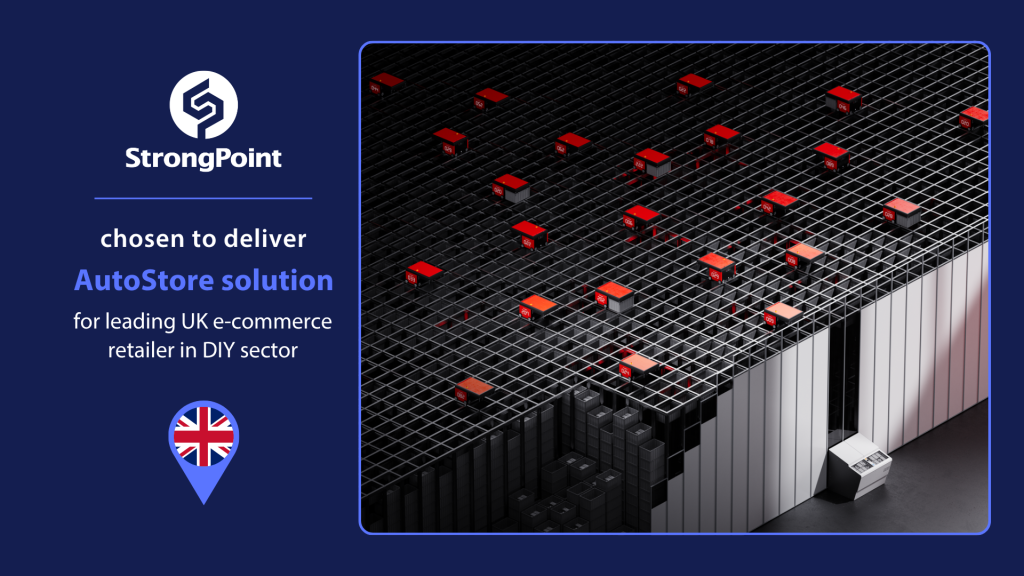
StrongPoint has been selected to design and install an AutoStore system for a UK e-commerce retailer operating in tools, equipment, and DIY, adding another warehouse automation project to Britain’s online fulfilment market.
The contract is valued at about NOK 17m and covers the design and installation of an automated storage and retrieval system. Installation is scheduled for completion next year, giving the retailer additional fulfilment capacity, improved storage density, and a more efficient order-processing base.
AutoStore systems use dense cube storage, robots, ports, and software to retrieve bins from a compact grid. The model is well suited to high-SKU environments where floor space is constrained, inventory accuracy is critical, and operators need to reduce the amount of manual walking built into picking processes.
Tools, equipment, and DIY retail can create awkward fulfilment demands because product ranges often combine accessories, consumables, replacement parts, components, and higher-value equipment. Automated cube storage is most effective where smaller and medium-sized items can be held densely without losing accessibility, allowing slower-moving stock to remain available without occupying expensive pick-face space.
The UK e-commerce market has moved beyond broad growth assumptions. Retailers now have to process complex orders economically while maintaining delivery speed, returns discipline, and stock accuracy. Labour availability, warehouse rents, energy costs, and customer expectations are forcing more operators to redesign fulfilment around storage density and process control.
StrongPoint’s project fits that redesign. Automated storage can reduce walking time, improve space utilisation, and support higher throughput without requiring the same level of warehouse footprint expansion. It also creates a stronger data layer around inventory location, pick performance, replenishment frequency, equipment utilisation, and bottleneck management.
Automation across parcel and fulfilment networks is also being used to impose more predictable flow on growing order volumes. SingPost’s automated parcel backbone shows the same principle at network level: reduce manual handling, consolidate movement, and build operating rhythm around data and equipment rather than labour-intensive workarounds.
Warehouse automation is often framed too narrowly around headcount reduction. In practice, many operators are trying to reduce variability. Peaks, product launches, seasonal demand, weather-driven purchasing, and promotional activity create order surges that manual processes struggle to absorb consistently. Automated storage gives operations teams a more stable base when it is combined with disciplined slotting, replenishment planning, maintenance routines, and warehouse management integration.
Property constraints strengthen the case. UK logistics space remains expensive in locations close to major demand centres, while planning, power availability, and fit-out costs can slow expansion. Higher storage density can defer the need for an additional site or allow existing facilities to process more orders within the same envelope.
Implementation still determines value. An automated system will only improve throughput if order profiles, inventory data, replenishment schedules, operator workflows, and maintenance planning are aligned before the system goes live. StrongPoint’s role as design and installation partner therefore sits close to the operational outcome, not just the technical handover.
The contract gives the retailer a route to more resilient e-commerce fulfilment and gives StrongPoint another UK automation reference in a market where retailers are being pushed to extract more performance from existing space. In high-SKU retail, the warehouse is increasingly becoming the point where customer promise, stock control, and automation strategy either converge or collide.