IN Brief:
- SingPost has opened a S$30m automated parcel sortation hub in Tampines.
- The hub raises small and medium parcel processing capacity from 100,000 to 300,000 parcels per day.
- The investment supports the islandwide rollout of SingPost@MyBlock by 30 September.
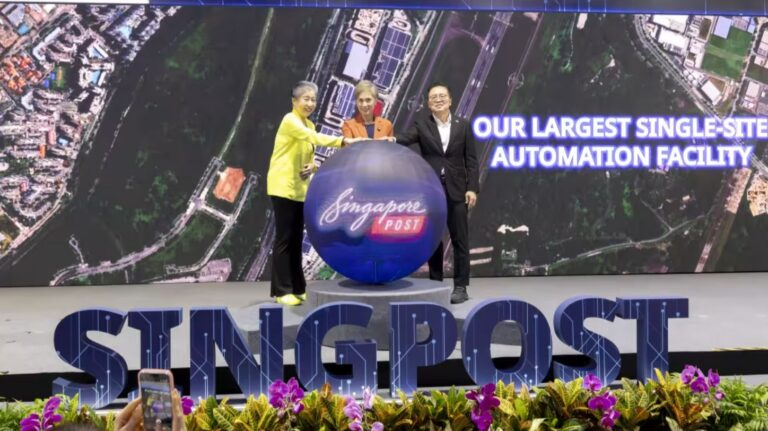
Singapore Post has opened a S$30m automated parcel sortation hub at its Regional eCommerce Logistics Hub in Tampines, lifting parcel capacity and reshaping its domestic processing model.
The new hub uses two automated systems: a 3D Sorter and an Intelligent Flexi Sorter. Together, they increase small and medium parcel processing capacity from 100,000 parcels per day to 300,000 parcels per day. When combined with existing large-parcel operations at the site, total daily throughput now stands at 400,000 parcels.
Before the consolidation, SingPost processed smaller parcels at SingPost Centre in Paya Lebar while larger items were handled at the Regional eCommerce Logistics Hub in Tampines. That dual-site arrangement required regular cross-island trucking, creating extra handling, additional vehicle movement, and more complexity inside the network.
The new sortation hub brings parcel processing into a single automated spine. Centralising the operation reduces internal transport, removes avoidable handovers, and gives SingPost a clearer operating model for parcel growth. In a compact market such as Singapore, even relatively short internal transfers can add cost and operational friction when they are repeated across high parcel volumes.
The automation investment also supports the islandwide rollout of SingPost@MyBlock, which allows residents to drop off letters and small packets at designated letterbox nests in HDB and residential blocks. Following trials, the service is scheduled to expand across Singapore in three phases by 30 September.
Parcel networks are moving in two directions at once. Processing is becoming more centralised and automated, while customer access points are being pushed closer to homes, workplaces, and neighbourhood infrastructure. SingPost’s model follows that pattern, using a high-throughput hub for sortation and a distributed drop-off network for first-mile convenience.
Postal operators across mature markets are trying to rebuild their economics around declining letter volumes and uneven parcel demand. Ecommerce has lifted parcel expectations, but it has also created cost pressure through residential delivery density, return flows, failed deliveries, and peak volatility. Automation offers a way to protect service levels while reducing the cost-to-serve of each parcel.
The same capacity argument is playing out across other layers of warehousing and intralogistics. Pallet-level automation has already moved into sharper focus through J-Elephant and Geek+’s push into brownfield pallet systems, while parcel operators are applying similar logic to sortation density, speed, and exception control. Whether the unit is a pallet, tote, parcel, or envelope, the constraint is increasingly the same: labour-heavy handling cannot keep pace with service expectations without better systems around it.
SingPost’s hub will also place more emphasis on maintenance, data quality, and exception handling. Automated sortation increases capacity, but it makes the performance of equipment, software, scanning accuracy, and operational discipline more central. A manual process can absorb some variation through labour, albeit at a cost. An automated process has to be designed to handle irregular items, damaged labels, mis-sorts, equipment downtime, and demand surges without creating a new bottleneck.
The cost improvement target is notable. SingPost has said the measures are expected to cut cost-to-serve by more than 10%, a figure that would be commercially significant in parcel networks where margins can be pressured by labour, fleet, premises, and delivery density. That saving will depend not only on sortation speed, but on the network simplification that comes from removing unnecessary inter-site movement.
By combining a larger automated hub with more convenient local drop-off points, SingPost is reworking the structure of parcel movement rather than simply adding equipment. The result is a denser, more controlled processing model suited to a market where land, labour, and vehicle movement are tightly constrained.