IN Brief:
- J-Elephant has received strategic investment from Geek+ to expand vertical pallet robot deployment.
- The partnership combines J-Elephant’s pallet automation technology with Geek+’s global sales, deployment, and service network.
- The agreement targets lower-infrastructure automation for brownfield warehouses in manufacturing, retail, pharma, food, and industrial logistics.
J-Elephant has received strategic investment from Geek+ as the companies move to widen global deployment of vertical pallet robot technology.
The agreement brings together J-Elephant’s VPR systems with Geek+’s international warehouse robotics network, adding a pallet-level automation layer to a market that has already seen rapid growth in mobile robots, goods-to-person systems, and fulfilment automation. J-Elephant will use Geek+’s sales, deployment, and service network to support overseas expansion, while Geek+ will fold the VPR technology into its own range of warehouse automation offerings.
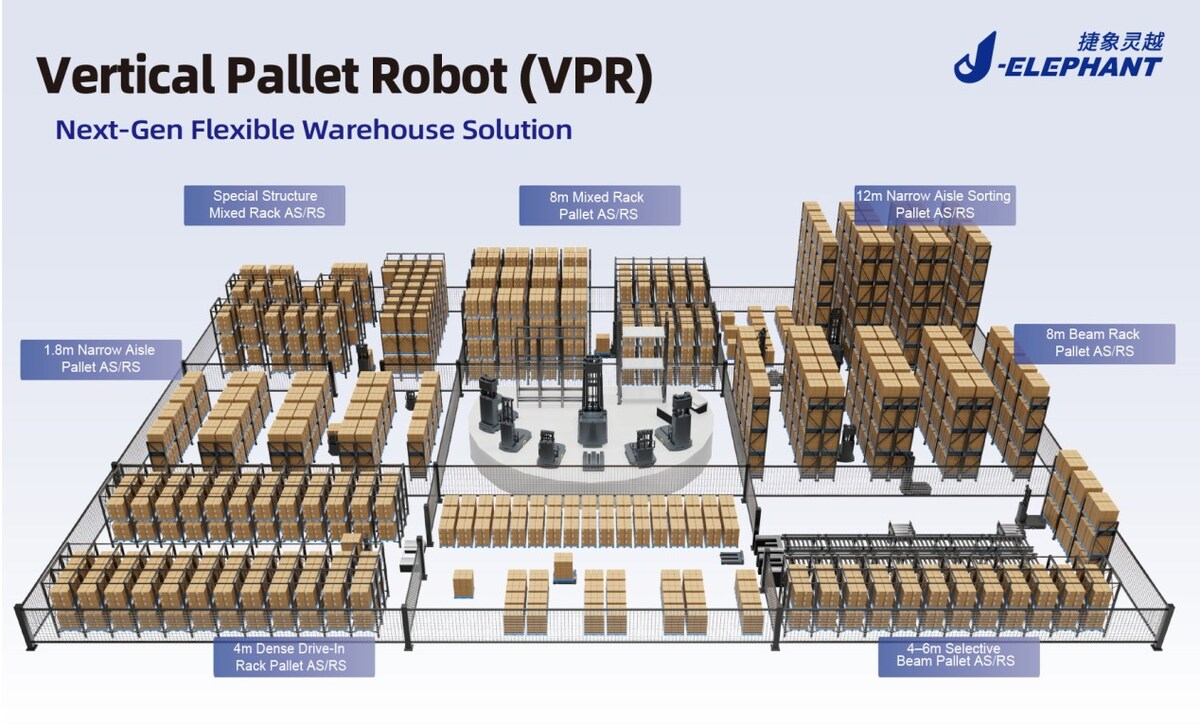
The technology is aimed at warehouses where pallet flows, dense storage, and building constraints have become difficult to reconcile. Traditional pallet AS/RS projects can require significant civil work, fixed infrastructure, and long implementation cycles. J-Elephant’s approach is built around lowering those barriers, particularly in existing facilities that cannot pause operations or justify a full high-bay rebuild.
Many warehouses still run pallet movement through manual forklift activity, conventional racking, and labour-heavy replenishment processes. Those models remain workable in stable environments, but they become exposed when space tightens, labour becomes harder to secure, and service levels rise. The operating question has shifted from whether pallet automation is technically feasible to whether it can be installed without overwhelming the building, the budget, or the workforce.
J-Elephant’s VPR system is designed for brownfield conditions, including narrow aisles, pallet-level storage, and layouts where conventional automation would require heavy adaptation. The investment gives the company a route into international projects through Geek+’s commercial and service infrastructure, reducing one of the usual barriers faced by specialist automation businesses: scaling from a strong technology proposition into repeatable global deployment.
The agreement also extends Geek+ into a heavier part of warehouse operations. Mobile robots and tote-based automation have already gained ground in ecommerce, retail, third-party logistics, and component fulfilment, but pallet movement has been slower to automate at scale in existing buildings. Loads are heavier, safety requirements are higher, and the operational disruption created by poor integration is greater.
That heavier end of automation is becoming harder to avoid. Warehouses are being asked to support higher SKU counts, faster replenishment cycles, more mixed pallets, and tighter delivery windows. At the same time, property availability remains constrained in many mature logistics markets. Adding more floorspace is often slower and more expensive than improving the use of the space already under lease.
Recent warehouse automation investments have increasingly centred on retrofit practicality. India’s widening automation race has brought robotics, cold chain, intralogistics, and materials handling into one capital investment conversation, while European retailers and industrial distributors have been looking more closely at systems that can work inside existing operational estates. The common thread is not novelty, but deployability.
Software integration will carry much of the burden. Pallet robots have to work with warehouse management systems, inventory rules, inbound scheduling, replenishment logic, safety controls, and transport cut-offs. Warehouse management systems are increasingly being placed at the centre of robotics projects because automation that cannot read demand, stock, and labour constraints in real time simply moves the bottleneck elsewhere.
Labour planning is also changing. Pallet automation does not remove the need for skilled warehouse staff; it changes where those skills are needed. Travel, repetitive transport, and high-risk handling can be reduced, while maintenance, exception management, supervision, quality control, and system support become more prominent. That shift is easier to manage when automation is introduced around the current operation rather than imposed as a complete site reset.
The partnership will now be judged by whether the technology can deliver consistently across varied facilities. Brownfield warehouses differ in floor quality, racking configuration, fire strategy, traffic flow, power provision, and operational discipline. A system that works only in carefully selected conditions will remain niche. A system that can be adapted repeatedly across imperfect buildings will have a much broader market.
For Geek+, the investment strengthens a portfolio that already speaks to automation-led fulfilment. For J-Elephant, it provides commercial reach and deployment support at a point when pallet automation is moving from specialist engineering project to mainstream warehouse consideration. The pressure on space, labour, and service levels is unlikely to ease, and pallet handling is one of the places where those pressures are most visible.