IN Brief:
- Arvato’s Hamm distribution centre processes up to 5,500 orders per hour for Douglas Group.
- KNAPP technology includes 550 shuttle robots, 132,000 storage locations, goods-to-person picking, and sortation.
- The project brings storage density, labour efficiency, packaging reduction, and omnichannel retail fulfilment into one system.
Arvato is using automated systems and software from KNAPP at its Hamm distribution centre to process up to 5,500 orders per hour for Douglas Group, supporting online and store fulfilment across Germany, Austria, and Switzerland.
The facility brings six former warehouses into one central operation for cosmetics, perfumes, skincare, and hair care products. KNAPP’s technology sits across the flow of the building, covering shuttle storage, goods-to-person picking, pick-to-light workstations, sortation, carton handling, automatic document insertion, and warehouse software.
At the centre of the system is KNAPP’s Evo Shuttle storage and retrieval technology, with 550 shuttle robots serving 132,000 storage locations across 22 aisles and 25 levels. The shuttle system handles almost all of the site’s 70,000 SKUs, using double-deep storage to increase density while maintaining rapid product retrieval for same-day and next-day orders.
Goods-in has also been engineered around data capture rather than basic receipt. Twenty-eight decanting stations and KNAPP’s MultiScan system record product dimensions, weight, and fragility, sending information directly into the warehouse management environment. That product data then supports storage logic, picking, carton selection, and handling decisions downstream.
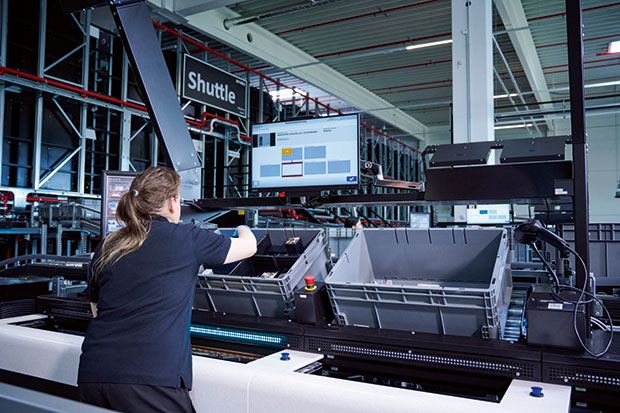
Order picking is handled through 32 Pick-it-Easy Evo goods-to-person workstations, allowing employees to work with two source containers and four order cartons at the same time. The facility also includes 36 pick-to-light stations, automatic carton erectors, three cross-belt sorters, automatic document-insertion machines, and intelligent conveyor systems.
Retail automation has been moving steadily away from single-channel e-commerce projects toward more complicated omnichannel environments, where store replenishment, consumer orders, promotions, samples, returns, and peak events interact inside the same network. A similar dynamic is visible in TD SYNNEX’s automated brownfield operation in Aalst, where shuttle storage, goods-to-person picking, packing, and sortation were integrated into an existing Belgian distribution environment. Hamm differs in product profile and scale, but the operational problem is familiar: volume is only one part of the automation challenge.
Beauty fulfilment is particularly demanding because the order profile is varied and product characteristics are awkward. Many items are small, fragile, lightweight, high value, or promotion-led. Retailers must handle large SKU counts while still protecting service levels during launches, seasonal peaks, and campaign activity. The warehouse has to be dense enough to control space, fast enough to meet delivery promises, and flexible enough to support changing product assortments.
Right-sized packaging gives the project a further operational layer. The Hamm facility uses nine carton sizes for business-to-consumer orders, with automated carton closing reducing carton height to limit empty space. In a cosmetics operation, where many items are light and small, reducing shipping air can improve vehicle fill, cut packaging waste, and lower the cost of moving parcels that would otherwise cube out before they weigh out.
The software layer is central to how that complexity is managed. KNAPP’s KiSoft platform regulates workload and coordinates interaction between automated and manual areas, while KiSoft Analytics monitors system data and trends. Without that orchestration, dense automation can simply move bottlenecks from the aisle to the workstation, sorter, or packing area.
Labour planning changes as the system takes shape. Goods-to-person automation reduces walking and manual travel, but it also increases reliance on workstation design, maintenance, exception handling, and data quality. Operators remain central to performance, although their work moves toward system-guided activity rather than long pick routes and manual search.
The Hamm project shows how modern retail fulfilment is becoming an engineered system of inventory, labour, packaging, data, and transport efficiency. Large buildings still matter, but the competitive difference increasingly comes from what happens inside them.