IN Brief:
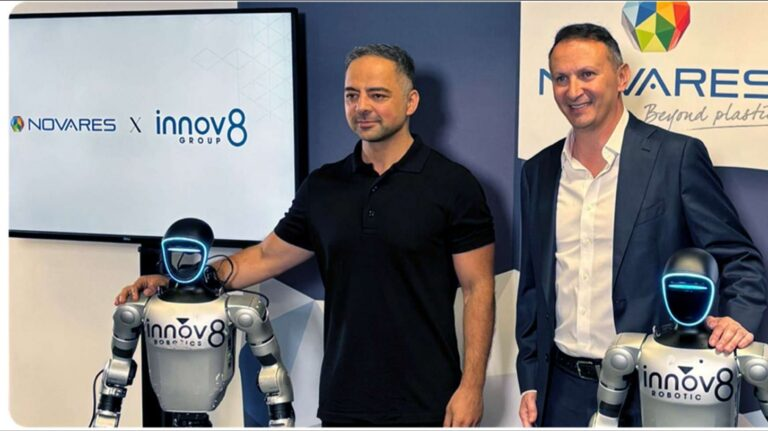
- Novares and Innov8 have signed an MoU for a humanoid robot proof-of-concept.
- The trial will use Unitree humanoid robots in an automotive manufacturing environment.
- The project tests whether flexible robotics can support repetitive and physically demanding industrial tasks.
Novares has signed an agreement with Innov8 to test humanoid robots in a live automotive manufacturing environment, bringing a high-profile automation category into a practical production setting.
The proof-of-concept will use Unitree humanoid robots and will focus on repetitive, physically demanding tasks. The trial is designed to test how machines with human-like movement can operate inside production spaces built around people, existing tools, and established workflows.
Automotive manufacturing already uses robotics extensively, but most established systems are fixed, task-specific, or integrated into tightly controlled cells. Humanoid robots carry a different proposition. They are intended to move through environments shaped for people and to perform varied tasks without requiring the same level of line redesign as traditional automation.
That flexibility is valuable only if it holds up under industrial conditions. Automotive suppliers operate under strict quality, safety, and uptime requirements. A robot that works in a demonstration still has to cope with shift patterns, floor conditions, changing part flows, human traffic, lighting variation, dust, tools, fixtures, and production pressure.
The likely early applications are not the high-speed tasks already served by conventional robotic arms. Humanoid robots are more plausibly suited to awkward, low-ergonomics, repetitive, or variable work where standard automation is too rigid or too expensive to justify. Parts handling, kitting, basic inspection support, production-adjacent movement, and intralogistics tasks all sit within that zone.
Industrial automation investment is moving towards systems that can adapt as product lifecycles shorten. Electrification, changing model mixes, and supplier volatility have all increased the need for flexible manufacturing capacity. In parallel, warehouse and fulfilment operators are pushing robotics deeper into daily operations, as shown by Amazon’s €10bn European robotics investment plan.
Humanoid robotics remains at an earlier stage than warehouse mobile robots or industrial arms, but production trials are beginning to separate workable use cases from novelty. The appearance of a humanoid machine can obscure the underlying industrial question: whether it can complete useful tasks safely, repeatedly, and economically without placing new burdens on supervisors and maintenance teams.
Safety will be the decisive constraint. A humanoid robot moving among workers needs predictable motion, strong sensing, reliable collision avoidance, and clear rules for human interaction. Factories are full of partial exceptions — a tool left out of place, a temporary obstruction, a worker crossing a path, a pallet arriving late. The robot’s ability to handle those conditions will carry more weight than its theoretical range of motion.
Integration will also shape adoption. A humanoid robot has limited value as a stand-alone device if it cannot take instructions from production systems, report task completion, respond to quality holds, and fit into maintenance planning. Connected task allocation could allow robots to move between work packages as production demand shifts, but that requires strong software integration and disciplined process design.
Automotive suppliers are logical early adopters because they already understand robotics and run tightly managed production environments. They also face labour pressures, ergonomic demands, and cost targets that can make automation attractive beyond simple headcount reduction. Repetitive manual tasks can create fatigue, injury risk, and inconsistent throughput; removing the most physically demanding work can improve resilience as well as productivity.
The trial also links manufacturing and logistics more closely. Many production-floor tasks sit between assembly and material flow: parts movement, container handling, line-side replenishment, sorting, and inspection support. As factories become more automated, those boundary tasks become more visible, because the line can only run as smoothly as the materials feeding it.
Humanoid robots still need to prove cost, reliability, maintainability, and task fit. Their adoption will depend less on speculative replacement of workers and more on whether they can fill the gaps left by conventional automation. A factory does not need a robot that looks human; it needs a machine that can work inside human-shaped processes without destabilising them.
The Novares and Innov8 programme gives the technology a sharper industrial test. If humanoid robots can support repetitive work in automotive production while meeting safety and uptime expectations, they could become another layer in flexible automation. If they cannot, the factory floor will expose the limits quickly.