IN Brief:
- ABB Robotics has launched the Flexley Stack F712 autonomous forklift for payloads up to 2,000kg.
- The system uses AI-enabled Visual SLAM navigation, avoiding fixed infrastructure such as reflectors or floor markers.
- The forklift joins ABB’s Flexley Tug and Flexley Mover AMRs on a common fleet management and software platform.
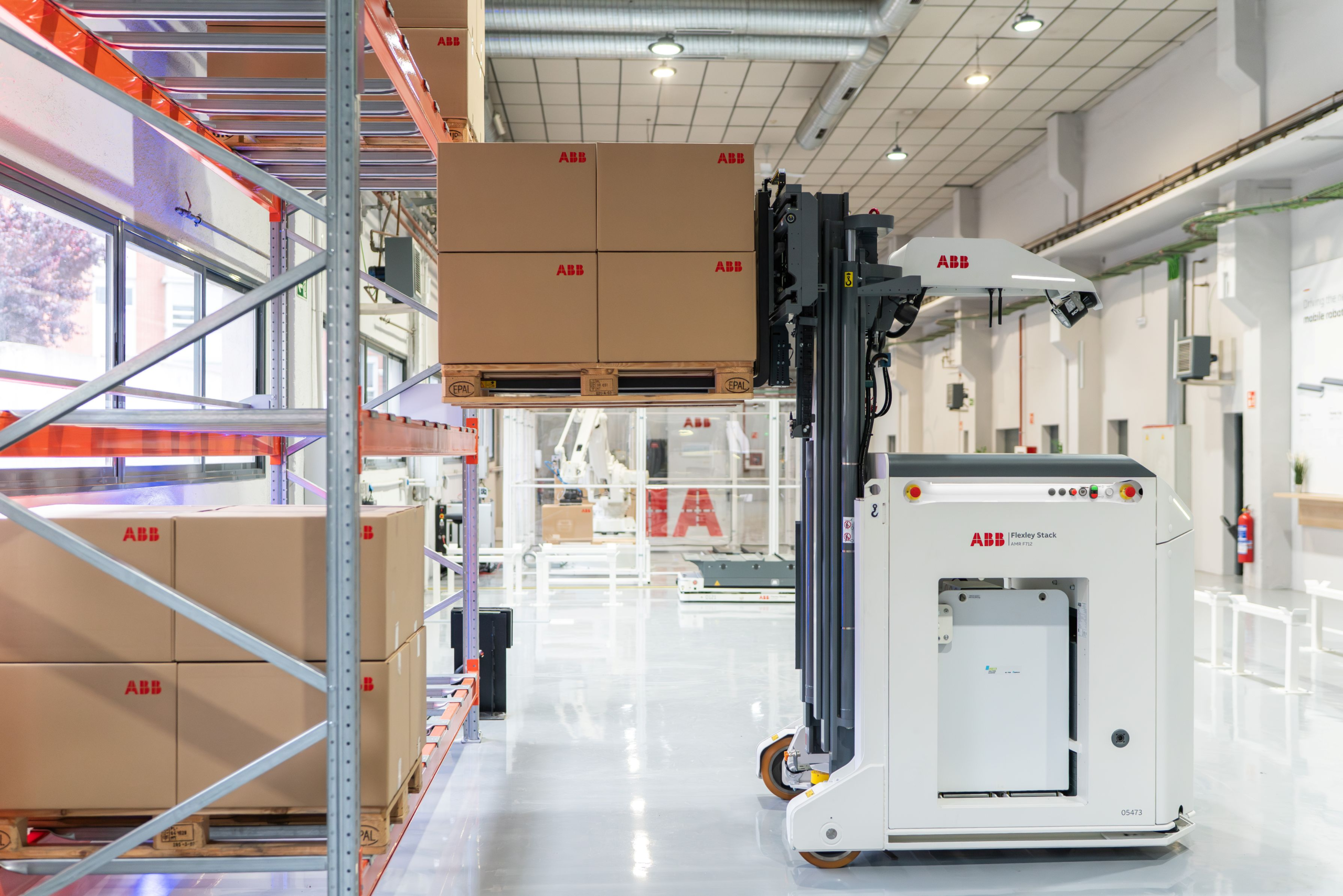
With the Flexley Stack F712, ABB Robotics has extended its Visual SLAM autonomous mobile robot portfolio into forklift-based material handling, giving warehouse and production operators a single automation family across pallet movement, tugger routes, and platform transport.
The F712 is designed for pallet transport, warehouse storage and retrieval, end-of-line handling, production logistics, body-shop and press-shop flows, drive-in racking, and light buffer operations. It can handle open and closed pallets, containers, racks, and custom load carriers, with payloads up to 2,000kg and lifting heights up to 8.5m.
Unlike autonomous forklifts that rely on fixed markers, reflectors, or other installed navigation aids, the F712 uses AI-enabled Visual SLAM to map and navigate its environment. ABB says the system delivers positional accuracy of ±10mm, allowing the truck to operate in demanding pallet-handling environments where load placement, aisle discipline, and repeatability are central to performance.
The forklift is fully integrated with AMR Studio, ABB’s no-code software suite for layout creation, fleet coordination, traffic management, and real-time visualisation. Commissioning times can be reduced by up to 20%, while layout changes can be managed through software rather than physical navigation infrastructure. The F712 is also VDA5050 compatible, supporting integration with existing systems and mixed mobile robot projects.
By adding a forklift to its existing Flexley Tug and Flexley Mover AMRs, ABB is giving operators a route to automate more than one internal transport process without building separate technology islands. A tug route feeding production, a platform AMR moving components, and a forklift AMR storing finished goods can now be managed through a shared navigation and orchestration environment.
The move extends the same industrial automation pressure visible in robotics demand at Automate 2026, where mobile automation, machine vision, and industrial AI were being pulled into live deployment planning rather than remaining as demonstration technologies. Forklift AMRs sit at the harder end of that curve because they must manage weight, height, load stability, pedestrian interaction, and mixed traffic inside active warehouses and factories.
Labour availability is also pushing pallet movement higher up the automation agenda. Internal transport still consumes large amounts of time in manufacturing and logistics sites, particularly around repetitive floor-to-storage, line-feed, and end-of-line tasks. The strain increases when production volumes rise but skilled forklift labour remains tight, forcing operators to choose between overtime, manual inefficiency, or selective automation.
Safety and interoperability will shape adoption as much as the vehicle specification. Pallet-handling AMRs need to operate around pedestrians, manual trucks, conveyors, racking, doors, and other automation, often in facilities that were never designed around autonomous vehicles. ABB says the F712 is certified to current ISO and ANSI safety standards and can operate at up to 1.7m/s while loaded.
The product also reflects a larger shift in warehouse automation procurement. Companies are looking for systems that can scale from targeted route automation into broader material-flow control, without forcing every use case into a separate fleet manager, navigation method, or software stack. The F712 gives ABB a fuller AMR range at a time when pallet logistics, production supply, and high-density storage are moving from manual routine towards software-controlled intralogistics.