IN Brief:
- The Busan customer fulfilment centre will serve approximately four million households across Busan and the wider Yeongnam region.
- Ocado's automation includes a -25°C Auto-Freezer, 600 Series robots, robotic picking, and multi-temperature totes.
- South Korea's online grocery market reached KRW52.3 trillion last year, with online penetration at approximately 28%.
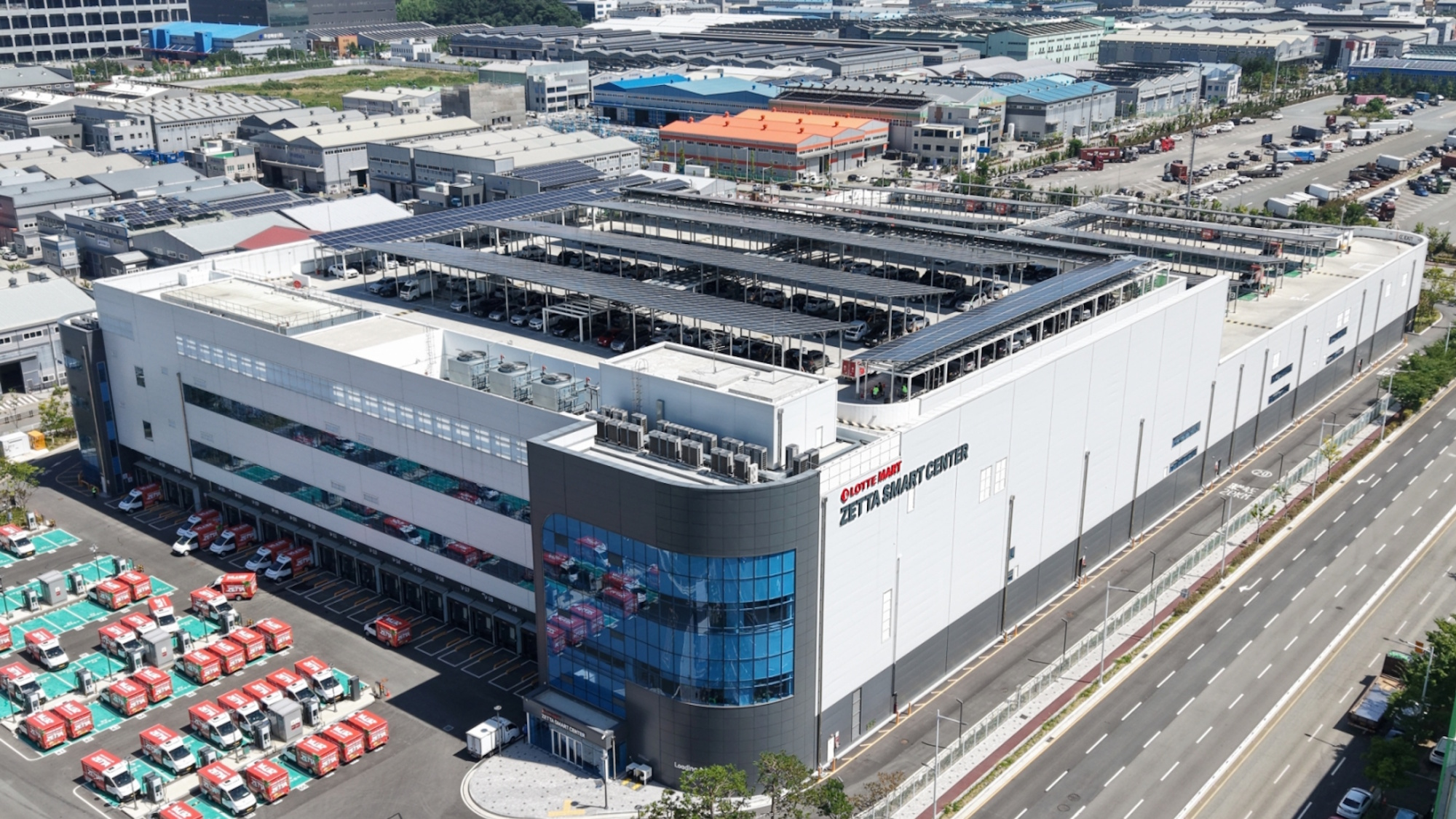
A new automated fulfilment centre in Busan is putting Ocado Group‘s latest warehouse technology into a South Korean grocery market where online sales already account for a substantial share of total spending.
The facility has opened with Lotte Shopping and will serve approximately four million households across Busan and the wider Yeongnam region. It is the first large automated customer fulfilment centre launched under the partnership agreed by the two companies in 2022.
Lotte initially introduced Ocado’s in-store fulfilment software to support online orders. Busan shifts the relationship into a dedicated automated warehouse, where inventory, picking, temperature control, consolidation, and dispatch are organised around a centralised fulfilment operation rather than predominantly store-based picking.
Among the more technically demanding elements is Ocado’s Auto-Freezer, which extends its grid-and-robot automation into temperatures as low as -25°C. The company expects the system to achieve more than twice the productivity of a conventional manually operated freezer.
Low-temperature warehousing is a difficult environment for both people and equipment. Manual work is physically restrictive and often organised around limited periods inside cold zones, while automation has to cope with battery performance, condensation, lubrication, sensors, maintenance access, and materials exposed to sustained sub-zero conditions.
Ocado’s 600 Series fulfilment robots are also being used at the site. The company describes the latest generation as around three times lighter than its predecessor, reducing the structural load imposed on the storage grid and lowering the amount of material required to support the system.
Picking is handled partly through Ocado’s On-Grid Robotic Pick technology, which places robotic arms above the storage grid. The company says its robotic picking systems have completed more than 350 million picks across deployments to date.
Grocery remains a difficult category for robotic manipulation because products vary sharply in shape, weight, packaging, fragility, and rigidity. A picking system that handles tins successfully may face a very different problem with soft packaging, fresh produce, glass, or irregularly shaped household goods.
Multi-temperature totes are intended to reduce another source of warehouse and delivery inefficiency. Products held at different temperatures can be consolidated into fewer delivery containers, helping increase van utilisation while preserving separation between chilled, frozen, and ambient goods.
The operating model has also been built around South Korea’s established dawn-delivery market. Packed orders are intended to reach customers before 7am, concentrating order cut-offs, picking, consolidation, vehicle loading, route planning, and last-mile departures into a narrow overnight window.
That service promise leaves little scope for a warehouse to recover slowly from lost productivity. Delays late in the picking cycle can move straight into transport because the dispatch window is fixed by the customer’s expected delivery time.
Ocado says daytime deliveries from the site will use a fully electric vehicle fleet. Solar panels are also expected to reduce annual carbon emissions by more than 1,000 tonnes, while lighter 3D-printed robots and denser storage are intended to reduce the material and energy intensity of the operation.
The commercial environment gives the automation system a large order base against which to work. Statistics Korea data cited by Ocado puts online grocery transaction value at KRW52.3 trillion last year, compared with KRW17.17 trillion in 2019.
That represents compound annual growth of 20.4%, while online channels now account for approximately 28% of grocery retail sales. Centralised automation generally has a stronger case where order density is high enough to spread the fixed cost of robotics, software, property, and maintenance across substantial daily throughput.
Dense urban demand can also help the transport side of the calculation. More orders within a compact delivery area can improve route economics, particularly where the same facility is attempting to support tight delivery windows rather than conventional multi-day ecommerce.
Ocado has simultaneously been broadening its automation model towards smaller and store-based deployments in other markets. Busan represents the other end of that portfolio: a large CFC using grid robotics, automated freezer handling, robotic picking, multi-temperature consolidation, and integrated delivery operations.
The contrast reflects the economics of different grocery networks rather than a single preferred automation model. Store density, labour cost, property availability, delivery promises, online penetration, and order volume all influence whether a centralised CFC, local fulfilment site, or hybrid network makes more sense.
Busan is therefore a useful commercial test of the large-format model in a market already accustomed to buying groceries online and receiving them quickly. The technology no longer has to demonstrate that robots can move containers around a grid; it has to sustain freezer productivity, picking accuracy, storage density, vehicle loading, and pre-7am dispatch over time.
Automation announcements often arrive with impressive individual performance figures. Lotte’s more relevant measure will be whether those separate systems continue to work together when order volumes peak, product ranges change, equipment needs maintenance, and customers still expect breakfast-time delivery.