IN Brief:
- ÖBB demonstrated Digital Automatic Coupling under real operating conditions at Vienna’s Floridsdorf freight yard.
- DAC automatically connects freight wagons while creating continuous pneumatic, electrical, and data links through the train.
- Pioneer DAC Trains will take the technology into commercial freight operation as the next stage of testing and certification work.
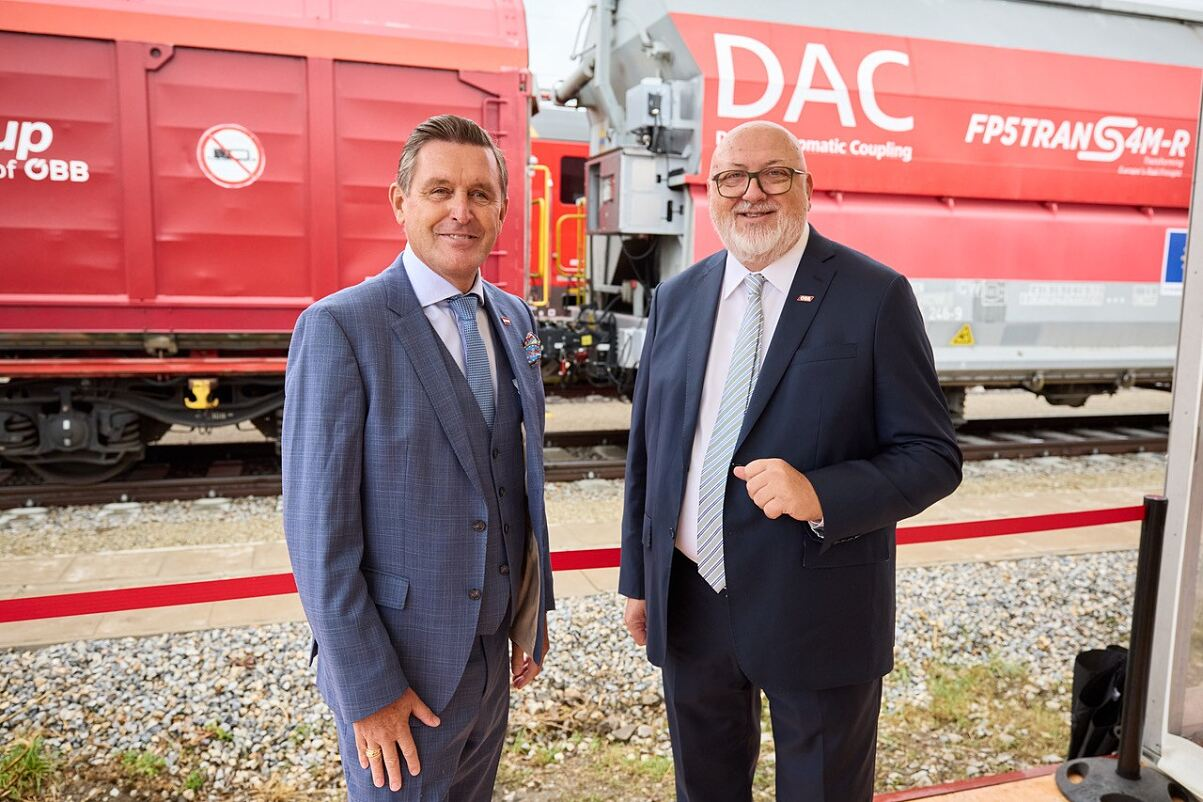
ÖBB has demonstrated Digital Automatic Coupling under real operating conditions at Vienna’s Floridsdorf freight yard, taking a European rail-freight automation programme from component testing into a working yard environment.
The demonstration compared the screw coupling widely used on European freight wagons with Digital Automatic Coupling, or DAC. The technology automatically connects and disconnects vehicles while establishing pneumatic, electrical, and data links through the train, extending the change well beyond the mechanical coupling between two wagons.
Continuous power and data connections allow additional processes to be automated or digitally recorded. ÖBB identifies automated brake testing and automatic recording of wagon order among the applications already being developed, while train-integrity monitoring is listed as a future use case.
The Floridsdorf work uses a specially equipped Austrian demonstrator train developed under the Europe’s Rail FP5 TRANS4M-R project. ÖBB is using the train to assess technical reliability, safety, maintenance requirements, and integration with existing freight operating processes. Appropriately equipped locomotives are included alongside DAC-fitted wagons, reflecting the need to treat the system as a train-level technology rather than an isolated wagon component.
Earlier testing included winter trials in Austria. Moving into a live freight yard adds another layer because the operating environment brings coupling together with train formation, inspections, staff movements, locomotive activity, and the timing pressures involved in getting freight ready to depart.
Traditional screw coupling requires railway staff to work between wagons to connect the mechanical coupling and brake equipment. DAC reduces those manual tasks and introduces the electrical and digital backbone needed for functions that are difficult to implement consistently across conventional freight trains.
The productivity case depends on more than reducing the time needed for one coupling operation. Freight yards repeatedly assemble, divide, and reorganise trains, so relatively small time savings can accumulate where large numbers of wagons pass through the same processes. Automated brake tests and reliable digital wagon-order records can remove additional manual steps, provided the equipment and operating procedures are authorised for routine use.
That proviso is substantial. European freight wagons move between operators, owners, terminals, and national networks, making interoperability central to the project. A digitally coupled wagon provides limited network benefit if neighbouring vehicles, locomotives, workshops, or operating systems cannot work with the same technical standard.
ÖBB consequently identifies harmonised European standards, suitable authorisation procedures, viable financing, and a coordinated migration plan among the conditions needed before wider deployment. Those requirements place DAC in a different category from a technology that can be adopted independently by one operator without affecting the rest of the network.
The installed fleet also creates a migration challenge. Freight wagons can remain in service for decades, while leasing companies and industrial owners renew assets at different rates. Retrofitting a large existing fleet means fitting new coupling equipment and supporting electrical and data systems before the full network benefit is available. During a transition, operators may need to manage conventional and DAC-equipped vehicles at the same time.
New rolling stock is beginning to anticipate that possibility. Recent TSI-approved silo wagons developed by Winton are offered with preparation for Digital Automatic Coupling alongside telematics and other systems. Designing provision into new wagons can reduce later modification work, although it does not determine when European freight networks will move to large-scale DAC operation.
The next stage for ÖBB is the Pioneer DAC Trains programme, supported through the Connecting Europe Facility. The project is intended to take DAC into commercial rail freight for the first time and produce evidence on certification readiness and economic performance under market conditions.
Commercial operation will expose the technology to variables that a demonstration cannot reproduce fully. Vehicles have to move through customer loading cycles, maintenance events, timetable disruption, wagon interchange, and cross-border operating procedures while continuing to deliver the expected reliability and time savings.
ÖBB also sees longer-term potential for longer and heavier freight trains and more efficient use of infrastructure, although those outcomes depend on route capability, braking rules, terminal length, train paths, and several other constraints beyond the coupling itself. DAC can create the technical basis for additional automation without removing those physical limits.
The Floridsdorf demonstration therefore establishes that the equipment can operate as part of a functioning freight train and yard process. The Pioneer DAC Trains will provide the harder evidence: whether the same system can survive routine commercial cycles, integrate with existing operating rules, and deliver enough measurable productivity to justify the cost and complexity of fleet-wide migration.