IN Brief:
- The approximately 200km service links Fujairah Terminals with the Industrial City of Abu Dhabi three times per week.
- ICAD’s AECAD UN LOCODE allows shipping lines and cargo owners to book the inland hub directly as a destination and clearance point.
- The corridor combines rail haulage with customs, inspection, and cargo release closer to Abu Dhabi’s industrial customers.
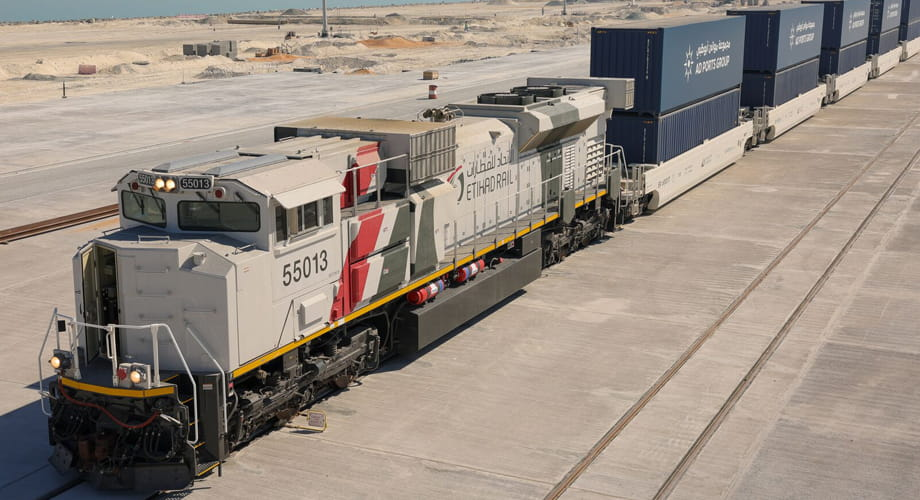
Etihad Rail and AD Ports Group have launched a direct freight service linking Fujairah Terminals with the Industrial City of Abu Dhabi, creating a scheduled rail connection between the UAE’s east-coast maritime gateway and one of its principal inland manufacturing zones.
The service moves cargo approximately 200km from Fujairah to ICAD, where importers, exporters, manufacturers, distributors, and logistics providers can use customs clearance, inspection, and cargo-release facilities. Trains are scheduled to operate three times per week, with containers able to be booked directly to ICAD rather than requiring a separate inland movement to be arranged after port discharge.
That booking model is supported by ICAD’s AECAD UN LOCODE, giving the inland location a recognised identifier within international shipping and trade systems. Shipping lines and freight forwarders can therefore treat the industrial destination as part of the booked transport chain rather than as a domestic leg arranged separately once cargo reaches Fujairah.
The service extends Fujairah Terminals’ role beyond the port gate. Containers arriving on the Gulf of Oman can transfer to rail for movement across the UAE to an inland location with customs and inspection capability, reducing the number of separate hand-offs required before goods reach customers around Abu Dhabi.
Omar Alsebeyi, chief executive officer of Etihad Rail Freight, said the arrangement brings “key port services closer to where cargo is ultimately needed”. The operating model combines line-haul rail transport with destination booking, customs processing, inspection, and final cargo release rather than treating rail as an isolated substitute for one road journey.
ICAD has been part of the UAE’s rail freight build-out for several years. Its terminal was connected to the national network in 2022, placing an inland rail node within Abu Dhabi’s industrial area. Etihad Rail has since expanded the range of traffic carried across the network, while AD Ports Group has continued developing links between ports, dry ports, and industrial customers.
AD Ports Group set out plans in May for a consolidated rail-linked inland logistics network incorporating ICAD and using Khalifa Port and Fujairah Terminals as maritime gateways. Memoranda involving Emirates Global Aluminium, EMSTEEL Group, Al Ghurair Iron & Steel, and Tenaris identified large industrial cargo owners as prospective users. The Fujairah–ICAD launch gives that network strategy a defined scheduled service.
Port choice and inland transport are closely linked for industrial importers. Attractive vessel connections can be undermined if containers then face additional handling, uncertain road capacity, or fragmented customs arrangements before reaching production sites. A rail connection with inland clearance gives shippers another way to manage the entire route rather than optimising the maritime leg in isolation.
Fujairah also occupies a different position from UAE gateways located inside the Arabian Gulf. Its Gulf of Oman location provides access to international shipping lanes, while the new rail service carries containers westwards into Abu Dhabi’s industrial base. AD Ports Group says the terminal supports connections across the GCC, India, the Red Sea, and East Africa.
The three-times-weekly frequency will now determine how effectively the corridor can attract recurring cargo. Rail performs best where predictable volumes can be consolidated into scheduled movements, while road haulage retains greater flexibility for individual containers, short-notice changes, and dispersed delivery points.
Customs processing at the inland end may also influence inventory planning. Bringing clearance closer to factories and distribution operations can reduce the number of separate stages between port discharge and production availability, particularly for repeat flows of industrial materials and components.
Those gains depend on coordination between vessel arrivals, train departures, customs activity, and onward collection. A missed connection or irregular train utilisation can erode much of the benefit offered by the longer rail leg, so schedule reliability will be as important as transit time.
The corridor also gives cargo owners another option for reducing reliance on road movements between ports and inland industrial zones. Rail cannot replace every truck journey because containers still require first- and last-mile handling, but moving consolidated long-distance flows by train can reduce the road mileage attached to each unit.
For AD Ports Group, the launch adds an operating service to its wider inland logistics strategy. For Etihad Rail, it broadens the commercial use of a national network that has moved progressively from bulk freight towards containers, finished vehicles, and other higher-value cargo.
The next useful indicators will be train utilisation, cargo volumes, and the number of shipping lines and customers prepared to use ICAD as a booked destination. Consistent traffic would make the service increasingly resemble an inland extension of Fujairah Terminals rather than a standalone rail connection.