IN Brief:
- Emergency gives eligible shipments Lufthansa Cargo's highest transport priority and guaranteed uplift.
- The service is available at more than 200 stations and can be booked up to the applicable Latest Acceptance Time.
- Shipments receive proactive monitoring, with additional dedicated supervision at Frankfurt, Munich, and Vienna.
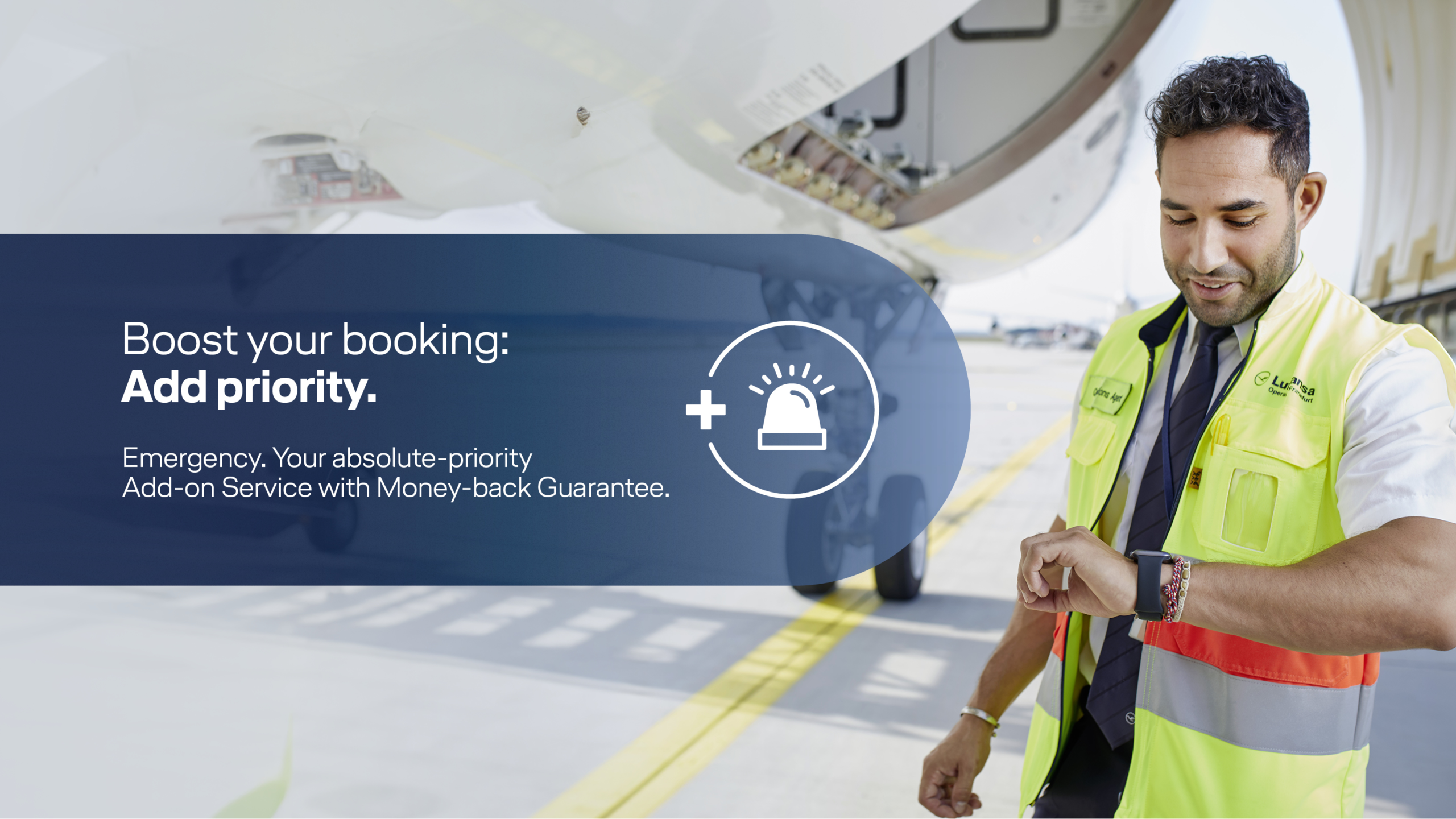
Lufthansa Cargo has launched Emergency as a modular add-on for time-critical airfreight, giving eligible shipments its highest transport priority, guaranteed uplift, 24/7 monitoring, and a money-back guarantee under specified conditions.
The service has been available since 16 September and replaces Emergency as a standalone product. Customers can now add it to selected combinations of Lufthansa Cargo products and speeds, including General Cargo, Dangerous Goods, Passive Temp Support, and Vulnerables when booked with td.Flash or td.Zoom.
Moving Emergency into the carrier’s modular portfolio allows the underlying cargo type and service speed to be selected separately from the additional priority treatment. The add-on can be booked regardless of shipment size or weight and, subject to capacity, can use the maximum cargo space available on the booked flight.
Lufthansa Cargo says the service is available across more than 200 stations in the Lufthansa Group network. Bookings can be made at short notice up to the applicable Latest Acceptance Time, with eBooking available where capacity is shown. If suitable space is not available online, the company’s 24/7 customer service team and local sales organisation can work on alternative booking arrangements.
The intended use cases are shipments for which delay carries a much larger cost than the freight charge. Lufthansa Cargo cites urgently required spare parts and machinery, life-saving pharmaceuticals, and medical samples. In industrial supply chains, a relatively small component can stop an assembly line, delay maintenance, or hold up the commissioning of equipment worth many times the cost of the shipment itself.
Guaranteed uplift is therefore the central operating commitment. Standard airfreight remains exposed to capacity constraints and network disruption, and even confirmed cargo can require replanning when an aircraft changes, a connection is missed, or demand exceeds available space. Emergency places the shipment at the top of the carrier’s priority structure within the agreed transport plan.
The add-on also includes proactive monitoring through the journey. Emergency consignments are clearly identified, while Lufthansa Cargo provides additional dedicated monitoring at its Frankfurt, Munich, and Vienna hubs. At Frankfurt, urgent shipments can be handled through the time:matters Courier Terminal in Cargo City North, which has direct apron access and is designed around short transfer routes.
A 24/7 customer service operation acts as a single point of contact and monitors consignments for potential irregularities. Lufthansa Cargo’s eTracking tools remain available through web and mobile channels. For critical freight, the value of visibility comes from the time it creates to react: production can be rescheduled, another component sourced, or an alternative route activated before a delay reaches the factory or customer.
The money-back guarantee provides a defined service commitment but does not transfer the commercial consequence of a delayed shipment to the carrier. Under Lufthansa Cargo’s terms, reimbursement of the Emergency add-on freight cost applies if the shipment is not available for collection within six hours after the promised Time of Availability. The wider value of lost production, missed maintenance, or unusable inventory remains a separate supply-chain risk.
That distinction is important when deciding which consignments merit premium treatment. Paying for maximum priority on routine cargo would weaken the economics quickly, while using it for a production-critical spare, urgent medical consignment, or other high-consequence movement can be justified by the cost of the delay being avoided.
The service design also acknowledges that critical logistics extends beyond the flight itself. Cargo can lose time at acceptance, transfer, customs, warehouse handling, or collection even when the aircraft operates to schedule. Dedicated identification and monitoring are intended to keep priority visible across those interfaces rather than confining it to loading decisions on the aircraft.
Lufthansa Cargo’s wider network operates through cargo hubs in Frankfurt, Munich, Brussels, Vienna, and Rome and covers around 350 destinations. The carrier uses dedicated Boeing 777F and Airbus A321F freighters alongside passenger-aircraft belly capacity from Lufthansa Group airlines and a substantial road-feeder network.
That scale creates both reach and complexity. A priority service has to operate consistently across different stations, handlers, aircraft, transfer processes, and local operating environments. The usefulness of the Emergency add-on therefore depends on the priority status surviving each handover rather than being recognised only at the booking stage.
The launch follows continued investment in Lufthansa Cargo’s ground infrastructure. Earlier in September, the carrier agreed to acquire LUG aircargo handling, subject to regulatory approval, which would add substantial German warehouse and handling capacity. The two developments address different parts of the same transport chain: one adds physical handling infrastructure, while Emergency defines how selected cargo is prioritised through it.
Urgent freight procurement works best when priority services are treated as an exception mechanism rather than a substitute for resilient planning. Safety stock, qualified alternative suppliers, preventive maintenance, and normal expedited freight can reduce the number of shipments that reach emergency status. No transport product removes the underlying exposure created when one component or consignment becomes a single point of failure.
There will nevertheless remain movements where time has a direct operational value and ordinary airfreight priority is insufficient. Emergency gives those shipments a clearer service level: short-notice booking, maximum available capacity, guaranteed uplift, proactive monitoring, and defined recourse if the promised availability is missed.
The practical test will come during network disruption or periods of constrained capacity, when priority rules matter most. Consistent execution across more than 200 stations will determine whether the add-on provides a dependable procurement option for critical freight rather than simply another premium label in the booking system.