IN Brief:
- Nine Kim Long Motor electric buses formed the first finished-vehicle export shipment from Chan May Port.
- The vehicles moved to Laem Chabang in Thailand aboard an NYK-operated pure car and truck carrier.
- NYK plans continued Chan May calls and is considering other rolling cargo, including construction machinery.
Headway Logistics has coordinated the first roll-on/roll-off vessel call at Chan May Port in central Vietnam, opening a finished-vehicle export option for manufacturers that have traditionally depended on gateways in the north and south of the country.
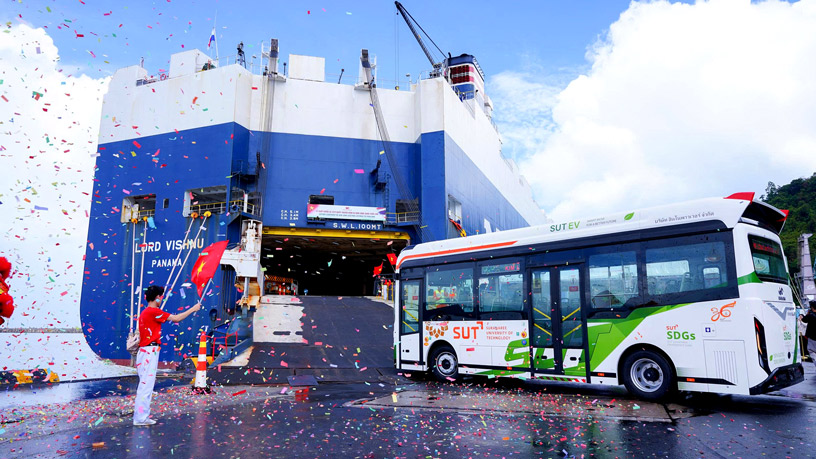
The first movement involved nine electric buses built by Kim Long Motor near Hue City and exported to Thailand. The vehicles were loaded at Chan May on 18 September for discharge at Laem Chabang aboard the NYK-operated pure car and truck carrier Lord Vishnu. Headway handled local logistics coordination, while NYK has said it plans further calls at Chan May in support of the export project.
Finished-vehicle flows in Vietnam have historically been concentrated through Hai Phong in the north and Ho Chi Minh City in the south. Manufacturers in the central region have therefore faced longer inland legs before vehicles reached established deep-sea automotive services. A RoRo call at Chan May places specialised ocean capacity closer to production in and around Hue.
RoRo shipping is built around wheeled cargo being driven on and off the vessel rather than lifted by crane or packed into standard containers. For complete vehicles, that can reduce handling stages between factory and ship, although the port operation still depends on secure compounds, vehicle inspection, documentation, stowage planning, and close coordination around vessel arrival.
Kim Long Motor gives the route an immediate industrial cargo base. Established in 2018, the Vietnamese manufacturer operates a production complex near Hue and is focused on buses, with expansion into other passenger-vehicle segments planned. The first shipment therefore connects a local vehicle factory directly with a regional export market rather than serving as a demonstration movement without an identified cargo owner.
NYK’s plan for further calls is central to the route’s development. Automotive logistics depends on frequency and predictability: production planners need to know when finished units can leave the factory, how long they are likely to sit in port, and whether shipping capacity can absorb changes in output. A first call proves physical feasibility; a recurring schedule allows the gateway to become part of the production plan.
Chan May is around 50km north of Da Nang and already handles bulk, container, and cruise traffic. Adding a pure car and truck carrier broadens its cargo capability, but specialised automotive shipping still depends on sufficient cargo density to justify recurring calls. The nine-bus first shipment is small in deep-sea vehicle-shipping terms, so the commercial case will depend on repeat Kim Long Motor volumes and additional rolling cargo.
NYK has said it will examine opportunities to handle other cargo types, including construction machinery, using the experience from the initial project. Headway has also pointed to oversized, overweight, and heavy construction equipment as areas in which its transport capabilities could expand. A mixed cargo base would reduce reliance on a single vehicle programme and give carriers more reasons to include Chan May in regular rotations.
A nearer gateway can reduce road distance, handling points, and scheduling complexity between central Vietnamese factories and the vessel. The actual cost advantage will depend on sailing frequency, port charges, vessel utilisation, destination coverage, and how reliably the port can turn vehicles through its compound and loading process.
Those economics become more important once volumes increase. A factory can absorb an occasional longer inland transfer for export, but repeated road movements over hundreds of kilometres add vehicle-kilometres, driver time, damage exposure, and timetable risk. A closer RoRo gateway can remove part of that cost without changing the overseas leg.
The route also adds another node to Southeast Asia’s automotive logistics network as vehicle production spreads across a wider manufacturing footprint. Thailand remains a major automotive market and production centre, while Vietnam is expanding both conventional and electric-vehicle output. Direct sea links between manufacturing locations can support that regionalisation when volumes are sufficient to sustain them.
Port capability will have to grow with the cargo. Finished vehicles require secure staging space, disciplined key and documentation control, damage inspection, and enough room to marshal units in loading sequence. Construction machinery and other project cargo can add different requirements around dimensions, lashing, and handling.
Chan May does not need to displace Hai Phong or Ho Chi Minh City to become useful. Its value will be determined by whether central-region manufacturers can rely on it as a repeatable export gateway rather than routing finished vehicles towards ports built around another region’s production geography. The next NYK calls, and the cargo they carry, will show whether the first shipment becomes a regular lane.