IN Brief:
- Antwerp becomes the fourth specialist European wind logistics location established by deugro in a short period.
- The operation handles blades, nacelles, and tower sections using heavy lifting, storage, inspection, and project logistics services.
- First vessel discharges were completed in July after the facility was commissioned for a turbine manufacturer in June.
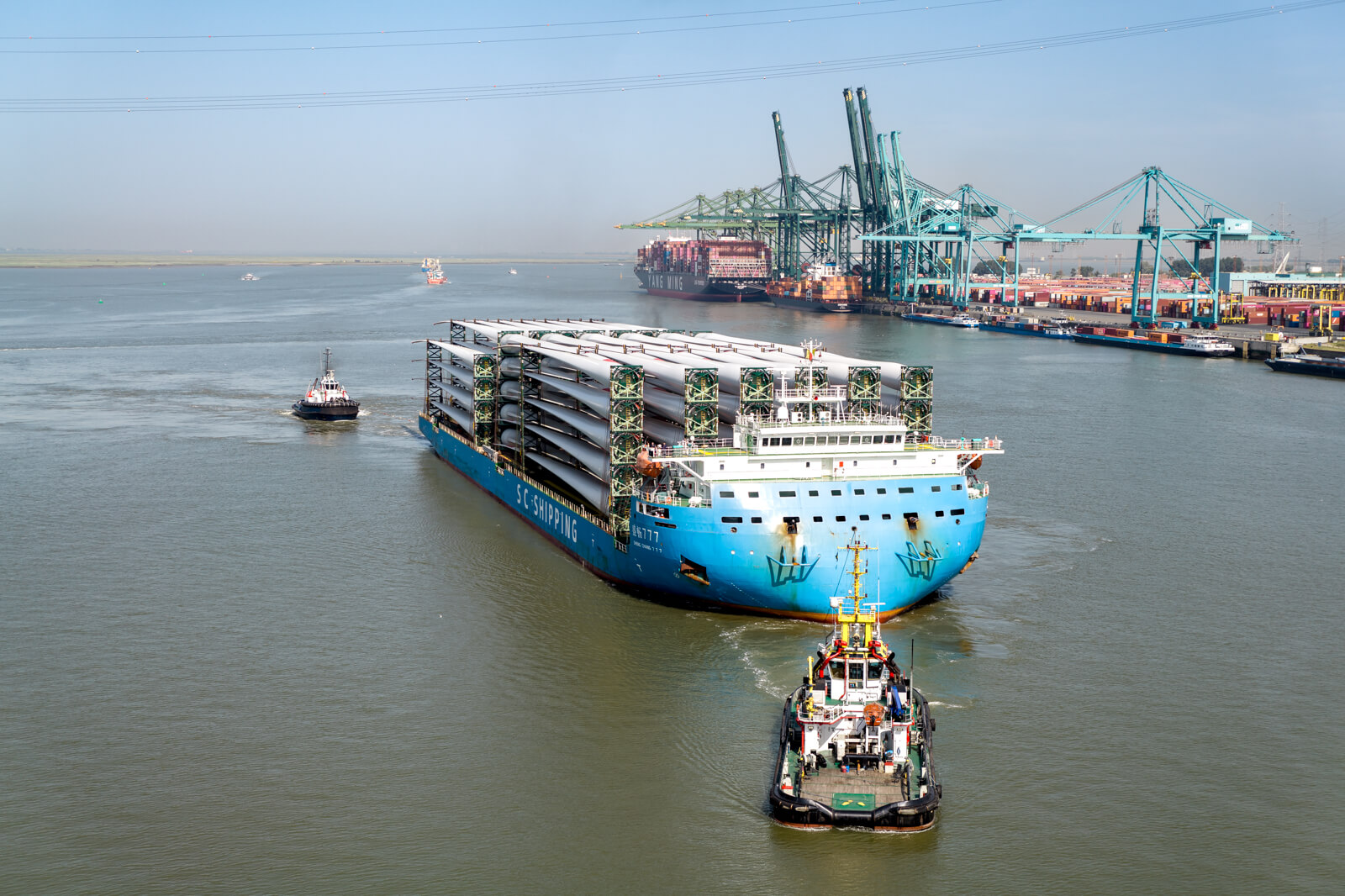
deugro has expanded its European wind logistics network with a dedicated port operation in Antwerp for the handling, storage, and onward movement of rotor blades, nacelles, tower sections, and other oversized turbine components.
The facility was commissioned in June for a global wind turbine manufacturer and completed its first vessel discharges in July. The operation adds another fixed logistics hub to a network intended to provide repeat handling and storage capacity close to European wind project markets.
Antwerp becomes the fourth specialist location established by deugro in a short period, joining facilities at Lindø in the Port of Odense, Wilhelmshaven, and Brake. The new setup uses high-capacity cranes, specialist handling equipment, and extensive storage and pre-assembly areas, allowing it to handle the main categories of wind turbine generator components rather than one cargo type alone.
The port also gives deugro direct access to road, rail, and inland waterway networks. Its position on the Rhine-Scheldt corridor allows oversized and heavy cargo to move inland by barge towards projects in Belgium, Germany, the Netherlands, and neighbouring markets, reducing the distance that abnormal loads have to travel by road.
Wind logistics has become increasingly infrastructure intensive as turbine dimensions have grown. Longer blades, larger nacelles, and heavier tower sections need more quay space, higher-capacity lifting equipment, and larger storage areas. Project schedules can also leave components at ports for extended periods before installation teams are ready to receive them.
The Antwerp operation combines port agency coordination, vessel discharge supervision, terminal operations, and heavy-lift handling with storage management, inventory control, condition inspections, and documentation. Components can then be prepared for onward road or inland waterway movements under the same project logistics programme.
That combination is particularly useful when components for one wind farm arrive from several origins on different vessels. Rotor blades can reach Europe before nacelles or towers, while installation teams require complete sets to arrive at site in the correct sequence. Storage and inventory control at the port create a buffer between international shipping schedules and construction demand without scattering components across several terminals.
The first rotor-blade shipment arrived from China, illustrating the international nature of the supply chain. European projects frequently combine equipment, subassemblies, and materials produced in several countries, making port selection dependent on vessel access, crane capacity, storage, and the feasibility of the final inland route.
Inland waterways can remove some of the constraints faced by abnormal road transport. Large blades and tower sections may otherwise require route surveys, escorts, road closures, bridge checks, and carefully timed movements. Barges cannot eliminate the final road leg to most project sites, but they can reduce the number of exceptional road kilometres and widen the range of viable storage locations.
Fixed port capacity also changes how deugro can approach new projects. A one-off forwarding assignment often requires cranes, storage areas, inspection processes, and local suppliers to be assembled specifically for the cargo programme. A standing network gives the company established procedures and infrastructure that can be reused across different customers and projects.
The Antwerp development follows deugro’s expansion of local capability for the Papua LNG project. The cargoes and geography are different, but both programmes rely on specialist infrastructure and local execution to support supply chains running across several years. The Papua LNG programme illustrates the same move towards permanent project logistics capability rather than one-off shipment management.
Wind developers and turbine manufacturers increasingly have to consider port capacity early in project planning. Vessels and components can be ready while suitable quay space, storage, or heavy-lift equipment remains unavailable, turning the port into a constraint on construction progress. Dedicated hubs provide more control over those interfaces, although they need enough project volume to justify reserved specialist capacity.
The first Antwerp vessel discharges show that the facility has moved beyond planning and into operation. Repeat use will determine how effectively it functions as part of deugro’s wider European network, particularly as larger turbines place heavier demands on storage areas, cranes, inland routes, and the coordination between port handling and construction schedules.
The commercial value of the site will ultimately come from its ability to absorb variability between manufacturing and installation. Wind components rarely arrive in the exact sequence required at site, and weather or construction delays can alter delivery dates with little warning. Storage, inspection, and multimodal access give the Antwerp hub room to manage that mismatch without leaving oversized cargo waiting aboard vessels or forcing premature delivery to constrained project sites.