IN Brief:
- The Bradfield distribution centre will provide 108,000 square metres of floor space on a 22-hectare site.
- Around 80% of operations are expected to be automated, including storage and retrieval across multiple temperature-controlled environments.
- Peak capacity is planned above 680,000 cases per day and approximately 2.5 million pallets annually when the centre opens in 2030.
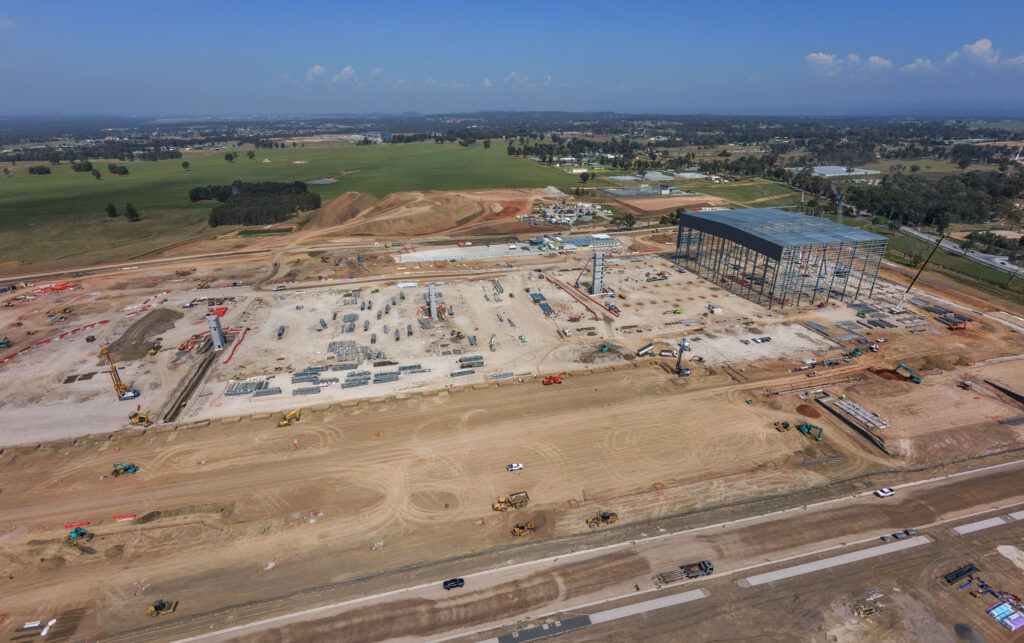
ALDI Australia is building a heavily automated distribution centre at Bradfield in Western Sydney, with the facility planned to double the retailer’s warehouse capacity in New South Wales when operations begin in 2030.
The project represents combined investment of more than A$1 billion and will occupy a 22-hectare site with approximately 108,000 square metres of floor space. At more than half a kilometre long, the building is being designed around large-scale automated storage, retrieval, and product movement rather than conventional manual warehousing.
ALDI expects around 80% of operations to be automated. The systems will operate across multiple temperature-controlled environments and are expected to run 24 hours a day, seven days a week, moving inventory through storage and retrieval processes serving stores across New South Wales and the Australian Capital Territory.
Peak capacity is planned above 680,000 cases per day and around 2.5 million pallets annually, approximately 30% more than ALDI handles through its current operation. The retailer says the building has been sized to support forecast demand through at least the mid-2040s.
The Bradfield centre will replace existing distribution facilities at Minchinbury, Prestons, and Eastern Creek. Consolidating those operations creates a larger inventory pool and removes some duplicated warehousing activity, while placing more of the state network’s throughput into one highly mechanised site.
That concentration makes equipment availability a central operating requirement. A conventional warehouse can often respond to volume changes by altering labour levels or adding temporary manual processes. A building designed around automated storage and retrieval depends more heavily on equipment uptime, controls, software integration, and maintenance access throughout the working day.
The mixed-temperature design adds another layer of complexity. Grocery distribution combines ambient, chilled, and other temperature-sensitive products with different handling and storage requirements. Extending automation across several environments reduces the number of manual transfers between storage zones but also requires the systems to function reliably under different operating conditions.
Inbound logistics will remain largely physical even as internal movements become automated. Suppliers still have to deliver products into receiving areas, trailers must be scheduled through the yard, and palletised or case-level stock has to be presented correctly before the automated equipment can take control.
Outbound flow presents a similar constraint. Processing 680,000 cases inside the building provides little benefit if dispatch doors, trailer availability, or transport planning cannot move equivalent volumes towards stores. Yard design, dock allocation, transport scheduling, and loading performance will therefore determine how much of the automated capacity can be used during peak periods.
ALDI is partnering with Richard Crookes Constructions on the project, which will become the first major development within Ingham Property Group’s 182-hectare industrial estate at Bradfield. The site is also among the first major logistics projects associated with the Western Sydney Aerotropolis.
More than 3,000 construction jobs are expected during development, with over 500 ongoing operational roles once the facility is running. The employment profile inside a heavily automated warehouse is likely to differ from a predominantly manual site, with greater demand for equipment maintenance, controls, systems support, fault recovery, and technical supervision around the automated installation.
The retailer is developing another automated distribution centre at Tarneit in Victoria, taking combined investment in the two automated warehouse projects above A$2.5 billion. Both facilities support ALDI’s stated intention to add approximately 100 stores across Australia.
The expansion therefore ties store growth directly to logistics infrastructure rather than attempting to stretch the existing warehouse network across a larger retail estate. Additional shops generate more individual replenishment requirements, more inventory positions, and more transport movements even if sales growth appears manageable at national level.
Bradfield will also test the resilience of warehouse consolidation. Replacing three distribution centres with one larger operation can simplify inventory and reduce duplicated processes, but it increases the consequences of equipment or systems disruption at the remaining site. Redundancy, maintenance planning, and recovery procedures will need to match the scale of throughput passing through the building.
Construction remains several years from completion, leaving ALDI to install and commission the automation before migrating volume from its three existing New South Wales facilities. The physical building is substantial, but the decisive stage will be the systems integration and operating transition required to bring 80% automation into a live grocery distribution network without interrupting store supply.