IN Brief:
- Gideon has made its TREY autonomous forklift commercially available across North America for complete trailer loading and unloading.
- The system can move up to 28 single or double stacked pallets or cages per hour and identify more than 119 load carrier types.
- TREY is already deployed in automotive manufacturing, food and beverage distribution and third-party logistics operations.
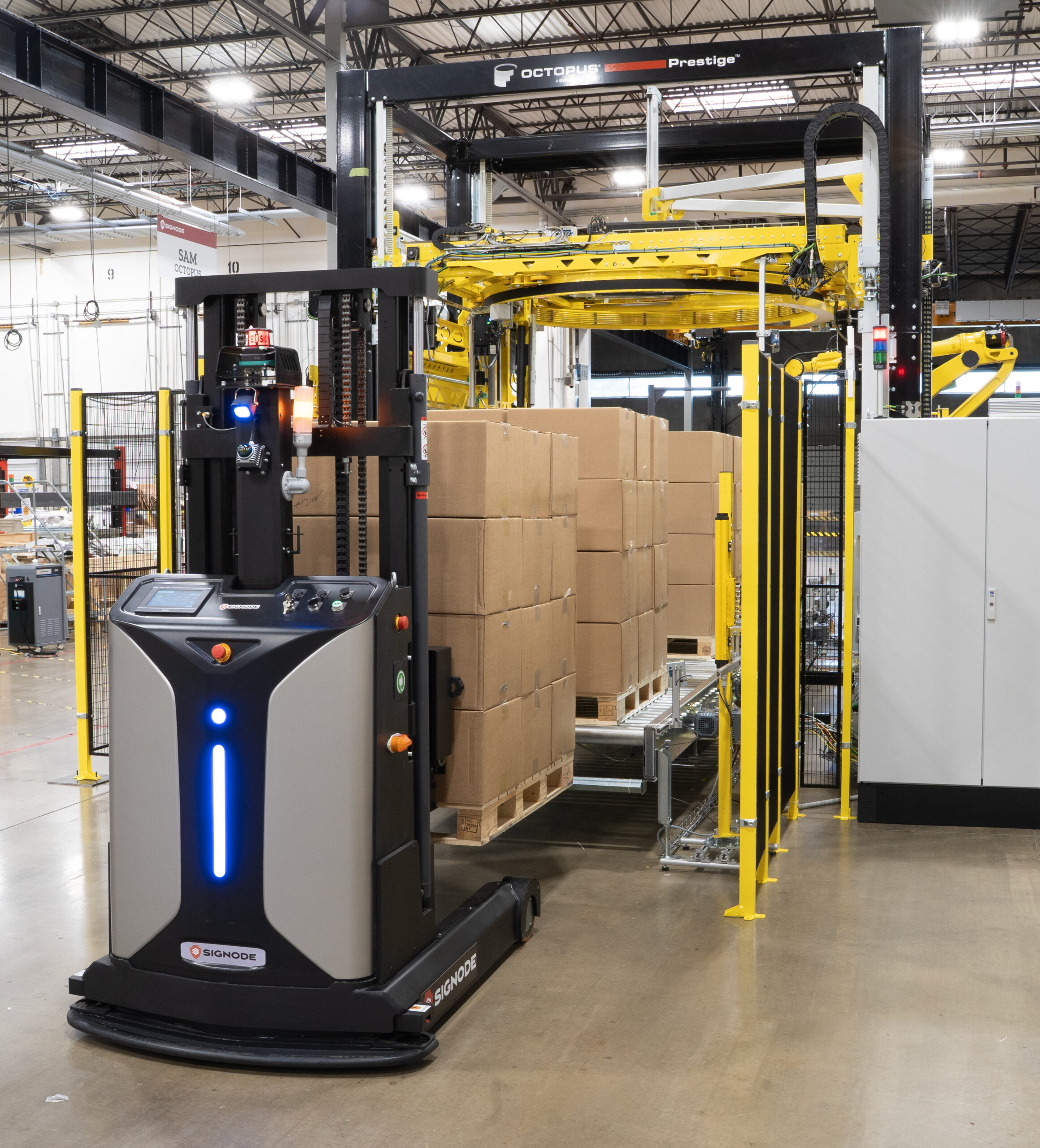
Gideon has made its TREY autonomous forklift commercially available across North America, moving a platform first introduced several years ago into broader commercial deployment. The system targets complete trailer loading and unloading, where variation in vehicle interiors, pallet positions and dock conditions makes automation more difficult than repetitive transport between fixed warehouse locations.
Racks and production lines can be mapped precisely, whereas trailers arrive from different fleets, stop in slightly different positions and contain loads arranged differently from one journey to the next. An autonomous forklift therefore has to recognise the trailer interior, locate each pallet or cage, understand its orientation and determine how to collect or place the load safely before it can complete the same task a driver would normally perform.
TREY can identify more than 119 load carrier types and operate with dry vans, refrigerated trailers, drop deck vehicles and intermodal equipment. Gideon combines cameras, laser scanners and other sensing equipment with its physical AI software, using depth information and machine learning models to distinguish load carriers and other objects within the working environment rather than treating every detected shape as a generic obstacle.
That perception capability allows the system to deal with practical variation inside the trailer. Inbound pallets can arrive facing different directions, so TREY can recognise their orientation and rotate them during unloading where required, while outbound work can follow predefined loading patterns. The system can also recognise dunnage and pause when an employee needs to remove or insert material before automated handling continues.
Gideon rates the system at up to 28 single or double stacked pallets or cages per hour in suitable operating conditions and identifies docks receiving 30 or more trailers a day as strong candidates for automation. Actual throughput still depends on the process around the forklift because a robot waiting for paperwork, staging space, an available trailer or downstream warehouse capacity is no longer productive even if its own driving cycle is fast.
Outbound work is particularly sensitive to sequencing because pallets have to reach the loading area in the order needed for the trailer plan. If the warehouse sends the wrong load to the dock first, the robot may have to wait or the staging area may need additional handling before loading can continue, reducing the benefit of automated trailer movement.
Inbound operations face the reverse constraint because unloaded cargo has to leave the dock fast enough to prevent staging lanes from filling. TREY can share those areas with manually driven forklifts while its fleet software reallocates work as pallet positions change, allowing the system to keep operating as the physical layout evolves during the shift.
The forklift can integrate with warehouse management and execution software or operate through Gideon’s own fleet platform, allowing higher level systems to assign transport work while the vehicle manages navigation and load handling locally. An analytics dashboard records completed trailers, robot performance and employee interventions, while images captured during pallet movements create a time stamped record of loading and unloading activity.
That data can help distinguish between limitations in the autonomous vehicle and delays elsewhere in the process. A low trailer completion rate may reflect robot exceptions, but it can also result from late trailer presentation, missing loads or blocked staging lanes, so useful performance analysis has to account for the complete dock workflow rather than the vehicle alone.
Two configurations cover different load requirements. The medium duty model carries up to 3,500 lb and is rated for 12 hours on one battery charge, while the heavy duty version carries up to 6,000 lb and is rated for 10 hours. Autonomous charging between work cycles can reduce the manual work associated with battery management, although charger availability and fleet size still have to match the daily trailer schedule.
Safety systems include two laser scanners, an embedded controller monitoring safety inputs and emergency stop controls, with protective zones changing according to operating conditions. Those controls allow the forklift to work around people and other equipment while keeping manual intervention available for damaged pallets, unusual obstructions and tasks outside the approved automated workflow.
The labour effect is therefore concentrated on repeated driving and load handling rather than on removing people from the dock entirely. Employees remain responsible for supervision, exception handling, trailer preparation and tasks that fall outside the automated process, while the robot takes over the repetitive movements that can occupy a driver for much of a shift.
Commercial deployments are already operating in automotive manufacturing, food and beverage distribution and third-party logistics, giving Gideon live environments in which to prove the technology beyond demonstration work. Those sectors all process substantial pallet volumes, but trailer mix, loading pattern and exception rates can differ considerably between sites, making operating data across several applications useful before wider rollout.
The North American expansion consequently shifts the question from whether autonomous trailer handling is technically possible towards whether it can maintain useful throughput under normal dock variation. A successful deployment will depend on the robot recognising changing loads reliably while warehouse systems, staging areas, trailer schedules and human exception processes keep enough work flowing through the dock to use that capability productively.