IN Brief:
- DP World announced delivery of two ship-to-shore cranes and six electric rubber-tyred gantry cranes on 9 October.
- The equipment forms part of a BRL 1.6bn Santos expansion targeting 1.7m TEU annual capacity by the end of 2026.
- A second delivery of two quay cranes and nine RTGs is expected in early 2027.
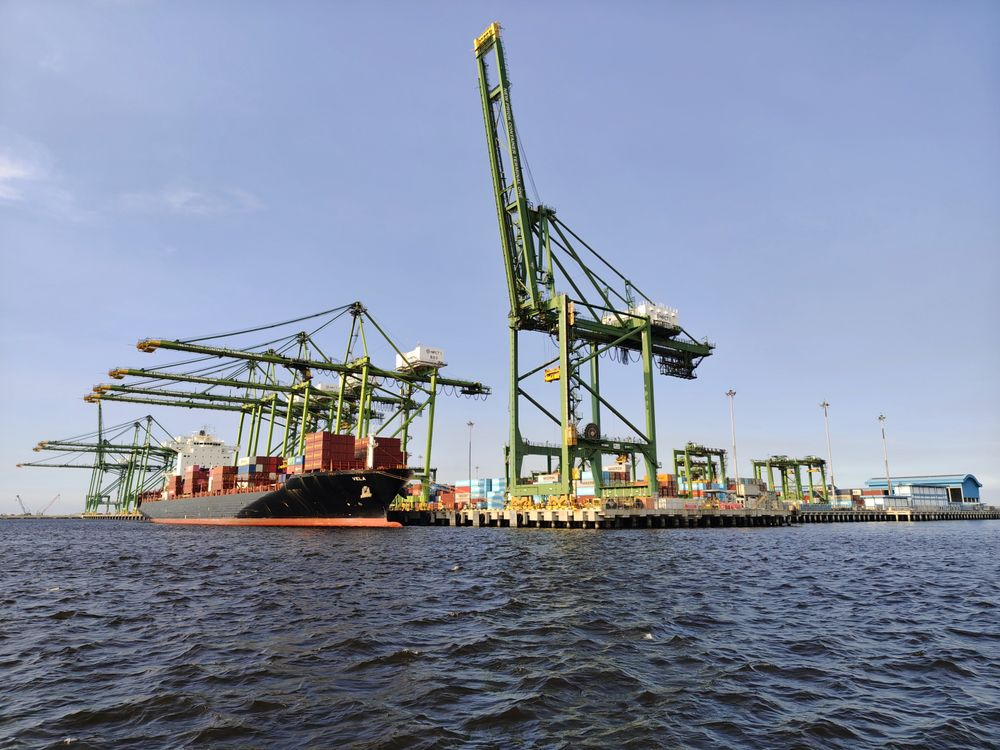
DP World has taken delivery of eight fully electric cargo-handling cranes at its Port of Santos container terminal in Brazil, moving a large expansion programme from investment planning towards equipment deployment. The delivery, announced on 9 October 2026, comprises two ship-to-shore quay cranes and six rubber-tyred gantry cranes, or RTGs. The equipment is part of a BRL 1.6 billion investment programme that DP World says will raise the terminal’s annual container-handling capacity to 1.7 million twenty-foot equivalent units by the end of 2026.
The delivery is the first instalment of a broader crane order, rather than the completion of the whole equipment programme. DP World plans to receive another two ship-to-shore cranes and nine RTGs in early 2027, bringing the total planned order to four quay cranes and 15 RTGs. That distinction is important for the capacity figures: the operator’s 1.7 million TEU target for 2026 relates to new equipment and optimised use of the existing licensed terminal infrastructure, while a further increase to 2.1 million TEU remains a longer-term development ambition.
Each of the two new quay cranes stands 56 metres high and has a 72-metre outreach, seven metres longer than the equipment it replaces or supplements in the existing operation. DP World says they can lift two 20-foot containers simultaneously. These specifications should give terminal planners greater flexibility when larger vessels berth and when the order in which boxes are lifted affects crane productivity. The reach and lifting capability are technical characteristics, however, rather than independently measured evidence that vessel turnaround times have already improved.
The six electric RTGs are designed to lift loads of up to 41 tonnes. They work within the container yard, where stacked boxes must be positioned for transfer between trucks, terminal vehicles and the waterfront. A larger quay-crane fleet can increase the rate at which containers leave a ship, but the overall terminal cannot sustain that pace unless yard handling and internal traffic can keep up. The combined arrival of quay and yard equipment addresses those connected parts of the cargo-handling process, rather than treating the berth as an isolated bottleneck.
Electrification is also central to the investment. The incoming RTGs will operate without the diesel engines used by conventional yard cranes, although their overall environmental impact still depends on electricity generation, utilisation and maintenance. DP World estimates that once the full new fleet of 15 RTGs is operational, it could avoid approximately 4,250 tonnes of carbon dioxide emissions each year compared with equivalent diesel equipment. That is an estimate for the future complete fleet, not an emissions reduction achieved by the six machines delivered in October.
The operator has already electrified 22 existing RTGs at Santos and reports adding 15 electric internal terminal vehicles and three electric reach stackers earlier in 2026. It also reports that diesel consumption during January to April 2026 was 29.2 per cent lower than the 2024 average. The comparison indicates reduced diesel use at the terminal during that period, but the release does not isolate the contribution of any one vehicle type or provide an equivalent whole-site electricity and greenhouse-gas calculation.
Santos is a major interface between Brazilian inland supply chains and international liner shipping. The value of additional terminal capacity depends partly on whether landside freight transport, customs processes and ship schedules can accommodate more cargo. Delays at a container port can propagate into trucking, distribution and manufacturing inventories, particularly when a vessel arrives outside its planned berth window. DP World is positioning the new cranes alongside its inland transportation, freight-forwarding and contract-logistics services, rather than as a stand-alone engineering purchase.
The October milestone is therefore a delivery of physical equipment with measurable specifications and a clear next phase, but several headline outcomes are still prospective. The operator must install, commission and integrate the machines with existing terminal operations before a full assessment of productivity is possible. The next useful indicators will be crane commissioning dates, actual vessel and yard productivity, and throughput against the stated 1.7 million TEU annual-capacity objective. The arrival of the eight cranes demonstrates progress; the promised operating improvements will have to be established through subsequent performance data.
The arrival also needs to be distinguished from commissioning. Port cranes are complex pieces of electrical and mechanical equipment, and delivery to the terminal is not itself evidence that each machine has entered daily service. The company’s capacity target should therefore be treated as a planned outcome of the wider expansion rather than a measured consequence of this shipment.