IN Brief:
- Clustag launched its InLine division in Valencia on 29 October 2026 to supply identification, inspection, and control systems to intralogistics automation integrators.
- The portfolio combines RAIN RFID, automatic print-and-apply labelling, dimensioning, weighing and scanning equipment, machine vision, and end-of-line operator stations.
- InLine plans to present its systems at Logistics & Automation Madrid on 11–12 November and offers remote technical support around the clock.
Clustag has established a division supplying identification, measurement and inspection equipment to companies integrating warehouse and logistics automation systems. The Spanish RFID specialist launched Clustag InLine on 29 October 2026, bringing together technologies used to identify goods, verify shipments and manage product flows at different points along a handling line.
Its portfolio covers print-and-apply labelling, dimensioning, weighing and scanning (DWS), machine vision, quality checks, process validation, operator stations and RFID. The equipment is intended to work inside conveyor, sorter, picking, packaging and dispatch installations, where each handling unit must be identified and checked before the control system can direct its next movement. Integrators can specify those functions together rather than treating every inspection point as a separate procurement exercise.
Labelmasters, recently incorporated into Clustag, contributes automatic labelling and volumetric measurement expertise to the division. That broadens the company’s existing RAIN RFID work into the adjacent steps of reading, weighing, measuring and verifying a package while it is moving. An integrator can therefore plan an identification station alongside its label application and inspection equipment, subject to the interfaces required by the warehouse control system.
RAIN RFID uses radio waves to read compatible identifiers without requiring the same direct visual alignment as an optical barcode scanner. Whether it is suitable for a particular station depends on tag placement, reader geometry, neighbouring tagged items and materials that affect radio signals. A well-designed installation must separate the intended read zone from adjacent traffic to avoid misidentifying goods.
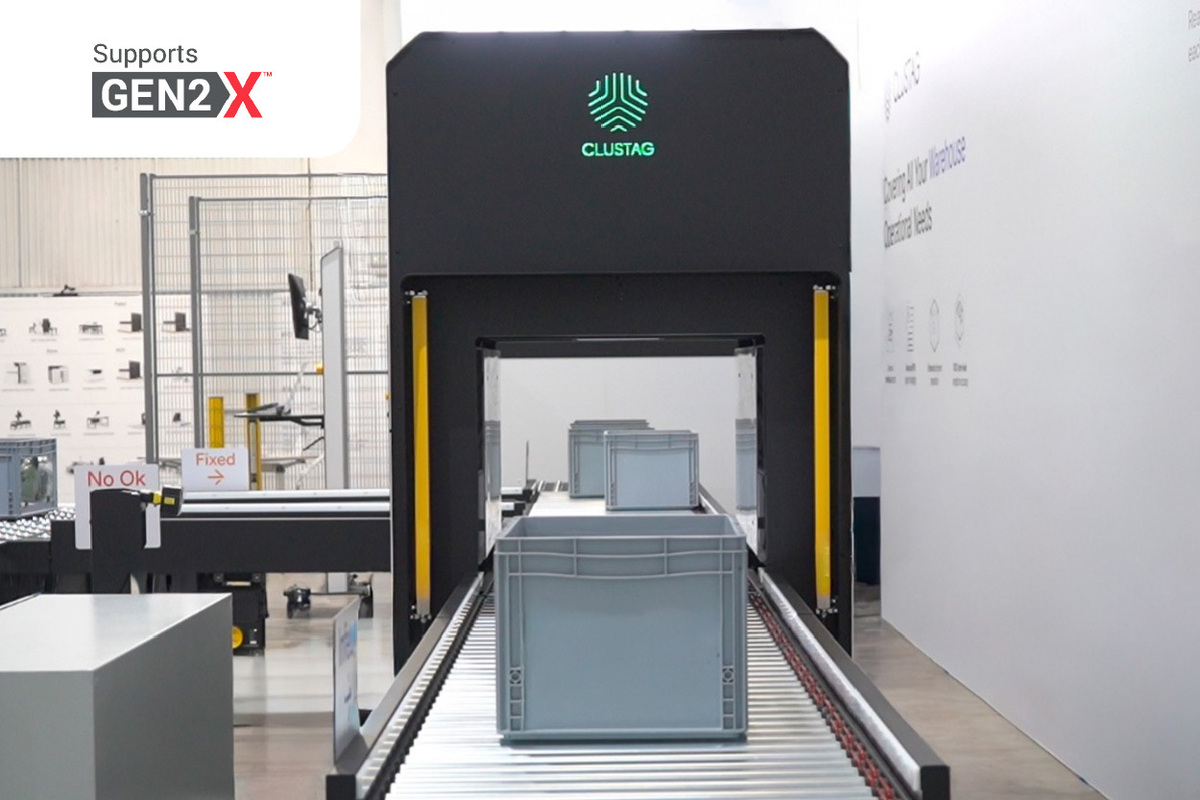
A parcel moving through a DWS station is identified and measured as it crosses a defined section of the conveyor. The scanner retrieves the handling-unit code while sensors capture weight and dimensions, producing a set of values that can be matched to the shipment record. Measurement accuracy depends on the equipment specification, presentation of the load and the operating conditions at that station.
A DWS station combines a load’s scanned identity with its weight and dimensions, allowing a transport or warehouse application to compare the measured values against the handling-unit record. A reliable match depends on the item passing through the measurement zone in the specified orientation and on the scanner returning the correct code. RFID adds another way to associate an item with a system record, but the read zone still has to distinguish that item from neighbouring tagged stock.
Automatic print-and-apply units add another stage by placing labels onto packages moving past an application point. Their performance depends on line speed, package orientation and the physical space available to position the applicator. Where a label is missing, misplaced or unreadable, a downstream scanner or vision station can be configured to identify the exception before the load moves onward.
Cameras positioned after labelling can check visible details such as print placement, package orientation and apparent external damage, provided the lighting and view are suitable. Image processing can then flag a package for diversion when it falls outside the configured criteria. That inspection has a different role from the barcode or RFID read, which identifies the handling unit in the control system.
In a sorter, identification has to occur early enough for the controls to select an exit before the parcel reaches its divert mechanism. A label printer needs a suitable application surface, while a vision system requires a camera view and lighting matched to the inspection task. When an item fails a reading or inspection check, the conveyor controls must route it to a suitable exception point; the sensor result alone cannot physically remove a faulty package from the line.
The equipment also has to coexist with the customer’s warehouse management or operational software. Barcode scans, RFID reads and measurement results become useful only when they can be linked to a transaction, shipment or inventory record. Incorrect sequencing or duplicated reads can produce misleading records even when individual sensors are functioning normally.
Installation support will include technical documentation, a 24-hour remote assistance service, a hotline and ticketing platform, video troubleshooting and the option of on-site intervention. These services can support the integrator during commissioning, when scanner positions, sensor triggers and software event sequences are adjusted against actual products, and during maintenance after the line enters production.
Clustag identifies the handled product, line speed, application position and working environment as factors in specifying its equipment. A high-speed parcel conveyor and a mixed industrial parts operation may require different read zones, label application positions, reject mechanisms and inspection criteria. Those parameters shape the solution before any overall processing rate can be established.
End-of-line operator stations can connect automated inspection with human intervention where an exception requires a physical check or correction. The balance between automatic processing and manual handling depends on the acceptable error rate, the volume of non-standard goods and the consequence of sending an incorrectly identified shipment forward.
Clustag InLine will present the division at Logistics & Automation Madrid on 11–12 November, extending the company’s RFID business into integrated inspection and end-of-line systems. Its initial emphasis is on supplying automation integrators with equipment, engineering advice and continuing service rather than on a named customer installation.