IN Brief:
- Schneider and Norfolk Southern have agreed to expand domestic intermodal services across the eastern United States, including a change to Schneider’s primary eastern rail provider.
- Schneider reports approximately 26,800 containers, 23,900 chassis and more than 60 North American intermodal hubs, with company drivers completing more than 90% of its domestic dray moves.
- Norfolk Southern is investing in terminal capacity, gateway improvements, double-stack clearances, reliability, and security across its 22-state network.
Schneider has agreed a domestic intermodal partnership with Norfolk Southern that will change its principal rail provider in the eastern United States. The agreement brings Schneider’s container, chassis and road haulage operations together with Norfolk Southern’s rail network, terminals and infrastructure investment programme across 22 states.
Schneider plans to move its principal eastern rail provision to Norfolk Southern, linking its intermodal containers and road collection network to the railway’s eastern terminals and train services. The transition will involve planning customer lanes around available departures, terminal cut-off times and delivery requirements, rather than changing only the name of the rail carrier on a booking.
Schneider operates approximately 26,800 containers and 23,900 chassis and uses more than 60 intermodal rail hubs across North America. The business reports that professional company drivers complete more than 90% of its domestic drayage moves, giving it direct control over much of the short road transport linking customer premises and rail terminals.
Drayage is the truck movement between a terminal and a nearby origin or destination such as a factory, warehouse or distribution centre. Its timing affects the whole intermodal journey: a container delivered after the terminal cut-off can miss the planned train even when the rail service itself operates to schedule.
At the rail terminal, a crane or other handling system lifts a container off its road chassis and places it on a suitable rail wagon. The reverse movement occurs at the destination terminal before local drayage takes the box to its receiver. That physical transfer adds handling steps compared with a direct truck journey, but rail can carry groups of containers together over the long-distance leg.
With Schneider providing boxes, chassis and much of the drayage fleet, the partnership can coordinate equipment supply around Norfolk Southern’s rail departures and terminal capacity. A train slot is usable only when a container reaches the origin terminal in time and there is a corresponding destination handling and collection arrangement. The partners’ assets address different parts of the same shipment cycle.
Norfolk Southern’s network investment includes a Cincinnati–Atlanta service, East Edge route clearance improvements between the Midwest and New England, and terminal expansions in Ohio, Michigan, North Carolina and Illinois. At sites including Atlanta, Louisville, Harrisburg, Croxton, Chesapeake, Charlotte, Chicago and St Louis, work also covers truck access, pavement, lighting, storage, maintenance and security. These are the facilities that govern how efficiently boxes enter and leave the railway.
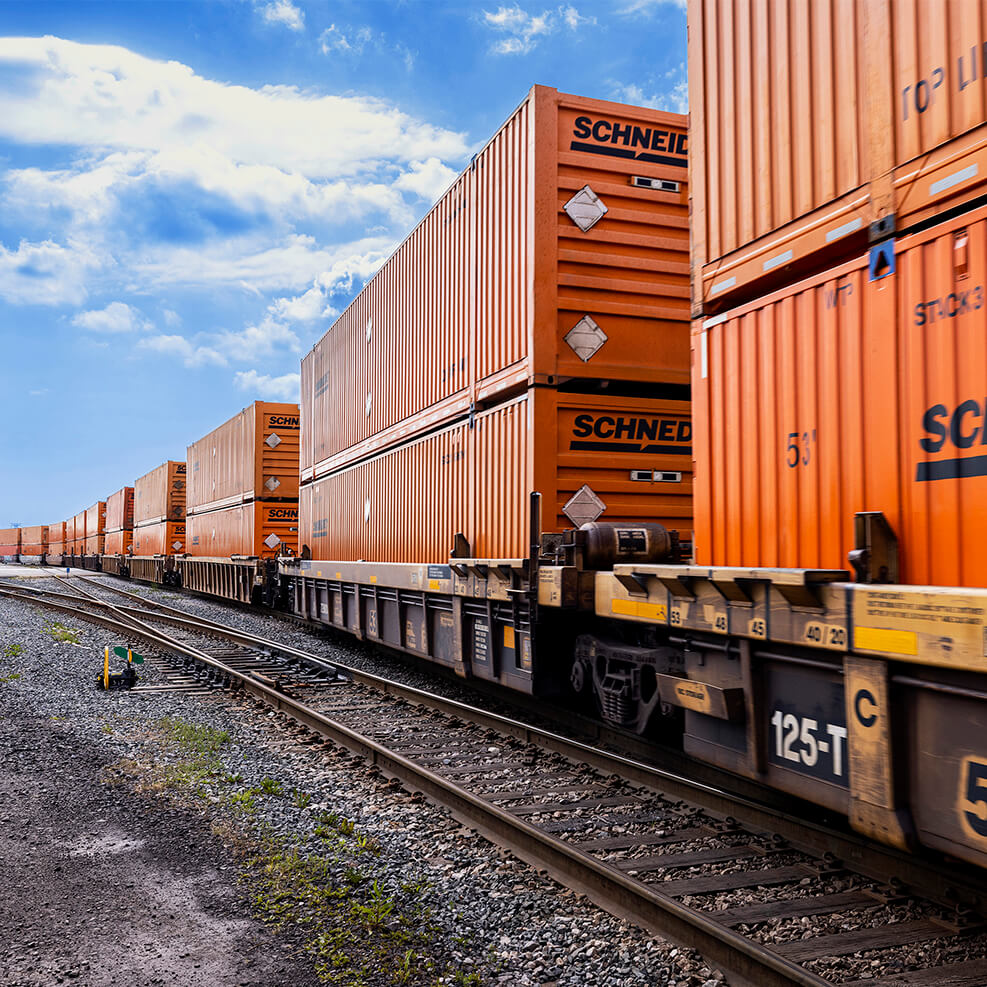
Double-stack clearance work allows two compatible containers to be carried vertically on a wagon where bridges, tunnels and other structures provide sufficient space. The resulting train capacity still relies on suitable equipment, usable train paths and terminals able to process arrivals. Road access is equally necessary: an expanded rail terminal gains little if inbound trucks accumulate outside its gates.
The railway reported intermodal volume growth of 3% in the third quarter of 2026. That provides context for its investment in capacity and operational reliability, although the reported increase describes traffic handled in the quarter, not the incremental freight expected specifically from the Schneider agreement.
Consignment data has to pass between Schneider’s drayage dispatch, terminal systems and Norfolk Southern’s rail operations. The same container identifier, train assignment and status events must remain aligned as the load changes mode. When a train is delayed or a collection window changes, the transport plan can be adjusted only if the parties receive a timely and accurate update.
Schneider says its intermodal operation includes priority rail access, proactive shipment management, satellite tracking and security measures. The usefulness of tracking is greatest when physical location events can be related to terminal handover and expected delivery time, rather than treated as isolated vehicle positions.
The combination increases routing options between origins and destinations served by the eastern network. A useful intermodal option requires a workable terminal at either end, a train service that meets the shipment’s timing and road transport for the final connection. Schneider’s largely company-driver drayage operation gives it direct control over one of those interfaces while Norfolk Southern controls rail capacity and terminal access.
Long-distance rail can reduce the road mileage on a suitable intermodal journey, although its emissions performance depends on the distance travelled by truck at either end, the train operation and the loading configuration. Customers changing lanes will also need to compare actual door-to-door cost and timing, including terminal handling and waiting. The agreement provides additional routing options rather than a single saving applicable to every shipment.
Switching an established eastern route requires new collection instructions, terminal booking procedures and reliable updates to consignment tracking. Schneider must align its customers and local drivers with the available Norfolk Southern trains, while the railway’s terminal investments are intended to support capacity and turnaround. Those handovers are particularly important when existing freight flows are being moved to different gateways.
The partners’ first operational task is to connect Schneider’s sizeable equipment fleet and road dispatch capability with Norfolk Southern’s available train paths and terminal processes. The resulting delivery times and consistency will be established on individual customer lanes as the eastern network transition progresses.