IN Brief:
- The AGV market is forecast to rise from US$3.9bn in 2024 to US$12.8bn by 2035.
- Growth of 10.3% a year is expected across logistics, manufacturing, food, pharma, automotive, and ports.
- Buyers are moving towards connected fleets integrated with warehouse, production, and enterprise systems.
Transparency Market Research forecasts that the global automated guided vehicle market will reach US$12.8bn by 2035, rising from approximately US$3.9bn in 2024.
The projection represents compound annual growth of 10.3% between 2025 and 2035. Demand is expected across transport and logistics, retail, food and pharmaceuticals, general manufacturing, automotive production, ports, chemicals, mining, construction, and energy.
The market spans automated forklift vehicles, towing units, guided carts, unit-load carriers, pallet trucks, assembly-line vehicles, and autonomous mobile robots. Navigation ranges from magnetic or inductive guidance to optical routes, lasers, cameras, and simultaneous localisation and mapping.
Labour shortages and rising handling costs remain major investment drivers because repeated pallet, cage, tote, component, and work-in-progress movements absorb considerable working time without changing the product or completing the customer order.
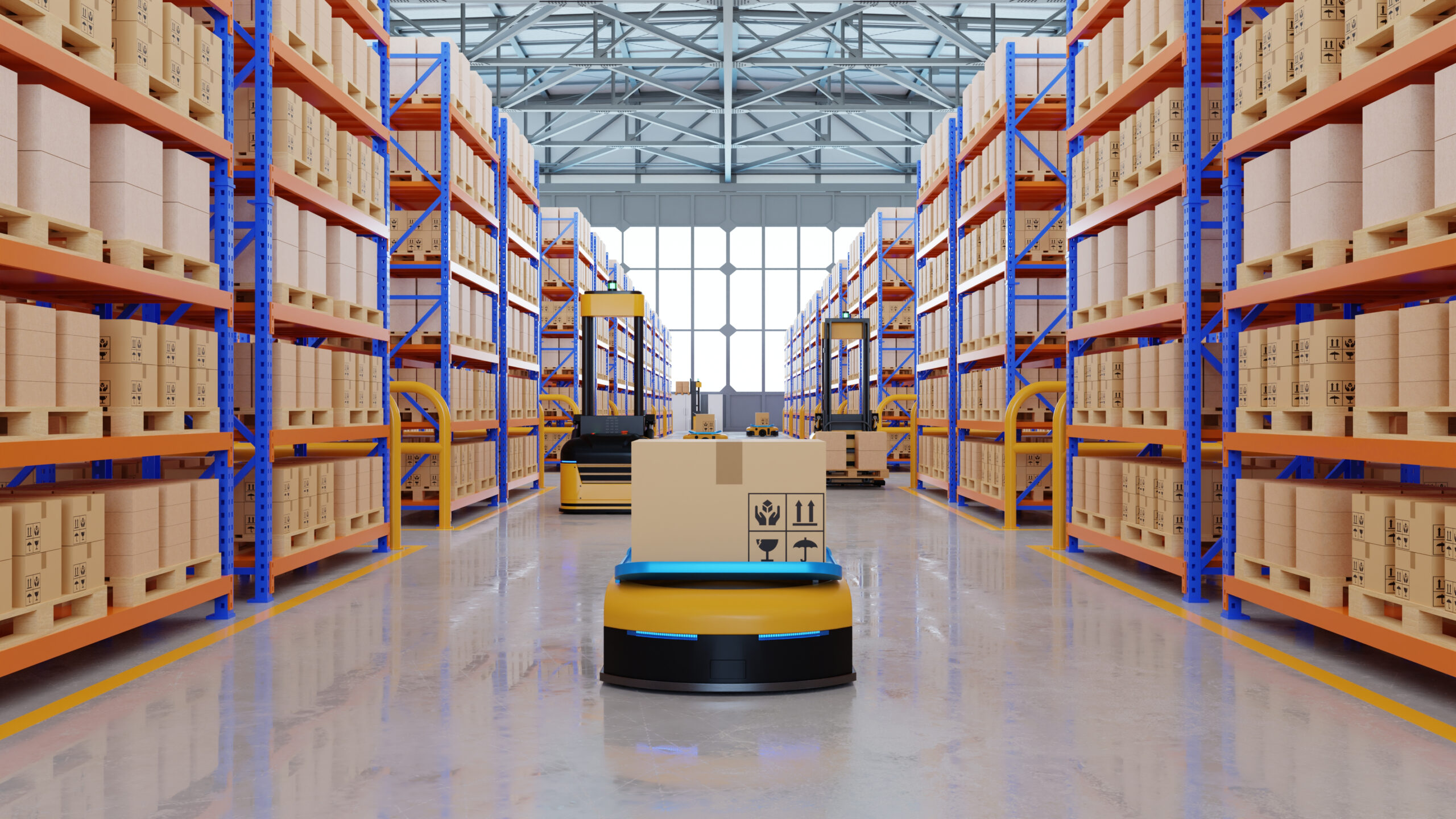
AGVs are strongest on defined point-to-point tasks where loads, collection points, routes, and delivery locations remain reasonably predictable. They can transfer pallets from receiving to storage, supply production lines, remove finished goods, connect picking zones, or move roll cages between parcel-processing areas.
Newer navigation and fleet systems make brownfield deployment more practical than earlier installations dependent on embedded wires or rigid markers. Vehicles can map routes and respond to some environmental change, although safe interaction with people, forklifts, doors, temporary obstructions, and changing work zones still requires careful design.
Market growth does not guarantee operational productivity. An AGV removes value only when it improves a necessary movement; automating an inefficient route, unnecessary transfer, or poorly located buffer merely fixes weak process design into equipment and software.
Brownfield projects therefore require detailed flow analysis before vehicle selection. Routes must account for pedestrian crossings, blind corners, floor condition, fire access, staging areas, doors, congestion, charging locations, and the behaviour of manual vehicles whose movements do not follow a fixed schedule.
Evri is already testing that model at its Rugby parcel hub, where AGV power pallets move loads along mapped internal routes. Each trial unit can handle up to 1.5 tonnes and switch between automated and manual operation when the process requires it.
At a larger integrated installation, Herba Ricemills has combined AGVs with conveyors, a stacker crane, pallet shuttles, and warehouse-management software at its Seville rice plant, increasing productivity while reducing picking errors.
Those applications show how mobile vehicles are becoming one layer within connected automation rather than isolated pieces of equipment. Fleet software must coordinate tasks with warehouse or production systems so vehicles arrive when loads are ready, avoid unnecessary queues, and deliver material to locations able to receive it.
Charging strategy influences both availability and fleet size. Opportunity charging can use short pauses during the shift, while battery exchange or scheduled charging may suit more intensive duty cycles; insufficient capacity reduces uptime, whereas excessive vehicle and charger provision weakens the investment case.
Traffic management grows more complex as fleets expand. Several vehicle types may share routes with people and manual equipment, requiring speed control, priority rules, stopping distances, warning systems, recovery procedures, and clear authority over when a vehicle can be stopped or moved manually.
Safety performance depends on the application rather than sensors alone. A technically capable vehicle can still create risk where routes cross busy pedestrian areas, floor markings are ignored, visibility is poor, or temporary pallets and equipment block the designed path.
Workforce requirements will shift as automated movement expands. Some manual transport roles will decline, while demand grows for fleet supervision, maintenance, process engineering, data analysis, mapping, and exception management.
Sites will also need stronger ownership of faults and recovery. When a vehicle stops in a critical aisle, operations must know who can diagnose it, who can clear or redirect traffic, and how work continues while the automated route is unavailable.
Interoperability is likely to become a larger purchasing consideration as warehouses deploy several vehicle types from different suppliers. A single facility may require pallet trucks, tow units, small tote carriers, and autonomous forklifts, making shared traffic management and standard interfaces preferable to isolated fleets.
The forecast US$12.8bn market reflects a sustained shift towards automated internal transport, but investment decisions will remain process-specific. The strongest deployments will begin with stable routes, measurable movement demand, disciplined inventory records, and clear system ownership before additional vehicles are introduced.
AGVs can remove repetitive travel and improve consistency, yet their performance is ultimately determined by the warehouse or factory around them. Connected software, charging capacity, route design, maintenance, and exception handling will decide how much of the forecast market becomes dependable daily operation.