IN Brief:
- Aldi has moved its £500m Bardon distribution centre into fresh produce operations.
- Cimcorp automation operates across three temperature-controlled areas for high-volume fruit and vegetable handling.
- Full operation in 2027 is expected to support more than 1.5 million kg of produce daily at peak periods.
Aldi has begun handling fresh produce at its £500m Bardon distribution centre in Leicestershire, bringing temperature-controlled fruit and vegetable flows into the UK’s largest automated supermarket warehouse.
The first produce pallets arrived on 16 September, with the first outbound pallet leaving the following day. The move follows the start of initial operations at Bardon in May and marks the next phase in the site’s gradual ramp-up.
Once fully operational in 2027, Aldi expects more than 1.5 million kilograms of fruit and vegetables to pass through the 1.3 million sq ft facility each day during peak periods. More than 6,000 fresh produce pallets are expected to leave the site daily for stores around the UK.
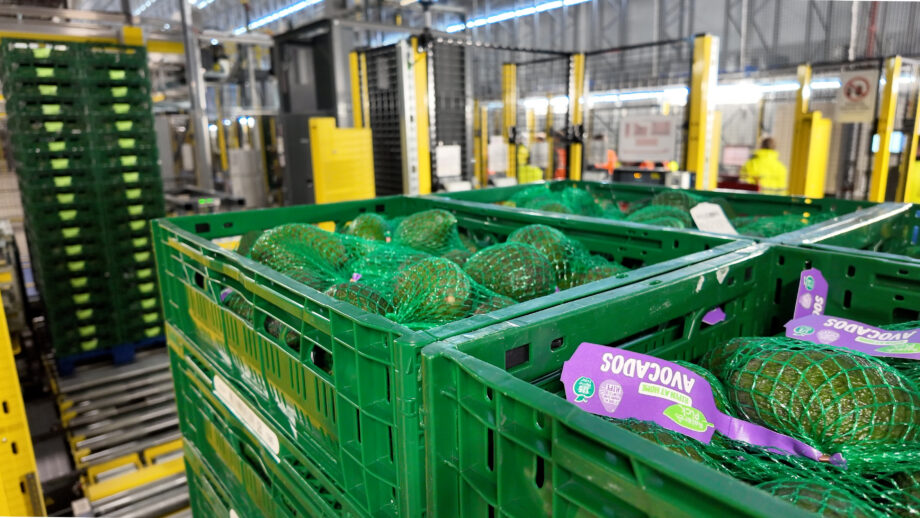
The fresh operation spans three dedicated temperature-controlled areas and uses automation supplied by Cimcorp. Chilled products including apples and carrots can be stored in high-bay racking before automated shuttles retrieve pallets for despatch, while the building also includes specialist space for bananas.
Jonathan Heaton, Regional Managing Director for Bardon at Aldi UK, said: “Fresh produce is a vital part of our customers’ shopping, yet it presents one of the most complex challenges in grocery logistics, with products needing to move quickly and efficiently from suppliers to stores to maintain freshness.”
That complexity begins before a pallet reaches the warehouse. Fruit and vegetables arrive with different temperature requirements, shelf lives, packaging formats and patterns of demand, while seasonal supply can change rapidly. Automated handling has to accommodate those differences without slowing the high-volume flow expected from a national grocery distribution centre.
Bardon is designed to handle close to seven million pallets annually once fully operational and will serve nearly 350 stores as well as operating as a national replenishment hub. The site is expected to employ around 1,000 people at full scale.
Fresh produce places particularly tight limits on dwell time. Ambient stock can often tolerate longer storage periods, whereas perishable goods lose saleable life throughout the distribution process. Delays at receiving, storage or despatch therefore translate more directly into waste, availability problems or shorter shelf life in store.
Automation can reduce some of that delay by moving pallets through repeatable processes at higher volume, but it also raises the importance of accurate upstream information. Advance shipment data, pallet presentation, product identification and arrival schedules have to match the operating rules of the warehouse if automated systems are to run without repeated manual intervention.
That places additional discipline on suppliers as well as the distribution centre itself. Pallet dimensions, labelling, case stability and arrival timing become more important when loads move quickly into automated handling rather than waiting for manual correction. A rejected or non-conforming pallet can create disproportionate disruption if it blocks an otherwise tightly sequenced inbound process, so the warehouse’s productivity increasingly depends on supplier compliance before the vehicle reaches Bardon.
Bardon began initial operations in May with ambient, chilled and automated capacity already forming part of the wider design. The fresh produce phase adds a more time-sensitive workload to that infrastructure, increasing the pressure on inventory rotation and temperature control as throughput grows.
Aldi says it sells an average of 2.2 billion items of fruit and vegetables each year, including more than 300 million bananas, 80 million apples and 160 million potatoes. Concentrating part of that volume through one highly automated hub gives the retailer greater scale, but it also makes the reliability of the site more consequential across the network.
Energy use is another operating consideration. Bardon includes 19,000 solar panels and Aldi describes it as the lowest carbon density warehouse in the Aldi South Group, although refrigeration and automation both add significant electrical demand to a building of this size.
The warehouse is also being brought into service while Aldi continues to expand its UK estate towards a long-term target of 1,500 stores. Distribution capacity needs to develop ahead of that growth if the retailer is to avoid placing additional volume into an already constrained network.
The fresh produce operation now gives Bardon a more demanding test than the initial opening phase. Performance will depend on whether automation, supplier compliance, labour, refrigeration and transport scheduling can remain aligned as volumes rise towards the site’s 2027 operating targets.