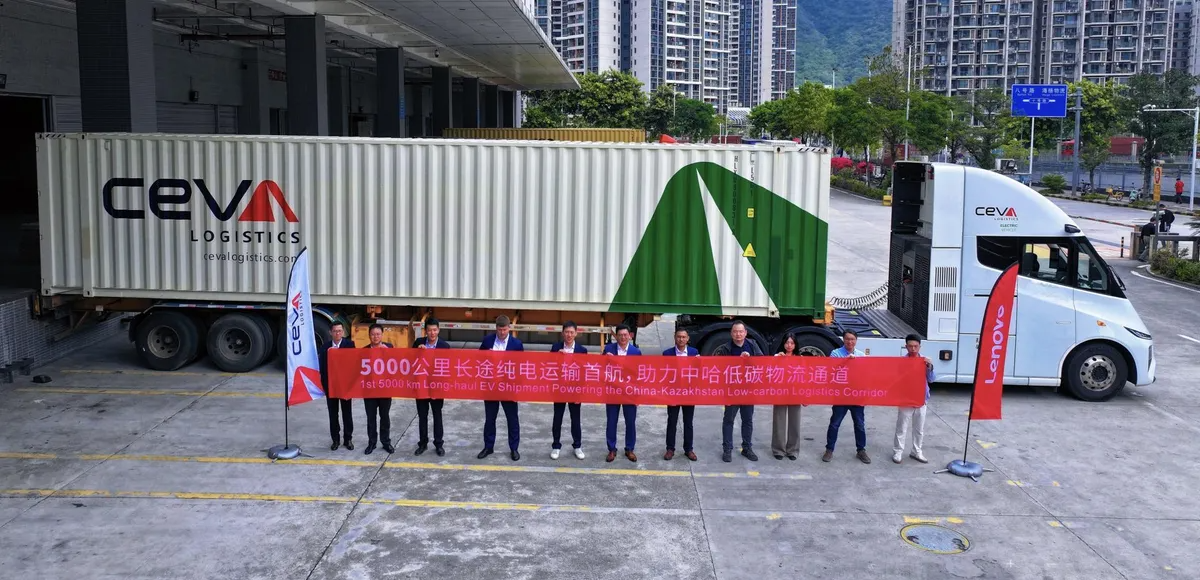
IN Brief:
- CEVA Logistics and Lenovo completed an electric truck pilot from Shenzhen to Almaty via Alashankou.
- The trial moved 5.3 tonnes of cargo over nearly 6,000km, combining electric and conventional road legs.
- The project points to growing interest in lower-emission corridor design across Asia-Europe supply routes.
CEVA Logistics and Lenovo have completed a long-haul electric truck pilot linking Shenzhen with Almaty, giving the market a clearer view of how battery-electric road freight could begin to fit into cross-border supply chains beyond short urban runs and depot work.
The trial moved 5.3 tonnes of cargo over nearly 6,000km in eight days. The route began in Shenzhen, continued by electric truck for roughly 5,000km to Alashankou in western China, and then switched to a conventional truck for the final leg into Kazakhstan’s largest city. CEVA said the electric section was completed in around four and a half days and required nine charging stops, while its TIR facility in Alashankou handled the customs and border transition.
The project was framed as a practical test rather than a one-off showcase. It combined a production freight movement, a live border crossing, and a demanding long-distance route through western China, which remains a useful proving ground for the economics of heavy-duty charging, duty cycles, and handover planning. For operators watching the development of lower-emission overland links between China and Central Asia, that makes the exercise more relevant than a closed-loop depot demonstration.
CEVA said the pilot reduced CO2 emissions by 46% compared with a conventional diesel operation across the same route profile. That figure will not settle the wider argument over infrastructure readiness or vehicle economics, but it does add to a growing body of evidence that electric road freight is beginning to move into freight lanes once viewed as out of reach. The harder question is no longer whether the trucks can run. It is whether charging coverage, border processes, asset utilisation, and network planning can support them at commercial scale.
That question matters because the China-Central Asia corridor is becoming more strategically important. Manufacturers are reassessing route mix, shippers are looking for alternatives to disrupted maritime flows, and logistics providers are under pressure to show measurable progress on emissions without giving away transit-time reliability. In that environment, pilot projects that combine linehaul, customs handling, and live customer freight are more useful than broad decarbonisation targets.
The next stage will be repetition. One successful run proves a route is possible, but regular service requires stable charging access, maintenance planning, payload discipline, and confidence that border dwell times do not erase the gains made on the road. Even so, the pilot suggests electric linehaul is starting to edge into the operational conversation for regional freight corridors, especially where cargo owners want lower-carbon options without shifting entirely to slower or more capacity-constrained modes.