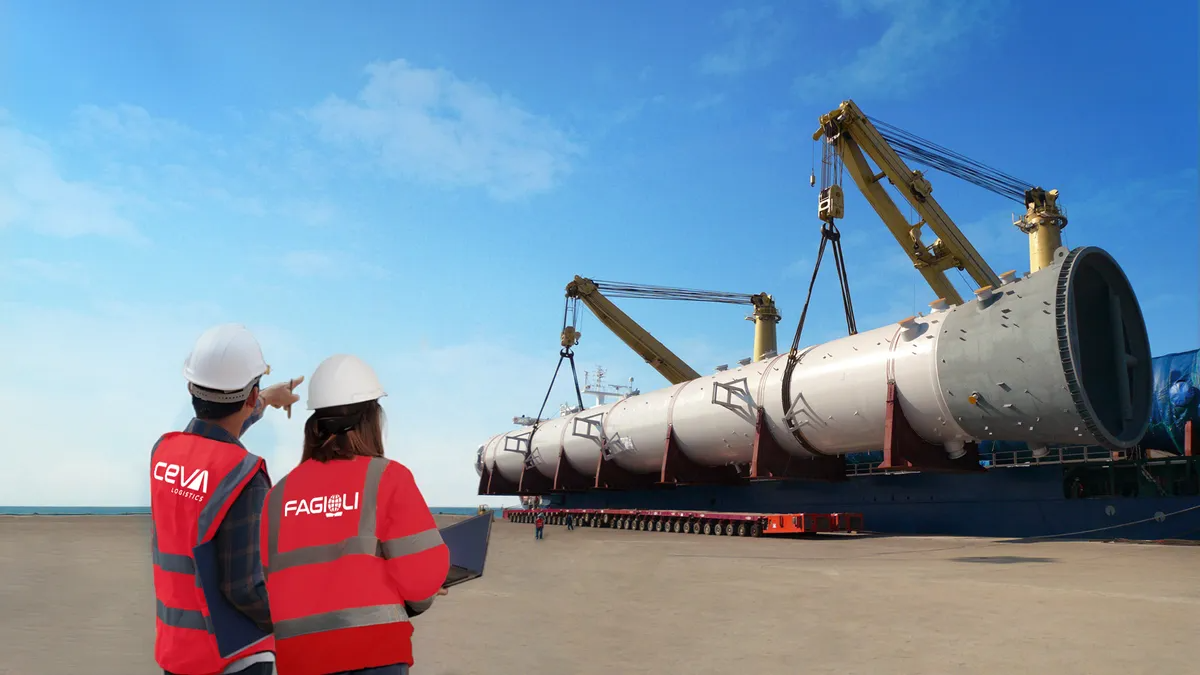
IN Brief:
- CEVA Logistics has completed its acquisition of 100% of Fagioli Group.
- The deal adds heavy-lift assets, engineering expertise, specialist transport, and installation capability.
- The acquisition strengthens CEVA’s project logistics offer across energy, infrastructure, industrial, and EPC markets.
CEVA Logistics has completed its acquisition of Fagioli Group, expanding its project logistics capability in heavy lifting, engineered transport, forwarding, complex delivery, and installation operations.
The transaction gives CEVA full ownership of Fagioli and brings around 450 employees into the business. Fagioli adds specialist heavy-lift assets, engineering expertise, and technical teams experienced in moving oversized and high-consequence cargo for industrial projects.
CEVA said the acquisition strengthens its ability to deliver end-to-end project logistics, from design and engineering through to heavy transport, forwarding, complex delivery, and installation. The combined offer is aimed at customers in energy, infrastructure, industrial manufacturing, and engineering, procurement, and construction markets.
Project logistics requires a different operating model from standard freight forwarding. Heavy and over-dimensional cargo movements depend on route engineering, lifting studies, permits, escort planning, port coordination, structural checks, safety systems, and installation sequencing. Delays or errors can affect entire construction, energy, or industrial programmes.
Fagioli’s integration gives CEVA greater internal control over specialist stages that are often difficult to subcontract at scale. Heavy-lift assets and engineering teams are not interchangeable commodities, particularly when cargo has unusual dimensions, tight delivery windows, or high project value.
The acquisition also strengthens CEVA’s position in a logistics market shaped by energy transition, infrastructure renewal, industrial expansion, and capital project activity. Grid upgrades, renewables, industrial plant, offshore equipment, rail systems, transformers, turbines, and process modules all require project logistics providers with enough technical depth to manage movement from origin to final position.
Large industrial customers are increasingly looking for partners that can combine global forwarding networks with specialist site capability. A standard freight network can move containers, pallets, and general cargo efficiently, but project logistics needs engineering judgement before transport begins. Route restrictions, bridge capacities, crane selection, access windows, and installation sequences can determine whether a shipment is feasible.
CEVA has been building scale in this area through acquisitions and regional expansion. Adding Fagioli gives the company a stronger platform in high-value, complex logistics, where customer relationships often extend across multiple project phases.
The integration will also broaden CEVA’s competitive position against specialist project cargo providers and global logistics groups with heavy-lift divisions. As major industrial projects become more complex and more exposed to permitting, labour, port, and equipment constraints, control over technical capability becomes a stronger differentiator.
Project logistics remains a demanding segment because every movement carries physical, commercial, and programme risk. CEVA’s acquisition of Fagioli gives the group more direct capability in one of the most technically sensitive parts of the industrial supply chain.