IN Brief:
- Corvus Trident mounts to forklifts, reach trucks, and other MHE.
- The device reads multiple barcodes at once and records pallet movement in real time.
- MSI Surfaces has recently deployed the system at its Orange, California headquarters.
Corvus Robotics has introduced Corvus Trident, a forklift-mounted AI system designed to create a continuous record of pallet movement across warehouse operations, from inbound receipt through putaway, replenishment, picking, and outbound dispatch.
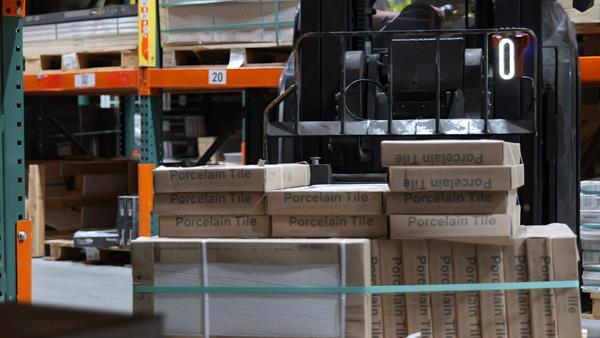
Unveiled at MODEX 2026 in Atlanta, the device mounts directly to forklifts, reach trucks, and other material handling equipment and captures pallet activity during normal operation. Corvus said Trident uses onboard AI and industrial-grade scanning to read multiple barcodes simultaneously, track both pallet and equipment movement in real time, and build a running system of record without requiring drivers to stop for manual scans at each handling stage.
The company said MSI Surfaces has recently deployed the system at its headquarters in Orange, California, extending a relationship that already included Corvus’ autonomous drone-based inventory tools. Trident is designed to read pallets stacked up to three high and to operate without GPS, fixed beacons, or markers. It can integrate with warehouse management systems through standard APIs or run independently, depending on how a site wants to deploy it.
The launch addresses a familiar weakness in warehouse execution. Most facilities still depend heavily on scan compliance to keep inventory data aligned with physical reality. That works well when every touchpoint is captured accurately and on time. In practice, the gaps are often where the cost sits: missed scans, delayed scans, duplicate handling, and pallet moves that happen in the real building but never quite make it into the digital record in the right sequence.
Those gaps are not minor. They sit behind shipment errors, chargebacks, inventory disputes, avoidable recounts, and the quiet drain of labour spent trying to reconcile system records with what is actually on the floor. What makes Trident notable is that it targets movement visibility rather than static inventory alone. The warehouse has invested heavily in counting stock at rest. The harder problem has often been understanding what happened in between those counts.
That is why the link to Corvus One, the company’s drone cycle-counting system, is significant. Corvus is building a stack that covers both inventory at rest and inventory in motion, feeding data into its AIMS software platform for operational analysis. In effect, it is trying to close the blind spot between receipt and storage, storage and pick face, and pick face to outbound handover.
The timing also fits the direction of warehouse technology investment more broadly. Operators are moving past narrow automation projects and towards tools that can improve traceability across everyday workflows without introducing extra handling steps. Forklift-mounted intelligence falls neatly into that category. It uses existing movements, existing assets, and existing routes to generate better data.
The broader question is whether systems like this can become a standard layer in busy distribution environments where pallets move too quickly for manual discipline alone to deliver reliable visibility. If they can, the result is likely to be less time spent proving what happened and more time spent acting on it.