IN Brief:
- DexoryView Adapt adds an AI reasoning layer to the DexoryView platform.
- The system combines live warehouse data, site-specific rules, and a multi-site knowledge base.
- Global availability is planned for later this year.
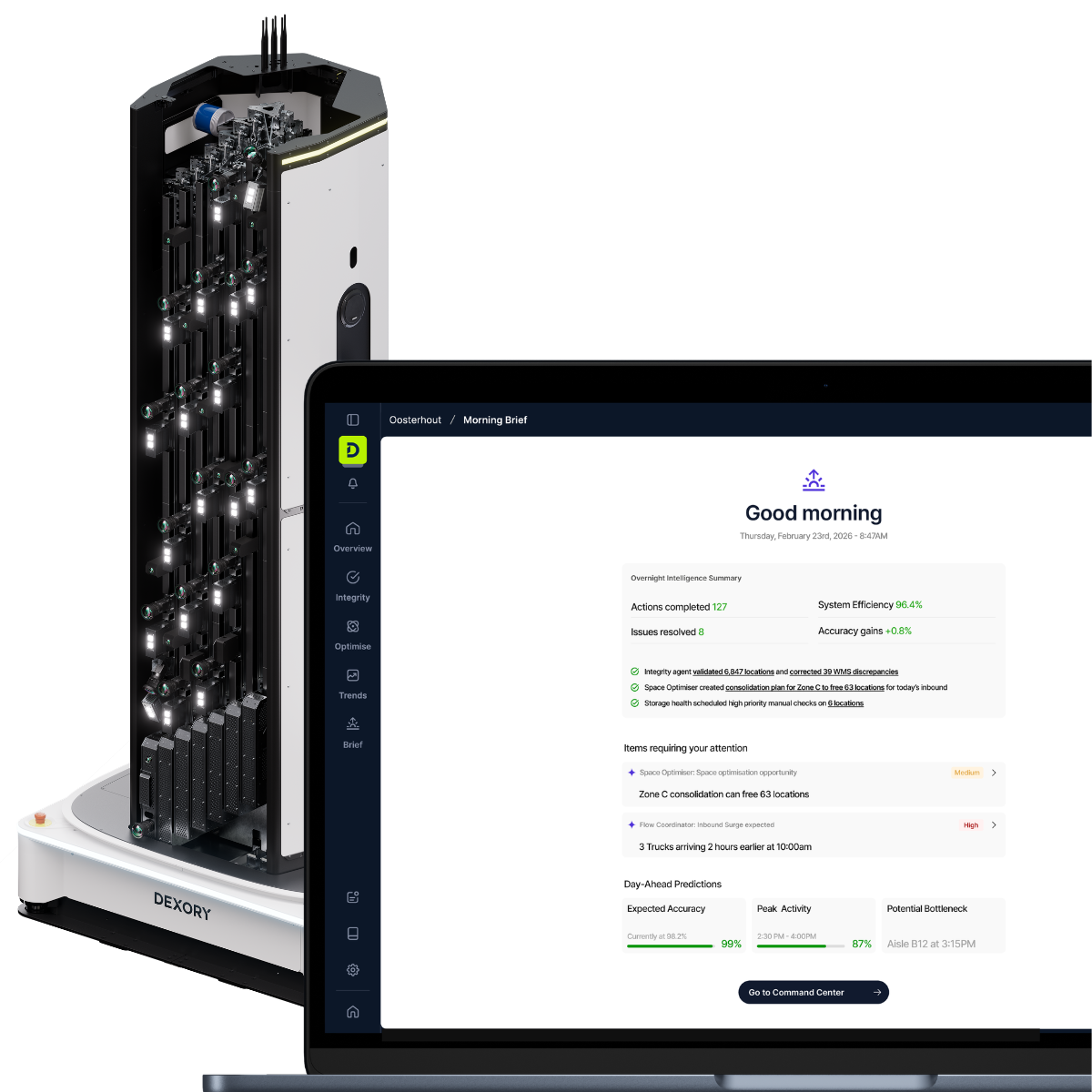
Dexory has launched DexoryView Adapt, a new capability within its DexoryView platform that is designed to turn live warehouse data into evidence-backed operational recommendations, marking a further shift from passive visibility towards more active decision support inside the warehouse.
Announced at MODEX 2026 in Atlanta, DexoryView Adapt builds on the company’s existing digital twin platform, which is powered by data captured by Dexory’s autonomous robots. The new layer is intended to analyse site conditions in real time, connect signals from multiple systems, detect patterns before they escalate, and recommend actions based on the current state of the operation rather than static reporting or delayed manual interpretation.
Dexory said the capability works by combining three inputs: real-time physical warehouse data, site-specific rules and operating constraints, and a broader warehouse knowledge base built across multiple deployments, sectors, and geographies. The system runs in two modes. In one, it continuously monitors the site and flags issues proactively. In the other, teams can query the operation directly and receive contextual responses based on current conditions.
The use cases outlined by the company point to a fairly wide brief. Adapt is being positioned for slotting and space utilisation, root-cause detection around congestion and operational errors, layout and flow changes, and visibility into cost-to-serve and client profitability. That is a more ambitious proposition than inventory monitoring alone. It suggests Dexory sees the warehouse intelligence layer moving beyond discrepancy detection and into the territory of operational orchestration.
That direction reflects a wider change in warehouse software expectations. Real-time visibility has improved sharply over the past few years, helped by robotics, sensor networks, and better integration between physical operations and enterprise systems. Yet many sites still struggle with the same practical problem: they can see more, but they do not always convert that visibility into action quickly enough. Data has become easier to collect than to operationalise.
That gap is where reasoning tools now aim to sit. The attraction is obvious. If a platform can combine live physical data with local rules and known performance patterns, it can potentially shorten the distance between issue detection and decision. The hard part is trust. Warehouses are rule-heavy environments with service commitments, labour constraints, customer-specific processes, and physical safety considerations. Any AI layer that moves closer to day-to-day decision support has to reflect those realities rather than flatten them.
Dexory’s emphasis on site-specific rules is therefore important. Generic optimisation is rarely enough in live operations. What counts is whether a system can work with the local shape of a warehouse: the customer mix, the replenishment cadence, the slotting logic, the labour model, and the service tolerances built into the contract. Without that, recommendation quality tends to collapse into generic advice at exactly the point where operators need specificity.
DexoryView Adapt is scheduled for global availability later this year. Its arrival says something wider about the market. The warehouse digital twin is no longer being sold only as a better mirror. Suppliers increasingly want it to behave more like an operational brain, capable of linking physical reality to next-step decisions at a pace that conventional reporting has struggled to match.