IN Brief:
- FOTON and COSCO Shipping Specialized Carriers have launched Guangzhou Yuanfu Automotive Supply Chain.
- The new structure is designed to secure vessel capacity and stabilise export flows.
- The first shipment under the new model sends 600 pickups to South America.
FOTON Motor has launched a new joint venture with COSCO Shipping Specialized Carriers aimed at taking firmer control of its export logistics, a move that underlines how sharply ocean capacity has risen up the agenda for vehicle manufacturers with expanding overseas programmes.
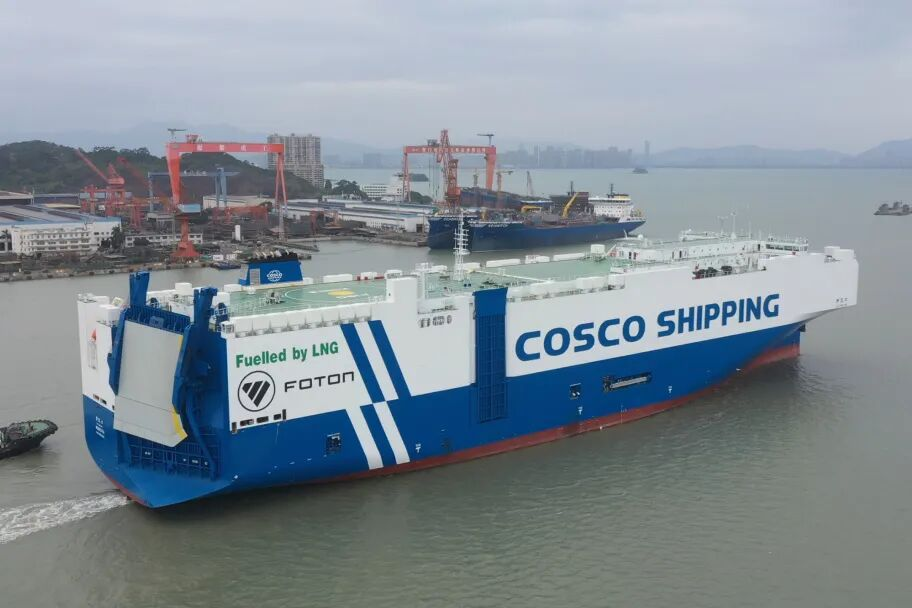
The new company, Guangzhou Yuanfu Automotive Supply Chain Co., Ltd., was formally inaugurated on 26 March. Alongside the launch, a roll-on/roll-off vessel carrying the FOTON and COSCO brands was delivered, and 600 FOTON pickups were prepared for shipment to South America aboard the newly delivered vessel Kai Yuankou as the first large-scale export order under the joint venture’s operating model.
FOTON is positioning the structure as a long-term answer to the volatility that has accompanied rapid export growth. The company said its overseas sales reached 164,500 units in 2025, while cumulative overseas sales have passed 1.25 million vehicles across more than 140 countries and regions. Against that backdrop, relying on fragmented vessel procurement and externally controlled schedules was becoming harder to justify, particularly as pricing, sailing availability, and delivery reliability all came under pressure.
The move reflects a wider shift in industrial logistics, especially in automotive and heavy equipment. For years, ocean freight sat one stage removed from the manufacturer’s core operating strategy. That is changing. Exporting producers are increasingly treating shipping capacity as a strategic asset rather than a purchased service, particularly where growth depends on predictable handover windows, regional inventory plans, and the ability to support overseas plants and distributors with parts as well as finished vehicles.
That change has been accelerated by successive disruptions in global shipping. Red Sea diversions, longer sailing times, tighter specialist vessel availability, and persistent schedule variability have all exposed the risks of leaving outbound logistics to a spot-driven or heavily intermediated model. In sectors where lead times, dealer allocations, and market launches depend on vessel certainty, transport control has become part of commercial execution.
The FOTON-COSCO structure is also notable for what it says about the evolution of Chinese export supply chains. Vehicle exporters are no longer simply scaling production and relying on the shipping market to catch up. They are moving to secure their own corridors, build dedicated operating capacity, and align plant output more closely with maritime deployment. That gives them more control over cost, but also over sequencing, destination planning, and resilience when trade lanes come under strain.
For logistics providers and ports, the implication is that automotive exporters are likely to behave more like infrastructure planners than occasional users of ocean services. As volumes grow, relationships between manufacturers, specialist carriers, ports, and inland distribution networks will become more tightly integrated. The first 600-vehicle sailing is modest in isolation, but the structure behind it is the larger story. It points to a supply chain model in which export growth is being built around capacity control from the outset rather than corrected after the bottlenecks appear.