IN Brief:
- The agreement signed on 20 November extends an existing CULines service relationship at Khorfakkan.
- Gulftainer will provide berth access and stevedoring, while CULines plans a weekly CGX service.
- The parties have not disclosed contracted TEU volumes, a start date for weekly sailings or performance targets.
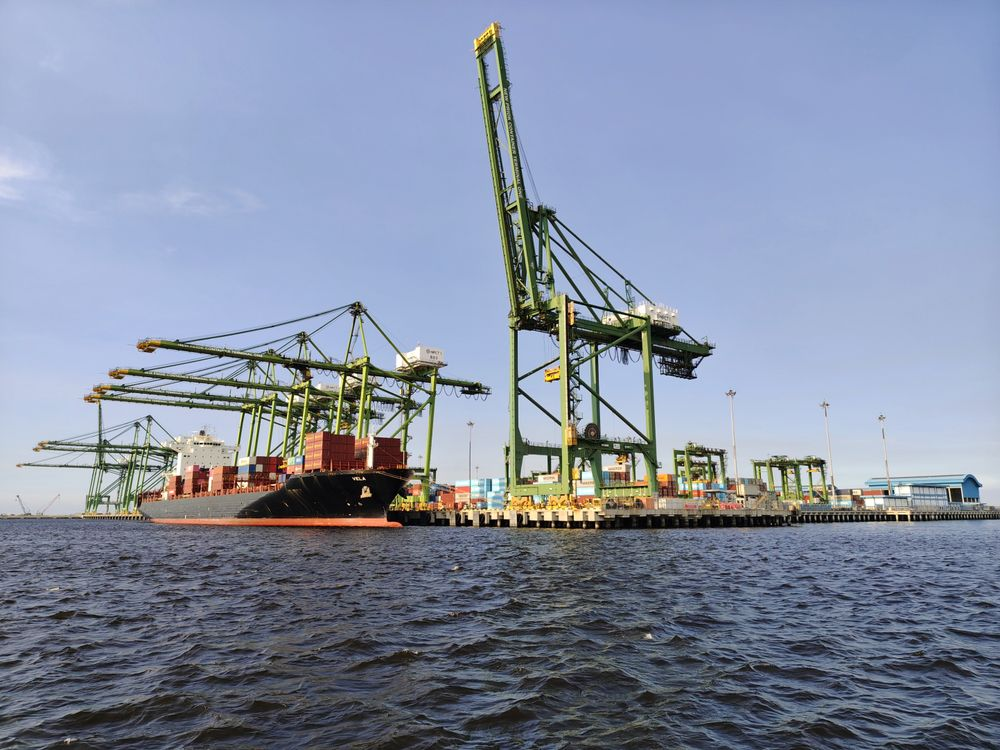
Gulftainer and China United Lines (CULines) have signed a ten-year agreement to support container traffic through Khorfakkan on the UAE’s Gulf of Oman coast. Signed in Singapore on 20 November, the arrangement gives the Chinese carrier long-term access to terminal handling and berth services as it develops its China–Gulf Express (CGX) service. The agreement follows cooperation disclosed earlier in November, when Gulftainer’s shipping division, GT Lines, identified CGX as one of the container services connecting Chinese ports with the UAE.
Gulftainer has committed to berth allocation and stevedoring services, backed by its logistics network in Sharjah, while CULines plans to develop CGX towards a weekly operating frequency. The carrier already calls at Khorfakkan Container Terminal. Its ten-year commitment is therefore an extension of the relationship, rather than the first introduction of a China–Khorfakkan connection. Neither party has disclosed a minimum annual throughput commitment, contracted handling price, or confirmed date for the proposed weekly frequency.
The November cooperation identified the existing CGX connection as KCX 5, with a published rotation involving Qingdao, Ningbo, Shekou, Nansha, Port Klang and Khorfakkan. That combination provides several Chinese loading points and a Malaysian call before arrival in the UAE. The route’s commercial appeal will depend on its actual sailing frequency, cut-off dates, equipment availability and inland delivery arrangements. A long-term terminal agreement does not establish that all the intended sailings are already operating at their planned frequency.
Khorfakkan sits outside the Strait of Hormuz, so a vessel arriving directly from the Indian Ocean can reach the terminal without entering the strait. Cargo destined farther into the Arabian Gulf still needs an onward movement, which could involve road transport or another maritime leg. The port’s position thus offers an alternative point of discharge, not automatic access to every final market. Customs clearance, feeder capacity, road connections and the consignee’s delivery location remain determinants of the complete route.
Regular container services place demands on terminal planning before a ship arrives. Vessel operators need agreed arrival windows and space for discharge and loading, while terminal managers must assign cranes, labour and yard positions to the corresponding call. Containers have to be matched to documentation and released to the correct inland carrier after discharge. The handling commitment may make that coordination more predictable, but no vessel turnaround time, yard dwell time or service reliability improvement has been reported under the new agreement.
Gulftainer’s wider network in Sharjah is intended to connect the coastal terminal with inland logistics activity. A shipment using such a corridor passes through successive handovers: shipping line to terminal, terminal to inland carrier, and inland carrier to warehouse or receiver. Each stage depends on release instructions, equipment, appointments and the acceptance of goods at the destination. A missed appointment or incomplete customs record can delay final delivery even when the vessel arrives on its scheduled day.
In July, Gulftainer described plans to raise Khorfakkan’s annual container handling capacity from about 3.5 million to five million TEU, with a longer-term masterplan exceeding ten million TEU. These are planned capacity figures, not verified current throughput. Additional berth, crane or yard capacity can accommodate more movements only if operators secure the scheduled services and freight demand to use it. The CULines agreement provides a longer planning horizon for one carrier, without quantifying its contribution to the expansion programme.
Capacity and traffic are distinct measures. A larger terminal can offer more possible handling slots while remaining below its stated design limit; equally, congestion can occur at a particular berth or gate without the whole port reaching its annual theoretical capacity. CULines has committed cargo to Khorfakkan, but the companies have not provided a figure against which future volume growth can be assessed. Published weekly timetables and actual vessel calls will offer firmer evidence of how the agreement develops.
The combination of multiple Chinese origins, a Southeast Asian call and a terminal outside the Strait of Hormuz gives cargo owners another routing option for Gulf shipments. Selection between that option and competing services will depend on the door-to-door transit, availability of suitable containers and the cost of inland distribution. Not all importers need the same route: some receive goods close to Khorfakkan, while others must pay for an additional inland or sea transfer, which changes both the delivery time and handling requirement.
The immediate agreement secures a decade-long commercial framework covering terminal access, handling and logistics support. CULines still has to implement the planned sailing pattern, and Gulftainer must allocate resources as those calls materialise. No new service commencement date or incremental TEU forecast has been disclosed. The operational record will become clearer as vessel schedules, terminal calls and sustained cargo movements demonstrate whether the planned weekly corridor has been established.