IN Brief:
- GEODIS has achieved IATA CEIV Pharma certification for its Hyderabad site in India.
- The certification validates quality systems, risk management, staff training, temperature control, and regulatory compliance.
- Hyderabad becomes part of a global GEODIS network of 29 CEIV Pharma-certified sites.
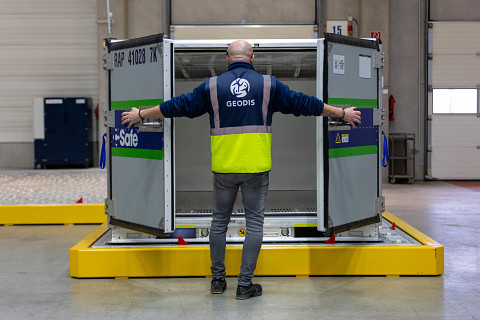
GEODIS has achieved IATA CEIV Pharma certification for its Hyderabad site, adding certified healthcare logistics capability in one of India’s most important pharmaceutical manufacturing and export centres.
The certification validates the site’s ability to handle pharmaceutical and healthcare shipments against international standards covering quality management, operational procedures, risk management, staff training, temperature-control capability, and regulatory compliance. Hyderabad now joins GEODIS’ global network of 29 CEIV Pharma-certified sites, including nine across the Asia-Pacific and Middle East region.
Hyderabad’s life sciences cluster supports pharmaceutical manufacturers, biotechnology companies, and healthcare exporters moving increasingly complex and temperature-sensitive products into global markets. Additional certified logistics capacity strengthens the city’s role as a controlled export base, particularly for shippers moving regulated healthcare products through multi-stage international routes.
Chris Cahill, Managing Director, Middle East and India Sub-continent at GEODIS, said: “Hyderabad is one of the world’s most important pharmaceutical manufacturing and export hubs, making it a strategic location for our healthcare logistics network.”
He added that the certification supports customers moving complex and temperature-sensitive healthcare products across global markets and reflects investment in specialist infrastructure and expertise in India, where GEODIS has more than 1,000 employees across 15 locations serving more than 7,000 customers.
Healthcare logistics has moved from a specialist compliance function into a strategic supply chain discipline. Growth in biologics, specialty medicines, vaccines, clinical trial materials, and personalised therapies has increased the importance of temperature control, traceability, and route assurance. A shipment that loses temperature integrity or documentation continuity can create product loss, regulatory exposure, and delayed treatment supply.
CEIV Pharma certification gives shippers a recognised framework around handling environments, staff competence, and quality procedures. In regulated healthcare supply chains, consistency across custody points is as important as capacity. A warehouse, airport handler, forwarder, airline, cross-dock, or destination facility can become a weak point if procedures are not aligned across the full lane.
India’s pharmaceutical export base is especially exposed to that challenge because its manufacturing clusters serve distant regulated markets across North America, Europe, Latin America, and Asia-Pacific. Inland movement, airfreight handling, ocean reefer options, customs processing, and final-mile transfer all have to work around the same quality expectations. Certification gives manufacturers a more structured basis for route qualification, supplier assessment, and audit readiness.
Hyderabad has already been attracting logistics investment aimed at healthcare exports. The city’s controlled supply chain credentials were strengthened further when a refrigerated rail corridor from Hyderabad to Nhava Sheva was launched for pharmaceutical exporters. The GEODIS certification adds a second layer to that development, with air and freight-forwarding capability sitting alongside inland refrigerated movement.
The broader market is shifting from basic cold storage toward connected healthcare logistics networks. Facilities need validated procedures, but manufacturers also need shipment visibility, handover control, lane risk assessment, and escalation processes when delays occur. Temperature-sensitive products often pass through multiple custody points before reaching destination markets, making quality alignment between origin site, inland leg, airport or port, carrier, destination handler, and final distributor essential.
Certification does not remove operational risk, yet it raises the handling baseline. It gives pharmaceutical companies a clearer framework for choosing logistics providers and helps providers demonstrate that healthcare operations are supported by trained people, documented processes, and infrastructure designed for regulated cargo. As more products require controlled environments, that distinction becomes commercially important.
The Hyderabad site’s certification also reflects a shift in the geography of pharma logistics. Rather than treating India mainly as a manufacturing source that feeds external logistics hubs, providers are developing more qualified infrastructure closer to production clusters. That reduces unnecessary handling, improves origin control, and gives exporters greater flexibility when choosing lanes into regulated markets.
Hyderabad’s role in global life sciences supply chains is likely to keep growing as India expands higher-value pharmaceutical production. The GEODIS certification gives the region another qualified node, strengthening the connection between manufacturing scale and international distribution control.